
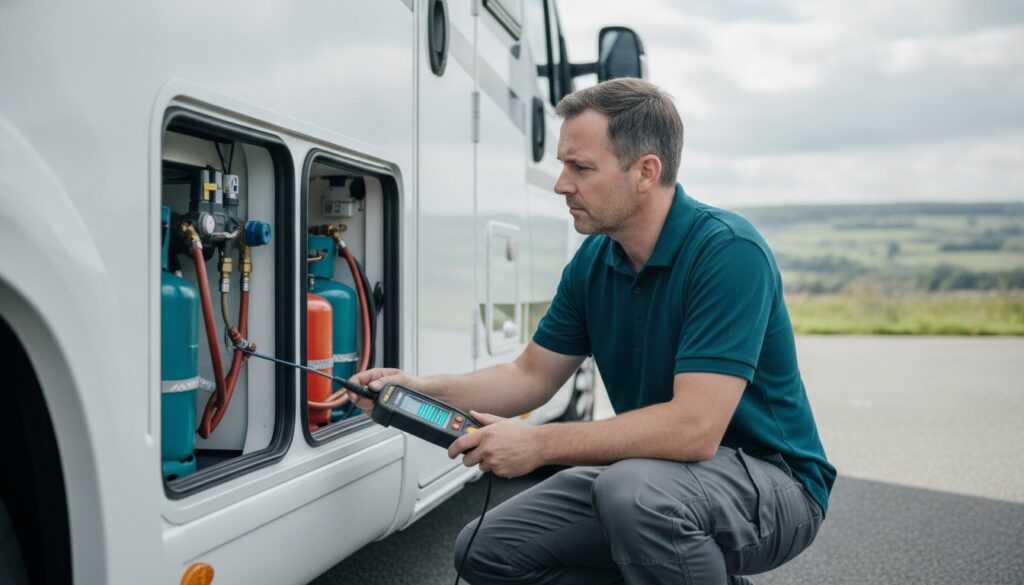
Could a gas hose no thicker than your thumb be the only thing standing between a peaceful night’s sleep and a life-threatening emergency? It’s a sobering thought that many owners overlook whilst planning their next getaway. If you’re feeling confused about the motorhome gas safety certificate cost or wondering if your standard habitation check is enough, you aren’t alone. Most people simply want to know their pride and joy is safe without being hit by unexpected repair bills or technical jargon.
We understand that safety shouldn’t be a guessing game. This guide provides a transparent look at the legal obligations and vital safety benefits of a dedicated gas inspection. You’ll learn the crucial differences between private use and hire requirements, how to spot a properly qualified LPG engineer, and what to expect during the process. By the end, you’ll have the clarity needed to keep your travels safe and your paperwork in order for the 2026 season.
Key Takeaways
- Understand the vital difference between a standard habitation check and a technical gas safety inspection to ensure your LPG system is fully compliant.
- Discover the main factors that influence the motorhome gas safety certificate cost, from the number of appliances to the convenience of mobile call-out fees.
- Learn why a professional Gas Tightness Test is the only way to identify hidden leaks that a visual inspection might miss.
- Identify common failure points like perished high-pressure hoses and outdated regulators to avoid unexpected repair costs during your inspection.
- Explore the benefits of using a mobile engineer in South Yorkshire to carry out technical safety checks at your home or storage site.
What is a Motorhome Gas Safety Certificate?
A motorhome gas safety certificate is a formal document issued after a thorough inspection of your vehicle’s Liquid Petroleum Gas (LPG) system. It isn’t just a tick-box exercise. It’s a technical verification that your pipework, regulators, and appliances are operating within safe parameters. Whilst many owners assume a visual check is enough, a professional certificate requires a technical pressure test using a manometer. This “tightness test” identifies microscopic leaks that you can’t see, smell, or hear. It provides a “safe pair of hands” for your holiday plans.
The Gas Safe Register is the official body that regulates this work. Every engineer must be specifically qualified for LPG in leisure accommodation vehicles (LAVs). This is a distinct qualification from standard domestic gas work because touring vehicles face unique stresses. Unlike a house, a motorhome is subject to constant road vibrations and temperature fluctuations. These factors can cause joints to loosen and hoses to perish faster than they would in a static environment. When considering the motorhome gas safety certificate cost, you’re paying for this specialist expertise and the calibrated equipment needed to keep your family safe.
Private Use vs. Hire (Landlord) Certificates
The legal requirements change depending on how you use your van. If you hire out your motorhome, you must have an annual Landlord Gas Safety Record, often called a CP12. This is a strict legal requirement under the Gas Safety (Installation and Use) Regulations 1998. For private owners, a certificate is highly recommended rather than a statutory law, but it’s often a condition of your insurance policy. Without a valid safety record, an insurer might refuse a claim following a fire or carbon monoxide incident. Most experts suggest an annual check to maintain total peace of mind.
LPG Systems in Leisure Vehicles
Leisure vehicles rely on LPG, usually propane or butane, which is stored under much higher pressure than mains natural gas. Your system powers essential comforts like hobs, fridges, and water heaters. Each appliance has its own safety shut-off device that needs testing. Because your gas locker and pipework travel hundreds of miles, the integrity of every connection is vital. A single loose joint caused by a pothole can lead to a slow leak in a confined space. This makes the motorhome gas safety certificate cost a small price to pay for ensuring your mobile home remains a safe haven.
What Happens During a Gas Safety Inspection?
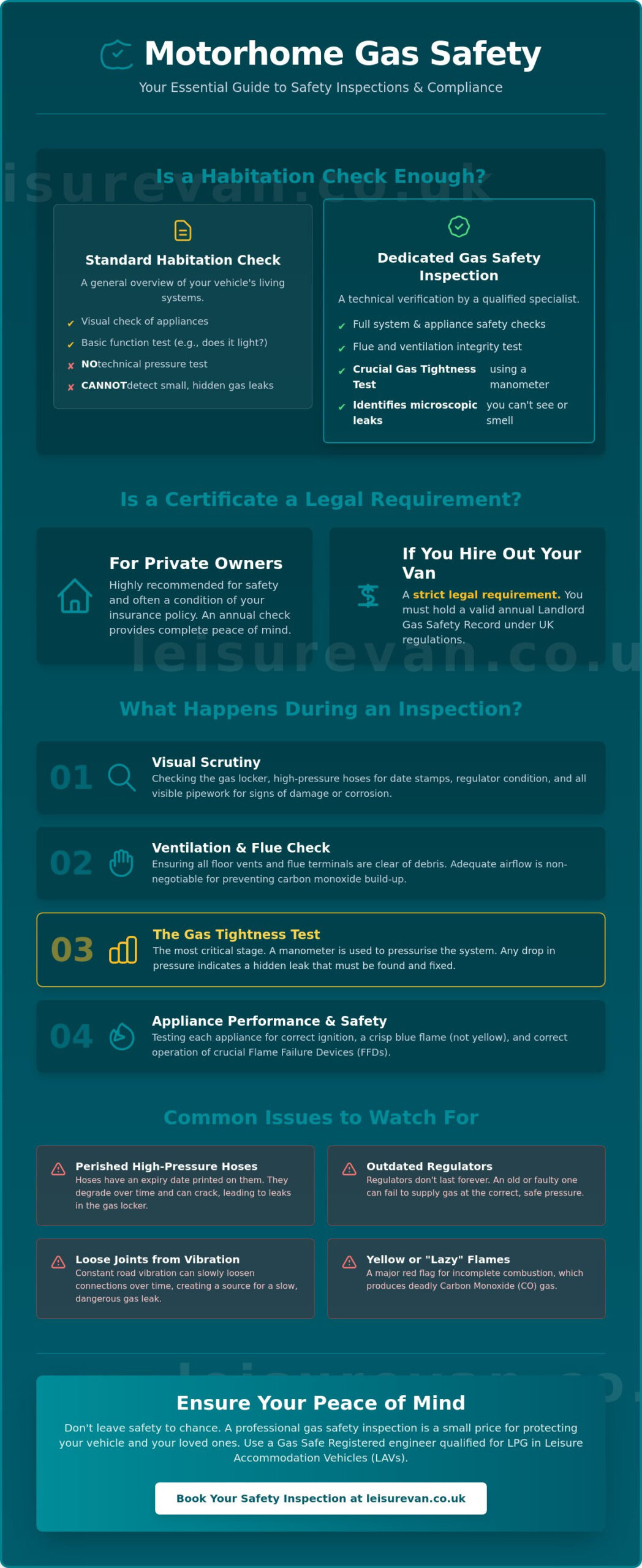
A professional gas inspection is a methodical process that ensures every component of your system is fit for the road. Unlike a static caravan, a motorhome experiences constant movement, which can cause internal components to shift or flues to become misaligned. The inspection begins with a visual assessment of the gas locker, high-pressure hoses, and the regulator. Your engineer will look for date stamps on hoses and check for any signs of physical damage or corrosion on the pipework. This thorough approach ensures that the motorhome gas safety certificate cost covers a complete health check of your fuel system.
Following the visual checks, the engineer moves inside the vehicle to inspect all ventilation points. In a confined space, adequate airflow is non-negotiable. We check that floor vents are clear of debris and that flue terminals are unobstructed. This is a vital part of the official gas safety guidance for motorhomes, as blocked vents are a primary cause of carbon monoxide build-up. Every appliance is then tested individually to ensure it ignites correctly and operates at the correct pressure.
The Gas Tightness Test Explained
The most critical part of the visit is the gas tightness test. This procedure identifies leaks that are far too small to trigger your sense of smell but could lead to a dangerous accumulation of gas over time. The manometer test is the industry standard for leak detection within the gas system. By connecting a manometer to the test point, the engineer can monitor the system’s pressure under load. If the pressure drops, it indicates a breach in the integrity of the pipework or a joint. In such cases, the engineer must isolate the leak and rectify the issue before a certificate can be issued. This technical precision is why a professional Gas safety Test is essential for any touring vehicle.
Appliance Performance and Flue Safety
Engineers don’t just check if your hob lights; they check how it burns. We look for a crisp blue flame, which indicates efficient combustion. Yellow or “lazy” flames are a red flag for “sooting” or incomplete combustion, which produces deadly carbon monoxide. We also test Flame Failure Devices (FFDs) on hobs and ovens. These safety valves automatically shut off the gas supply if the flame is blown out by a draught. Finally, we verify that your carbon monoxide and LPG alarms are positioned correctly and functioning. This ensures that even if a fault develops between inspections, you have a reliable early warning system in place. Investing in these technical checks provides a level of protection that a simple DIY look-over can never match.
Calculating the Motorhome Gas Safety Certificate Cost
Understanding what determines the final bill helps you plan your maintenance budget effectively. Several variables influence the motorhome gas safety certificate cost, primarily the complexity of your vehicle’s gas installation. A van with a simple two-burner hob takes less time to inspect than a high-end motorhome equipped with an oven, a three-way fridge, a water heater, and a blown-air heating system. Each additional appliance requires individual testing for flame failure and combustion efficiency, which naturally extends the duration of the visit.
Location and service type also play significant roles. Mobile engineers provide the convenience of visiting your home or storage site, saving you the fuel and time involved in driving to a fixed workshop. However, this often includes a call-out fee to cover travel time and vehicle overheads. Whilst some “cheap” inspections might seem attractive, they often lack the technical depth required for a valid LPG certificate. Investing in a thorough professional ensures that potential issues are caught before they become expensive or dangerous repairs. If you’re buying a used vehicle, understanding the motorhome pre purchase inspection cost UK buyers typically face can help you budget for both a gas safety test and a comprehensive pre-purchase check in a single visit.
Stand-alone Gas Test vs. Full Habitation Service
Many owners choose to combine their gas inspection with a comprehensive Motorhome Habitation Service. A stand-alone gas test focuses solely on the LPG system, whereas a full habitation service covers over 60 points, including damp checks, electrical safety, and water systems. Choosing the combined option is usually more cost-efficient than booking separate visits. It also ensures a holistic view of your vehicle’s health. If you are hiring out your vehicle, remember that the Landlord Gas Safety Record is a specific legal requirement that may carry a different rate than a standard private safety report.
Regional Price Variations in South Yorkshire
For owners in South Yorkshire, travel time can vary significantly between urban centres like Sheffield and more rural areas around the Peak District. Booking an engineer who regularly covers Barnsley, Doncaster, and Rotherham can often reduce travel-related costs. It’s also wise to factor in potential “hidden” expenses. For instance, high-pressure gas hoses (pigtails) must be replaced every five years to prevent leaks. If your hoses or regulator are out of date, these parts will be an additional cost on top of the inspection fee. Addressing these small items during the initial visit prevents the need for a follow-up call-out, keeping your overall maintenance spend manageable.
Common Gas Safety Issues and Repair Costs
A failed gas test is often the result of small, cumulative issues rather than a single catastrophic fault. Whilst the motorhome gas safety certificate cost covers the technical inspection, being aware of common failure points helps you avoid the frustration of a “refusal to certify” notice. Most failures in touring vehicles stem from the constant movement they endure. Road vibrations can slowly loosen compression joints or cause copper pipework to rub against the chassis, leading to microscopic fractures. These aren’t issues you would typically find in a static home, but they are a regular occurrence for seasoned motorhome owners. If you’re considering a used purchase, a professional used motorhome pre-purchase inspection can identify these hidden faults before you hand over your money, saving you from inheriting someone else’s maintenance problems.
Another frequent culprit is the humble spider. Many insects are attracted to the smell of gas and build nests inside burner tubes or jets, particularly in fridges and water heaters. This debris disrupts the gas-to-air ratio, causing “sooting” or incomplete combustion. Regular maintenance ensures these components are cleaned and adjusted, preventing the need for expensive component replacements later. By identifying these minor issues early, you reduce the risk of a breakdown whilst you’re miles from the nearest service centre. When buying a used motorhome, it’s equally important to carry out a thorough motorhome damp check before buying, as hidden water ingress can cause structural damage just as costly as a neglected gas system.
Hose and Regulator Replacement
Gas hoses, or “pigtails”, have a finite lifespan. Every high-pressure hose is stamped with a manufacturing date, and industry standards require their replacement every five years. Over time, the rubber perishes and develops internal cracks that can lead to significant leaks. Similarly, gas regulators can become “oiled up” or lose their ability to maintain steady pressure. A failing regulator often manifests as a yellow, flickering flame on your hob or inconsistent heat from your oven. Replacing a pigtail is a quick task, usually taking about 15 minutes, whilst a regulator replacement might take 30 to 45 minutes depending on the access in your gas locker.
Carbon Monoxide: The Silent Threat
The most critical part of any safety inspection is the detection of Carbon Monoxide (CO). This odourless, colourless gas is produced when LPG doesn’t burn correctly. Because the living space in a motorhome is so small, CO levels can reach dangerous concentrations very quickly. Symptoms of CO poisoning, such as headaches, dizziness, and nausea, are often mistaken for simple travel fatigue or a “heavy head” from a long drive. A professional inspection includes a flue gas analysis to ensure your appliances are exhausting safely. To ensure your vehicle meets these vital safety standards before your next trip, you can book a comprehensive Gas safety Test with a qualified engineer. This small investment provides the peace of mind that your family is protected from the silent threat of CO whilst you sleep.
Mobile Gas Safety Services with LeisureVan
Choosing a mobile specialist for your annual inspection removes the logistical headache of moving a large vehicle through narrow city streets or busy motorways. At LeisureVan, we bring the workshop to you. Whether your motorhome is parked on your driveway in Sheffield or tucked away in a storage facility in Rotherham, our engineers arrive fully equipped to perform a comprehensive Gas safety Test. This proactive approach allows you to focus on planning your next adventure while we handle the technical details. By booking your 2026 inspection early, you ensure your vehicle is compliant and ready for the first bank holiday of the season.
Our team consists of qualified LPG specialists who understand the nuances of both private and hire vehicles. We provide the necessary documentation for private peace of mind as well as the formal records required for Landlord Gas Safety certificates. When you consider the total motorhome gas safety certificate cost, the convenience of a mobile service often outweighs the fuel costs and time lost travelling to a fixed workshop. We pride ourselves on being a reliable partner for owners across the region, offering a “safe pair of hands” for your pride and joy.
Our Mobile Advantage in South Yorkshire
The primary benefit of our mobile service is the elimination of downtime. You don’t need to arrange a lift home from a workshop or lose your vehicle for several days. We perform the inspection on-site, and if minor issues like a perished pigtail or a blocked burner jet are discovered, we can often carry out immediate repairs. This ensures you receive your certification on the same day. Our coverage area is extensive, reaching owners in Barnsley, Doncaster, Chesterfield, and the surrounding rural villages. This local expertise means we understand the specific needs of touring enthusiasts in South Yorkshire and the North Midlands.
Comprehensive Peace of Mind
While gas safety is paramount, it’s often most efficient to address multiple maintenance needs in a single visit. Many of our clients choose to combine their gas test with a Damp Inspection and Report or an Electrical System Test. This integrated approach provides a complete health check for your vehicle and creates a robust service history, which can be invaluable for resale value. Every visit concludes with a detailed report, clearly outlining the condition of your systems and any recommendations for future care. Book your mobile gas safety test with LeisureVan today to ensure your motorhome remains a safe, comfortable retreat for all your 2026 travels.
Secure Your Peace of Mind for the 2026 Season
Your motorhome represents freedom and comfort, but its safety relies on the technical integrity of its most complex systems. A professional gas inspection is the only way to verify that your pipework and appliances remain resilient against the constant vibrations of the road. By understanding the factors behind the motorhome gas safety certificate cost, you can make an informed decision that prioritises long-term reliability over quick fixes. Catching a perished hose or a faulty regulator today prevents a dangerous emergency tomorrow.
LeisureVan provides the expertise of a fully qualified mobile LPG engineer, serving communities throughout South Yorkshire and the North Midlands. We deliver detailed safety reports that offer transparent proof of your vehicle’s condition, ensuring you’re ready for both private tours and hire requirements. Our goal is to make professional maintenance as convenient as possible by coming directly to your home or storage site. We take pride in being a “safe pair of hands” for your pride and joy.
Get a Professional Gas Safety Quote for Your Motorhome and start your next journey with total confidence. We look forward to helping you keep your adventures safe and your memories happy throughout the year ahead.
Frequently Asked Questions
Is a gas safety certificate a legal requirement for my motorhome?
It is a legal requirement if you hire your motorhome out to the public. Under the Gas Safety (Installation and Use) Regulations 1998, anyone renting out a leisure vehicle is classed as a landlord and must provide an annual Landlord Gas Safety Record. For private owners, while not a statutory law, a certificate is often a mandatory condition of your insurance policy and a vital safety measure for your family.
How much does a motorhome gas safety certificate cost on average in the UK?
The motorhome gas safety certificate cost for a standalone inspection typically ranges between £110 and £298.80. This price fluctuation depends on your geographical location and the number of gas appliances that require testing, such as hobs, ovens, and water heaters. Many owners choose to combine this test with a full habitation service to improve cost-efficiency and ensure a comprehensive vehicle health check.
How long does a gas safety inspection take to complete?
A professional gas safety inspection usually takes between 45 minutes and 90 minutes. This duration allows the engineer enough time to perform a technical gas tightness test, inspect all pipework, and verify the combustion efficiency of each appliance. If the engineer discovers minor issues like a perished hose or a blocked burner jet, the process may take slightly longer to allow for on-site rectifications.
Can any Gas Safe engineer check my motorhome gas system?
No, you must use an engineer who is specifically qualified to work with LPG in Leisure Accommodation Vehicles (LAV). While many engineers are registered for domestic natural gas, the systems in motorhomes operate under different pressures and conditions. Always check the back of an engineer’s Gas Safe ID card to ensure they hold the correct LPG and LAV certifications before they begin any work on your vehicle.
What is the difference between a habitation check and a gas safety test?
A habitation check is a broad 60-point inspection covering damp, electrical systems, and water, whereas a gas safety test is a technical audit focused purely on the LPG system. While a standard habitation service includes a visual gas check, a dedicated safety test involves rigorous pressure testing with a manometer and flue gas analysis. This provides a formal document that is more detailed than a standard service report.
How often should I have my motorhome gas appliances serviced?
You should have your gas appliances professionally serviced every 12 months. Annual servicing ensures that components like flame failure devices and regulators are functioning correctly despite the stresses of road travel. Regular maintenance also prevents the build-up of debris in burner jets, which can lead to incomplete combustion and the dangerous production of carbon monoxide whilst you are touring.
What happens if my motorhome fails its gas safety inspection?
If your vehicle fails, the engineer will provide a report detailing the specific faults that must be rectified. In cases of immediate danger, such as a significant leak, the engineer is required to isolate the gas supply or the faulty appliance to ensure safety. Once the repairs are completed, a follow-up test is performed, and the safety certificate is issued only when the system passes all technical requirements.
Do I need a gas certificate if I only use my motorhome for personal trips?
You aren’t legally mandated by law to hold a certificate for private use, but it’s essential for insurance and safety purposes. Most insurance providers require proof of regular professional maintenance to honour claims related to fire or gas incidents. Having a formal record also provides peace of mind that your gas joints haven’t been loosened by potholes or road vibrations during your travels.