
What if the most affordable quote you receive for your annual maintenance ends up being the most expensive mistake you make for your caravan’s safety? Calculating the full caravan service cost involves more than just looking at a bottom-line figure; it requires understanding the technical thoroughness required to keep your vehicle roadworthy. It’s frustrating to encounter “hidden” charges for parts or to feel confused about whether you need a habitation check or a full chassis service. You deserve a transparent process that prioritises your convenience and your equipment’s longevity.
This guide will help you discover the specific factors that determine professional servicing prices and how to ensure you’re getting expert value for your investment. We’ll explain the differences between service tiers and how to verify that your engineer is properly qualified. You’ll also learn how a proactive maintenance programme prevents costly repairs like damp or gas failures. Our goal is to provide you with the clarity needed to make an informed decision, ensuring your caravan remains a safe pair of hands for your next adventure.
Key Takeaways
- Understand the essential components of a full service, which combines chassis maintenance with critical habitation safety checks for gas and water systems.
- Identify how specific variables like axle count and vehicle age influence your total full caravan service cost to ensure transparent budgeting.
- Learn about the role of consumables and replacement parts in maintaining roadworthiness and preventing long-term mechanical failure.
- Evaluate the convenience of mobile servicing to eliminate the time and fuel costs associated with transporting your vehicle to a service centre.
- Discover how a professional service history protects your caravan’s caravan’s resale value and ensures compliance with your insurance policy.
Understanding the Components of a Full Caravan Service
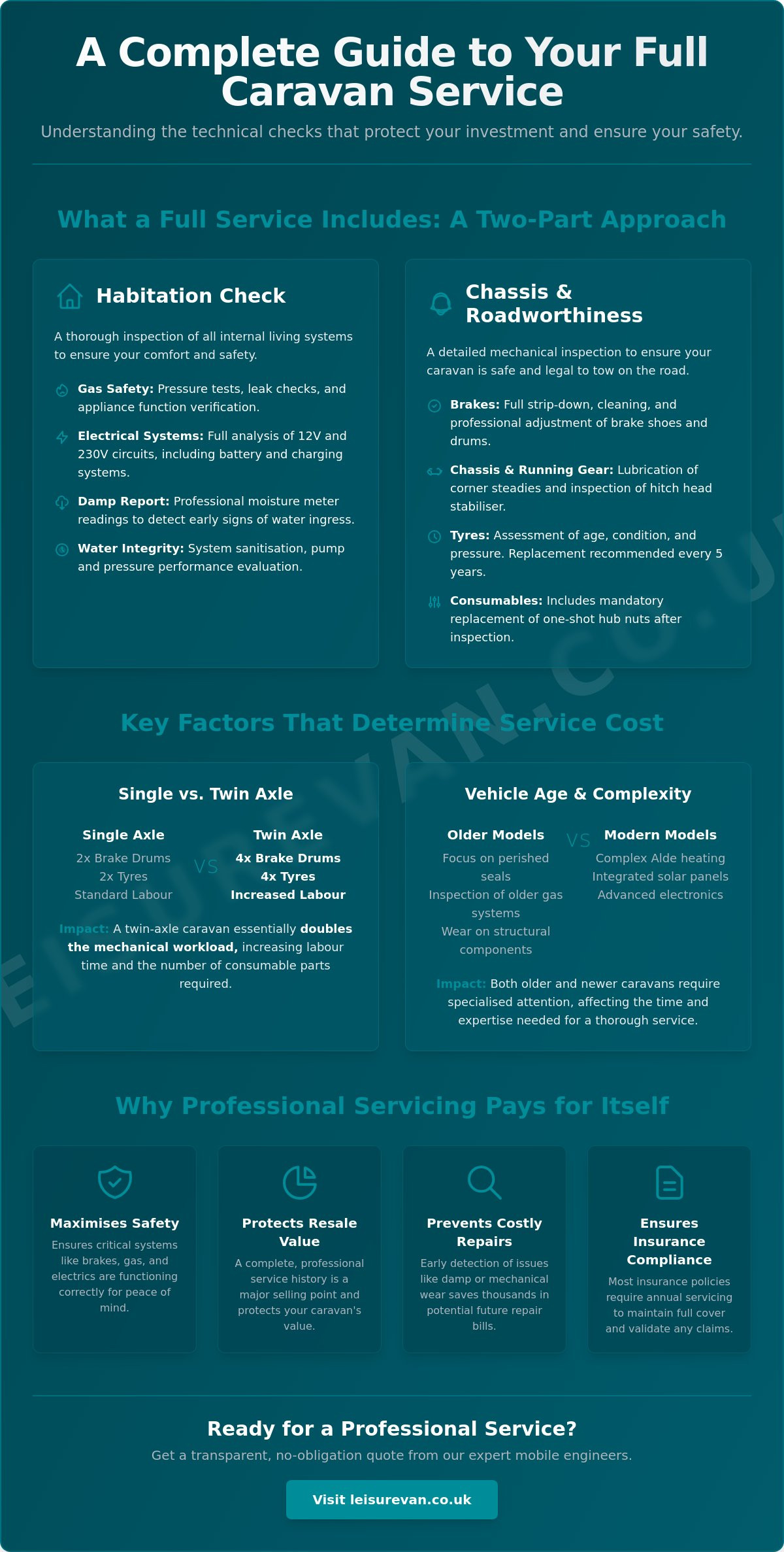
A full service represents the most thorough health check available for your caravan. It is far more than a simple visual inspection. This process is a dual-pronged approach that combines a mechanical chassis inspection with a comprehensive habitation safety check. By treating these two areas as a single, cohesive unit, you ensure that your recreational vehicle is both safe to live in and legal to tow. Understanding the variables that make up the full caravan service cost helps you appreciate the technical expertise involved in protecting your investment.
While some owners might consider these checks as separate tasks, they are designed to work in synergy. The habitation side focuses on the internal systems that provide comfort and safety, whilst the chassis side ensures the structural and mechanical integrity of the caravan during transit. A professional damp report is also a standard part of this service. This uses calibrated moisture meters to detect early signs of water ingress. Catching these issues early prevents the “hidden” costs of major structural repairs later on. It’s about precision and prevention.
The Habitation Check: Your Internal Safety Net
This part of the service focuses on your living environment. We prioritise the systems that could pose a direct risk to your health if left unmaintained. The inspection includes:
- Gas Safety: We perform gas pressure testing to identify leaks and check the flame failure devices on all appliances. Carbon monoxide safety checks are performed to ensure proper ventilation.
- Electrical Systems: Both the 12V battery system and the 230V mains circuits are analysed. This prevents short circuits and ensures your charging systems are functioning correctly.
- Water Integrity: The water system undergoes sanitisation and the pump performance is evaluated to ensure consistent pressure and hygiene.
Chassis and Roadworthiness: The Mechanical Core
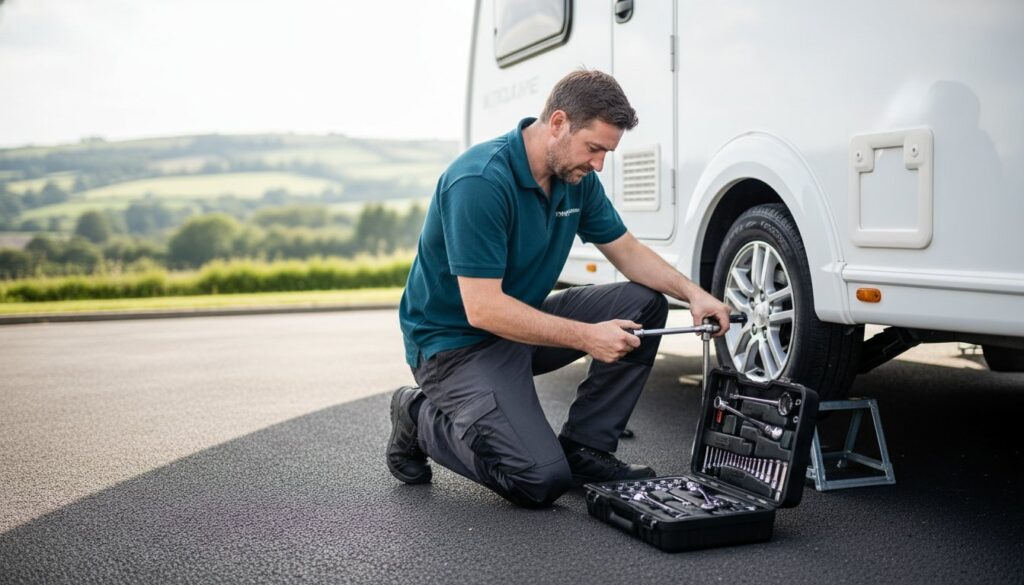
The chassis inspection keeps you safe on the road. We don’t just look at the brakes; we strip down the brake drums to clean, inspect, and professionally adjust the shoes. This ensures even stopping power and prevents overheating during long descents. Tyre age and condition are also assessed. This is essential for insurance compliance, as many providers require tyres to be replaced every five years regardless of tread depth. We also lubricate the corner steadies and check the hitch head stabiliser pads. These small mechanical details prevent “snaking” and ensure a smooth towing experience. Ultimately, the full caravan service cost reflects the time and expertise required to keep these complex systems in peak condition.
Factors Influencing Full Caravan Service Pricing in 2026
Pricing for a professional inspection is influenced by several mechanical and technical variables. While the base full caravan service cost often starts at a standard rate, the specific configuration of your vehicle determines the final investment. Technicians must account for the time required to meet government safety checks, which vary significantly between a compact single-axle trailer and a large, twin-axle tourer. It’s a methodical process where thoroughness is the priority.
Vehicle age plays a significant role in the service duration. Older caravans often require more intensive scrutiny of gas seals and window rubbers, which can perish over time. Conversely, modern caravans often feature integrated solar panels or advanced Alde heating systems. These require specialised diagnostic equipment and technical knowledge to assess correctly. If your caravan is equipped with high-end tech, the service duration naturally increases to ensure every circuit and fluid level is verified. This proactive approach prevents small issues from becoming expensive repairs.
Single vs. Twin Axle Cost Drivers
The most immediate factor is the number of axles. A twin-axle caravan essentially doubles the mechanical workload on the chassis. Technicians must strip, clean, and adjust four sets of brake drums rather than two. This also means checking four tyres for age-related cracking and flat spots. For mobile engineers, this extra labour translates to more time spent on-site. You’re also paying for additional consumables, such as one-shot hub nuts, which must be replaced every time the drums are removed for inspection.
The Impact of Specialised Systems
Modern leisure vehicles are increasingly complex. If you have an Alde system, it’s not just a quick check of a heater. It involves testing the glycol levels and ensuring the pump is circulating fluid efficiently through the radiators. Solar panel health checks are now standard for off-grid enthusiasts, requiring electrical load tests on the leisure battery. Air conditioning units also add to the checklist, as filters must be inspected for blockages. To ensure your systems are handled by a safe pair of hands, consider booking a Full Caravan Service with a specialist who understands these technical nuances.
Finally, the choice between a fixed workshop and a mobile engineer affects the value proposition. While workshops have high overheads, mobile caravan servicing in South Yorkshire offers a “doorstep” convenience that saves you hours of towing time and fuel. This efficiency often makes the mobile route the more logical choice for busy owners who want their caravan maintained where it is stored. It’s about finding the right balance between technical expertise and personal convenience.
The Variable Costs: Parts, Consumables, and Technical Work
Transparency is the foundation of a dependable service. Many caravan owners feel a sense of “bill shock” when the final invoice exceeds the initial quote. This usually happens because the base full caravan service cost generally covers the technician’s labour and expertise rather than the physical components that require replacement. Every caravan has unique maintenance needs based on its mileage, storage conditions, and age. Providing a “plus parts” quote isn’t about hidden fees; it’s about ensuring your vehicle receives the exact components it needs to remain safe.
Consumables represent the small but vital items used during every inspection. These include high-grade lubricants for the corner steadies, specialised sealers for exterior lockers, and cleaning agents for the brake assemblies. While these items are inexpensive individually, they are essential for preventing seized components and water ingress. By using professional-grade supplies, a technician ensures that the mechanical parts of your caravan operate smoothly until your next annual check.
Why “Plus Parts” is a Standard Industry Term
Safety-critical items often drive the variable portion of your bill. For example, one-shot hub nuts are designed to be used only once. When a technician removes the brake drums to inspect the shoes and bearings, they must replace these nuts to ensure the wheels remain securely fastened. Reusing an old nut is a significant safety risk and would void most warranties. The National Caravan Council sets the benchmark for these safety protocols, requiring the use of OEM-standard parts to maintain the integrity of the vehicle. A reputable engineer will always be transparent about these requirements, explaining why a gas hose or a regulator needs renewing before the work begins.
Specialist Technical Add-ons
Beyond the standard mechanical checks, some caravans require specialised technical work that falls outside a basic service. An Alde Heating System Fluid Change is a prime example. Depending on the type of glycol used, this fluid needs replacing every two or five years to prevent internal corrosion of the radiators. Other technical requirements might include a formal Gas safety Test if you intend to hire out your caravan, or an Electrical System Test for older models to verify the integrity of the wiring. These tasks require additional time and technical diagnostic tools, which is why they are often listed as separate line items on your service report.
Finally, your location within South Yorkshire may influence the final quote if you choose a mobile service. While many engineers offer a fixed price for local visits, those living in more remote areas might see a small call-out fee to cover travel time and fuel. This is a logical trade-off for the convenience of having a specialist arrive at your driveway or storage plot, saving you the hassle of a double-trip to a fixed workshop. It’s an efficient way to manage your maintenance without disrupting your schedule.
Mobile vs. Workshop: Calculating the True Value
Choosing between a mobile engineer and a fixed workshop is a decision that impacts your wallet and your weekend. While the base full caravan service cost might seem similar on paper, the “hidden” savings of mobile servicing often tip the balance. It’s about looking at the total expenditure of time, fuel, and logistical effort. A mobile service brings the technical expertise to your doorstep, allowing you to carry on with your day while your investment is professionally maintained.
Safety is a primary consideration that many owners overlook when booking a workshop slot. If your caravan has been in storage for several months, you cannot be certain of its roadworthiness until it has been inspected. Towing a vehicle with potentially seized brakes or perished tyres to a service centre puts you at risk. By opting for a mobile inspection, you eliminate this hazard. The engineer verifies the mechanical integrity of the chassis before the caravan ever touches the public highway. It’s a logical way to ensure your first trip of the season is safe and stress-free.
The Economics of Mobile Servicing
The true value of a mobile service becomes clear when you calculate the transit costs. A workshop visit requires two round trips: one to drop the caravan off and another to collect it once the work is finished. For owners in Sheffield, Rotherham, or Barnsley, this can mean hours spent navigating South Yorkshire traffic and significant fuel consumption. You also avoid the “storage gap” often found at busy workshops, where your caravan might sit in a yard for weeks awaiting its turn. Mobile servicing is efficient. The work is completed in a single session at your location, keeping your caravan exactly where you want it. For a transparent and convenient experience, you can book a Full Caravan Service to be performed at your home or storage plot.
Seeing the Work First-Hand
Direct communication with your engineer provides a level of transparency that a workshop reception desk simply cannot match. When the work happens on your driveway, you can see the results of the damp inspection in real-time. If a specific issue is found, such as a failing gas regulator or a worn brake shoe, the technician can show you the component and explain the necessary repair. This builds a long-term maintenance relationship based on trust and integrity. You aren’t just paying for a stamp in a book; you’re gaining a detailed understanding of your caravan’s condition from a seasoned specialist who treats your vehicle as if it were their own. This personalised approach ensures that nothing is missed and every question is answered with technical authority.
Protecting Your Investment: Why Professional Servicing Pays for Itself
Viewing the full caravan service cost as an investment rather than a mere annual expense is the hallmark of a responsible owner. Your caravan is a significant financial asset. Like any complex vehicle, its value and safety depend entirely on the consistency of its maintenance. A professional service provides more than a checklist; it offers a documented history of care that protects you from the catastrophic costs of neglect. By identifying minor issues before they escalate, you ensure your leisure vehicle remains a safe, reliable sanctuary for your family.
Insurance compliance is a critical factor that many owners overlook. Most UK insurance policies stipulate that the caravan must be maintained in a roadworthy condition for a claim to be valid. In the event of an accident or technical failure, a lack of professional service records can complicate the claims process. Having a current service report proves you’ve met your legal and contractual obligations. It provides peace of mind that your coverage is secure whilst ensuring that safety-critical systems, such as gas and brakes, are operating within modern 2026 technical standards.
The Link Between Servicing and Resale Price
A “stamped book” is the most powerful tool you have when the time comes to upgrade. In the competitive second-hand market, buyers look for transparency and integrity. A full service history, complete with professional damp reports, immediately increases buyer confidence and justifies a higher asking price. It proves that the caravan hasn’t just been used, but has been meticulously preserved. Many buyers now insist on a pre-purchase inspection; having your own recent service records often simplifies this process and helps close the sale quickly at the price you deserve.
Ensuring Long-Term Reliability
Preventative maintenance is particularly vital for structural integrity. For instance, catching water ingress during a damp check can be the difference between a simple reseal and a multi-thousand pound repair for floor delamination or wall rot. Similarly, regular servicing maintains the efficiency of expensive appliances like fridges and boilers. These units are costly to replace but often require only minor adjustments or cleaning to stay in peak condition. To ensure your vehicle receives this level of expert care, you can request a bespoke quote for your full caravan service from LeisureVan.
Ultimately, the value of a professional service is found in the silence of a trip without mechanical failure and the safety of a holiday free from gas or fire risks. It is the most effective way to guarantee that your caravan stays on the road and out of the workshop for major repairs. Investing in professional expertise today is the most logical way to save money tomorrow.
Secure Your Caravan’s Future on the Road
Investing in professional maintenance is the most effective way to protect your vehicle’s longevity and your family’s safety. By understanding the factors that influence the full caravan service cost, you can budget effectively for essential safety checks and technical support. From preventing expensive damp repairs to ensuring your gas and electrical systems meet 2026 standards, a proactive approach pays for itself through higher resale values and insurance compliance.
As an MCEA Qualified Engineer, I provide comprehensive mobile support across Sheffield, Rotherham, and Barnsley. Whether you require specialist Alde heating support or a thorough chassis inspection, I offer the technical expertise of a trusted local expert. You won’t have to worry about the logistics of towing to a workshop whilst I bring the service directly to your driveway or storage plot. It is the logical choice for maintaining your equipment’s safety and performance.
Book your expert mobile caravan service in South Yorkshire today. Enjoy the peace of mind that comes from knowing your caravan is in a safe pair of hands for your next adventure.
Frequently Asked Questions
Is a mobile caravan service as thorough as a workshop service?
A mobile caravan service is just as thorough as a workshop-based inspection because the same safety standards and diagnostic equipment are used on-site. Mobile engineers carry calibrated gas sniffers, damp meters, and technical tools to perform every check required by industry bodies. This ensures your vehicle receives a meticulous safety audit without the need for you to transport it to a fixed location.
Does a full caravan service include a damp report?
Yes, a comprehensive damp report is integrated into the full caravan service cost. The engineer will use a moisture meter to check for water ingress around windows, doors, and roof lights. You will receive a detailed report showing moisture percentages in various zones, which is vital for early detection and protecting your caravan’s structural integrity.
How long does a full caravan service typically take to complete?
A full service typically takes between three and four hours to complete for a single-axle caravan. Twin-axle models require more time, often taking up to five hours, because there are four sets of brakes and tyres to inspect rather than two. This duration ensures that every component, from the hitch head to the rear lights, is thoroughly examined.
Will a professional service help maintain my caravan manufacturer warranty?
Using a qualified professional engineer helps maintain your manufacturer warranty by providing a documented service history that meets industry standards. Most manufacturers require annual servicing by an approved technician to keep the warranty valid. Always check your specific warranty terms to ensure your chosen engineer holds the necessary qualifications, such as MCEA membership.
What is the difference between a habitation check and a full service?
A habitation check focuses exclusively on the “living” side of the caravan, including gas safety, electrical circuits, and water systems. A full service includes all these habitation checks but adds a complete inspection of the chassis and running gear. This mechanical side covers the brakes, tyres, and corner steadies, making it the most thorough option for roadworthiness.
Do I need to empty my caravan before the engineer arrives?
You don’t need to completely empty your caravan, but you must provide clear access to all lockers, floor areas, and appliances. The engineer needs to reach gas valves and wall surfaces for damp testing. Removing heavy items from under-seat storage and clearing the kitchen area allows the inspection to proceed efficiently and ensures no area is missed.
How often should the Alde heating fluid be changed during a service?
Alde heating fluid should be changed every two or five years, depending on the specific type of glycol currently in your system. Blue fluid typically requires a change every two years, whilst the long-life pink fluid lasts for five. This specialised task is often treated as a technical add-on to the full caravan service cost because it involves a complete system flush.
Are parts and VAT usually included in the initial service quote?
Most initial service quotes cover the labour and expertise required for the inspection but exclude the price of replacement parts and consumables. Items such as one-shot hub nuts, gas hoses, or batteries are billed as extras because their need is only confirmed during the service. A transparent engineer will always discuss these additional costs with you before fitting new components.