

Imagine opening your motorhome door after a long, wet British winter only to be met by the unmistakable, heavy scent of mildew. It is a moment every owner dreads; it signals that water has found its way into your sanctuary. You have likely invested significant time and money into your vehicle, so the fear of hidden structural rot or expensive repair bills is completely understandable. Protecting your investment requires more than just a cover and a prayer. This guide reveals the professional secrets to preventing damp in a motorhome, ensuring your interior remains fresh and your resale value stays protected throughout 2026 and beyond.
We agree that true peace of mind comes from knowing your seals are intact and your living space is bone-dry. In this ultimate guide, you will discover how to master the dual-front battle of managing internal humidity whilst rigorously auditing external seals. We will walk through the essential maintenance steps and professional inspection techniques that keep mould at bay. By the end, you will have a clear, actionable plan to keep your motorhome structurally sound and ready for your next adventure with total confidence.
Key Takeaways
- Understand the critical difference between internal condensation and external water ingress to better protect your vehicle’s structural integrity.
- Master essential ventilation techniques for preventing damp in a motorhome during the cold and humid British winter months.
- Identify high-risk external checkpoints such as awning rails and roof lights where sealant failure most commonly occurs.
- Learn why professional non-invasive moisture reports provide a level of accuracy and peace of mind that basic DIY meters cannot offer.
- Discover how regular habitation services and damp inspections in South Yorkshire safeguard both your safety and the vehicle’s future resale value.
Understanding the ‘Silent Assassin’: Why Damp is a Threat to Your Motorhome
Damp is often called the ‘silent assassin’ because it works out of sight, deep within the wall cavities of your vehicle. By the time you notice a dark patch or smell that familiar musty odour, the damage is often already advanced. When we talk about preventing damp in a motorhome, we are really talking about a two-front defence. It involves managing the moisture you create inside whilst stopping the British weather from getting in through the outside.
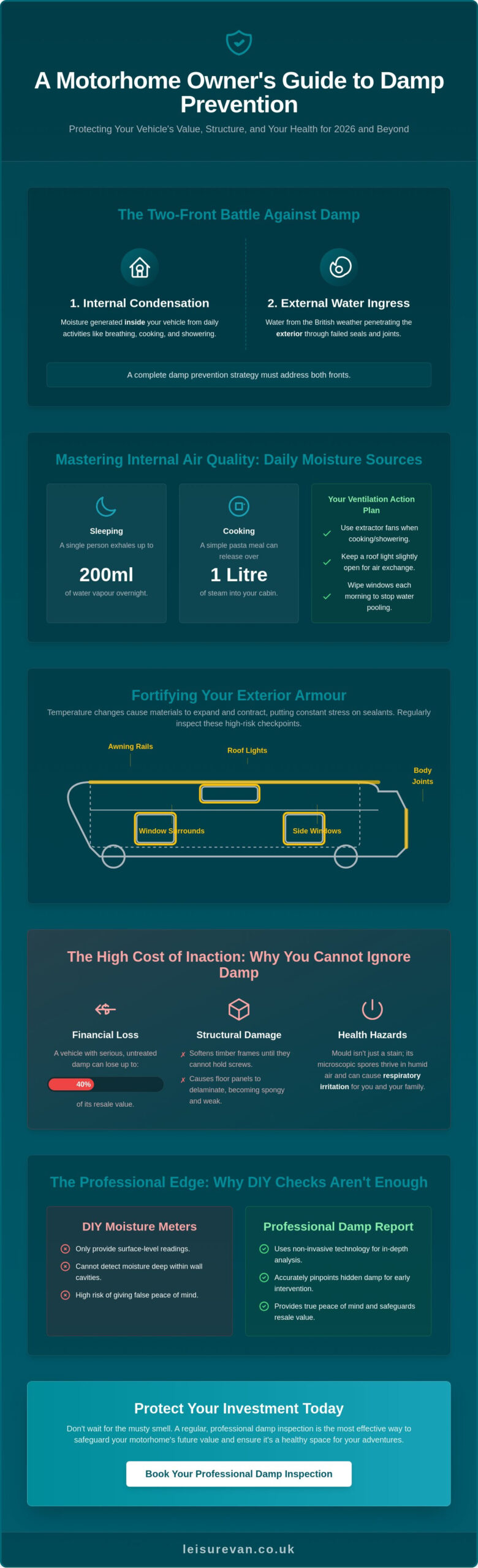
Leisure vehicles are uniquely vulnerable because of their mixed-material construction. Manufacturers use a combination of timber, polystyrene, GRP, and aluminium. These materials expand and contract at different rates as temperatures change. This movement puts constant stress on the mastic and sealants holding everything together. If these seals fail, water seeps into the structure. The financial impact is significant. Some industry experts report that a motorhome with serious, untreated damp can lose up to 40% of its resale value. It’s the difference between a minor maintenance task and a catastrophic repair bill.
Condensation vs. Water Ingress: Knowing the Difference
Mastering the art of preventing damp in a motorhome starts with identifying where the moisture is coming from. Condensation is moisture generated by daily activities. Every time you boil a kettle, take a hot shower, or simply sleep, you add litres of water to the air. If this air isn’t vented, it turns into liquid on cold surfaces. This is where owners often research how dehumidifiers extract water from the air to help keep things dry. However, water ingress is different. It is a mechanical failure of the vehicle’s exterior. This happens when window surrounds, roof lights, or awning rails lose their watertight bond. You must address both; using a dehumidifier won’t fix a leaking seal, and a new seal won’t stop condensation from a lack of ventilation.
The Health and Structural Risks of Neglect
Ignoring damp creates more than just a smell; it creates a health hazard. Mould isn’t just a stain; it’s a living organism that feeds on the organic matter in your wallboards and timber. It spreads through microscopic spores that thrive in the stagnant, humid air found behind cupboards and under bed boxes. In the confined space of a motorhome, these spores can lead to respiratory irritation for you and your family. Structurally, water is devastating to traditional builds. It softens timber frames until they can no longer hold screws and causes floor panels to delaminate. Once the internal plywood layers separate, the floor becomes spongy and weak. Catching these issues early during a professional Damp Inspection and Report is vital for the longevity of your vehicle.
Managing Internal Humidity: How to Stop Condensation at the Source
Many owners believe that keeping a vehicle tightly sealed is the best way of preventing damp in a motorhome during a British winter. In reality, a sealed van is often a damp van. Without a constant exchange of air, the moisture you produce through breathing, cooking, and showering has nowhere to go. It settles on the coldest surfaces, usually window frames and outer walls, where it eventually feeds mould growth. Effective humidity management is about creating a controlled flow of air that carries wet air out before it can condense.
Daily activities on the road are the primary culprits. A single person can exhale up to 200ml of water vapour overnight, and cooking a simple pasta meal can release over a litre of steam into the cabin. Modern heating systems, such as those from Alde or Truma, are excellent for maintaining a comfortable temperature, but they don’t remove moisture on their own. Instead, they warm the air, which increases its capacity to hold water. If you don’t vent that warm, wet air, it will turn back into liquid as soon as the heating is turned off. If you are concerned about your vehicle’s current moisture levels, a professional Damp Inspection and Report can provide the clarity you need.
Practical Airflow Strategies for Every Trip
Small habits make a significant difference to the internal climate. Always use your extractor fans or keep a roof light cracked open whilst cooking or showering, even in cold weather. It’s also vital to wipe down your windows every morning. This prevents water from pooling in the bottom of window channels, where it can seep into the wallboards over time. Ensure that your permanent gas vents are never covered or obstructed by rugs or storage boxes. These vents are designed by the manufacturer to provide a minimum level of safety and airflow that is essential for a healthy interior.
Winter Storage: Protecting the Interior
When your motorhome is not in use, the way you arrange the interior is critical. Pull all cushions and mattresses away from the walls or remove them entirely to allow air to circulate in the gaps. This prevents “cold spots” where stagnant air becomes trapped against the outer skin of the vehicle. Whilst internal humidity management is a constant task, it is vital not to confuse these surface issues with the structural failure involved in detecting and preventing water ingress, which requires a more technical approach to external maintenance.
The debate around moisture absorbers often divides owners. These passive tubs are a helpful supplement for small lockers, but they are not a cure for a lack of ventilation. They can only extract a limited amount of water from the air. A more effective strategy is leaving your heating on a low “frost” setting if you have a hook-up. This keeps the internal temperature slightly above the dew point, significantly reducing the risk of condensation forming on your soft furnishings during the dampest months of the year.
External Maintenance: Protecting Seals and Joints from Ingress
Whilst mastering the internal environment is essential for managing condensation and mould, the external shell of your vehicle requires a different level of vigilance. External water ingress is often the result of mechanical failure. Most motorhome sealants have a reliable lifespan of between 5 and 10 years. After this window, the material often enters a danger zone where it loses its elasticity and begins to pull away from the bodywork. This process is accelerated by “body flex,” which is the natural twisting of the chassis as you travel over uneven road surfaces. This movement puts immense pressure on every joint, eventually creating microscopic gaps that allow water to seep in.
Successful strategies for preventing damp in a motorhome rely on early detection of these failures. You should regularly inspect your vehicle for visual signs of distress. Look for cracking, discolouration, or shrinking in the sealant beads. Critical check-points include awning rails, roof lights, and window surrounds. If a seal looks dry or brittle, it is no longer doing its job. Catching these issues early is the best way to avoid the structural rot that leads to expensive repair bills later on.
The Annual Seal Audit
A thorough inspection should be a fixed part of your maintenance schedule. Safely use a ladder to check the roof area, paying close attention to any areas where water might pool after a downpour. Stagnant water is more likely to find a way through a weak seal than running water. Don’t forget the lower sections of the vehicle; check the integrity of the “skirt” and the under-floor seals where road spray is most concentrated. A common mistake is “over-sealing,” where owners apply a new layer of mastic over an old, leaking joint. This often makes the problem worse by trapping moisture against the timber frame, accelerating the rot you are trying to prevent.
Covering Your Motorhome: Pros and Cons
Protecting your vehicle from South Yorkshire’s driving rain during the winter months often leads owners to consider a cover. It is vital to avoid non-breathable plastic tarpaulins. These trap moisture underneath, creating a greenhouse effect that encourages mould growth on the exterior. Instead, invest in a high-quality, breathable cover. These allow internal moisture to escape whilst providing a robust barrier against the elements. Ensure the cover is fitted correctly so it doesn’t rub against the bodywork or damage the delicate acrylic windows during high winds. A well-fitted cover is a powerful tool in preventing damp in a motorhome, provided it allows the vehicle to breathe.
The Professional Edge: Why DIY Moisture Checks Aren’t Enough
Many owners try to take charge of preventing damp in a motorhome by purchasing a cheap, two-pin moisture meter from a local DIY shop. Whilst these devices can provide a rough indication of surface moisture, they have significant limitations. These basic meters only measure the electrical resistance between two pins pushed into the wallboard. They often fail to detect deep-seated structural issues hidden behind decorative finishes or within insulation layers. Relying solely on a basic tool can lead to a false sense of security, allowing a minor leak to develop into a major repair bill before it ever registers on a consumer-grade device.
Professional engineers use sophisticated equipment to get a clearer picture. We often employ non-invasive ultrasound or radio-frequency meters that can “see” through panels without leaving unsightly pinholes in your interior. These tools allow us to distinguish between temporary surface condensation and genuine water ingress. Understanding the data is just as vital as the tools themselves. Generally, readings between 0% and 15% are considered normal; however, once levels climb between 15% and 20%, it suggests a developing issue that requires investigation. Anything over 20% indicates a structural risk where timber rot is likely already occurring. To ensure your vehicle is accurately assessed, you can book a comprehensive Damp Inspection and Report with our specialist team.
What Happens During a Professional Damp Inspection?
A professional survey is a methodical process. We map the moisture levels in over 30 specific locations across the vehicle, creating a detailed digital blueprint of its health. This includes checking high-risk, hidden areas that owners often miss, such as the spaces behind lockers, under bed boxes, and around the gas locker seals. You receive a dated, professional certificate at the end. This document is a powerful asset. It acts as proof of maintenance for insurance claims and significantly boosts your vehicle’s value when the time comes to sell. If you also own a touring caravan, understanding how to get a caravan damp report from a qualified professional follows the same methodical principles and is equally essential for protecting your investment.
When to Book a Specialist Damp Survey
Timing is everything when it comes to early detection. The industry standard is the “once a year” rule, usually conducted as part of your annual Motorhome Habitation Service. This ensures that any seal failure caused by winter weather or road vibration is caught before the following season. A survey is also non-negotiable during the buying process. You should never purchase a used motorhome without a recent, independent damp report. Before committing to any inspection, it is worth understanding the motorhome damp survey cost and what a comprehensive report should include so you can be confident you are getting genuine value. Local expertise matters too. An engineer familiar with the South Yorkshire region understands how our local climate and road conditions affect specific makes and models, providing a level of insight a generic guide simply cannot offer.
Expert Damp Prevention and Habitation Services in South Yorkshire
LeisureVan Service Solutions Ltd provides a dedicated mobile solution for owners throughout South Yorkshire and the surrounding regions. We specialise in preventing damp in a motorhome by identifying potential ingress points before they cause lasting damage. Our engineers cover Sheffield, Rotherham, and Doncaster, extending into Barnsley, Chesterfield, and the wider Wakefield area. Because we are a mobile operation, we eliminate the hassle of driving your vehicle to a fixed workshop. We come directly to your home or storage site. This allows you to carry on with your day whilst we conduct a meticulous Damp Inspection and Report.
Our process is built on transparency and technical accuracy. After every inspection, you receive a comprehensive digital report that details moisture readings from across your vehicle. It is a clear, easy-to-read document that gives you an honest assessment of your motorhome’s health. Having this record is vital for maintaining your warranty and protecting the vehicle’s future resale value. By choosing a mobile specialist, you receive a level of focused attention that ensures no hidden seal or joint is overlooked.
Why Choose LeisureVan Service Solutions Ltd for Your Damp Protection?
Our team consists of qualified mobile engineers who bring specialist technical knowledge to every job. We don’t just look for problems; we act as a “safe pair of hands” to help you maintain your vehicle for the long term. You can expect honest advice on any necessary repairs and transparent communication from start to finish. We focus on providing peace of mind for local motorhome and caravan owners. We pride ourselves on being a reliable partner in your vehicle’s maintenance schedule, ensuring your equipment remains safe and structurally sound.
Book Your 2026 Habitation Check Today
The best strategy for preventing damp in a motorhome is to stay ahead of the weather. Don’t wait until you notice a musty smell or a spongy floor. Scheduling your annual check before the winter sets in is the most effective way to safeguard your investment. For complete confidence, many of our clients choose to combine their damp check with a Gas Safety Test or an Alde Heating System Fluid Change. This ensures all your systems are running efficiently and safely for the season ahead.
Take the first step in protecting your vehicle’s structural integrity and future value. Book your mobile damp inspection with LeisureVan Service Solutions Ltd today and ensure your motorhome remains a dry, healthy space for your next journey.
Secure Your Motorhome’s Future Today
Managing the atmosphere inside your cabin and auditing the external seals are the most effective ways of preventing damp in a motorhome. We’ve seen how internal humidity and external ingress work together to threaten your vehicle’s structural integrity. Whilst routine owner maintenance is vital, the technical accuracy of a professional inspection offers a level of security that DIY tools simply cannot match. It’s about moving from guesswork to certainty.
Our qualified mobile service engineer provides the comprehensive damp reports you need for insurance compliance and future resale. We offer a dependable, convenient service that comes to you in Sheffield, Barnsley, or Doncaster. This proactive approach ensures your vehicle remains a safe, dry sanctuary for every trip you plan. Protect your investment—book a professional damp inspection with LeisureVan Service Solutions Ltd today. Taking action now means you can look forward to your next journey with complete confidence.
Frequently Asked Questions
What are the first signs of damp in a motorhome?
Condensation on windows, spongy wallboards, or a faint musty smell are usually the first indicators that moisture is present. You might also notice discolouration, “pinking” on wallboards, or peeling wallpaper in corners. Inspecting hidden areas like under bed boxes and behind lockers can reveal these signs before they become obvious in the main cabin area.
How much does a professional motorhome damp report cost in the UK?
The cost of a standalone damp report in the UK typically varies depending on whether it is booked as an individual service or part of a full habitation check. Prices often reflect the thoroughness of the inspection and the engineer’s travel requirements. For a full breakdown of what to expect to pay and what should be included in a quality survey, our detailed guide to motorhome damp survey cost in 2026 covers everything you need to know. It is best to check with a local specialist for a quote that covers your specific vehicle type and location in South Yorkshire.
Can I fix damp in my motorhome myself?
While you can manage surface condensation yourself, structural damp repairs usually require professional intervention to be effective. Resealing a window or rail involves removing the component, cleaning away old mastic, and applying specialist sealants. Amateur “over-sealing” often fails because it traps moisture inside the wall, which leads to faster rot and more expensive repairs later.
Is damp covered by my motorhome insurance policy?
Most insurance policies do not cover damp caused by gradual wear and tear or a lack of routine maintenance. Insurance typically only pays out for water ingress resulting from a specific, sudden event like a storm or an accident. Maintaining a record of annual habitation checks is often a requirement to keep your manufacturer warranty valid and your insurance company satisfied.
How often should I have a habitation check for damp prevention?
You should schedule a habitation check at least once every twelve months to ensure early detection of any issues. Regular inspections are the most effective way of preventing damp in a motorhome. Catching a failing seal in the spring can prevent a small leak from causing major structural damage over the following winter months.
Does a motorhome cover prevent damp or cause it?
A high-quality, breathable cover prevents damp by shielding the vehicle from rain, but a non-breathable plastic sheet can actually cause it. Breathable covers allow internal moisture to escape whilst keeping the exterior dry. If you use a non-breathable tarpaulin, you risk trapping humidity against the bodywork, which encourages mould and mildew growth across the exterior and interior.
What is a “normal” moisture meter reading for a motorhome?
A reading between 0% and 15% is generally considered normal and indicates that the vehicle structure is dry. Once readings reach 15% to 20%, they suggest a potential issue that needs monitoring or further investigation. Anything above 20% is a serious concern; it indicates the presence of enough moisture to support the growth of timber-rotting fungi within the frame.
Why does my motorhome smell musty even though I can’t see any mould?
A musty smell usually indicates that damp is present behind the wallboards or under the floor where it is not visible. Mould spores thrive in stagnant air behind cupboards and bed frames. If you can smell it but not see it, moisture is likely working within the structure, making a professional preventing damp in a motorhome strategy and an urgent inspection a priority.