
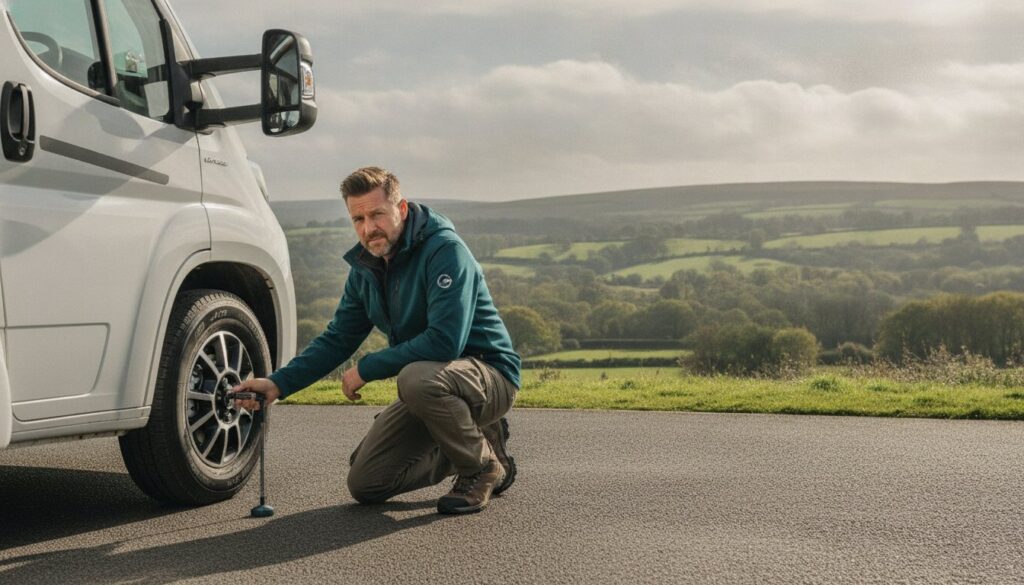
Did you know that almost 40% of UK vehicles were found to be on unsafe tyres during a 2025 check? When you are behind the wheel of a multi-tonne home on wheels, those statistics become more than just numbers; they represent the thin line between a dream holiday and a roadside disaster. Conducting a thorough motorhome pre-trip safety inspection is the only way to ensure your vehicle is truly roadworthy before you set off. We all know the excitement of planning a route, but that joy quickly fades if you are anxious about gas leaks, electrical faults, or the heavy fines associated with the UK’s strict 2026 overloading regulations.
You deserve to feel confident every time you turn the ignition key. We understand that the technical side of motorhome maintenance can feel overwhelming, especially with new 2026 safety standards and expanding Low Emission Zones to consider. This comprehensive guide simplifies the process by providing a logical walk-around sequence that covers both mechanical essentials and habitation safety. You will learn how to check your own tyre pressures and payload limits accurately, whilst also understanding exactly when it is time to call in a professional engineer for specialist gas and damp inspections. Let’s make sure your next adventure is defined by the views, not by a breakdown.
Key Takeaways
- Learn how to perform a systematic motorhome pre-trip safety inspection that covers both the vehicle chassis and the living area for total peace of mind.
- Identify critical exterior checks, from monitoring tyre tread depth and pressures whilst cold to verifying essential engine fluid levels.
- Protect your family from invisible hazards by inspecting gas hose integrity and ensuring all carbon monoxide and smoke alarms are fully functional.
- Master the art of payload management to avoid heavy fines and ensure your vehicle remains stable and legal on UK roads.
- Discover the benefits of a professional mobile habitation service that brings expert damp detection and safety testing directly to your doorstep.
What is a Motorhome Pre-Trip Safety Inspection?
A motorhome pre-trip safety inspection is a systematic review of two distinct areas: the vehicle chassis and the habitation space. While a standard recreational vehicle is designed for long-distance travel, its dual nature as both a vehicle and a home means maintenance is twice as important. This process isn’t just about ticking boxes. It prevents “holiday-ruining” breakdowns and ensures you remain fully compliant with UK road laws. Every major journey deserves a dedicated walk-around. Catching a small leak or a worn tyre at home is much easier than dealing with it on a rainy hard shoulder.
Legal Requirements for UK Motorhome Owners
An MOT is a legal necessity for roadworthiness, but it’s vital to realise that it doesn’t cover the habitation area. While the MOT ensures your engine and brakes work, it won’t check for gas leaks or faulty electrical circuits in the living space. Many campsites across the UK now require a valid gas safety certificate before they allow you to pitch up, making professional documentation a practical travel requirement. Under UK law, you are legally responsible for ensuring your vehicle has roadworthy tyres and fully functional lights at all times.
DIY vs. Professional Inspections: Know the Limits
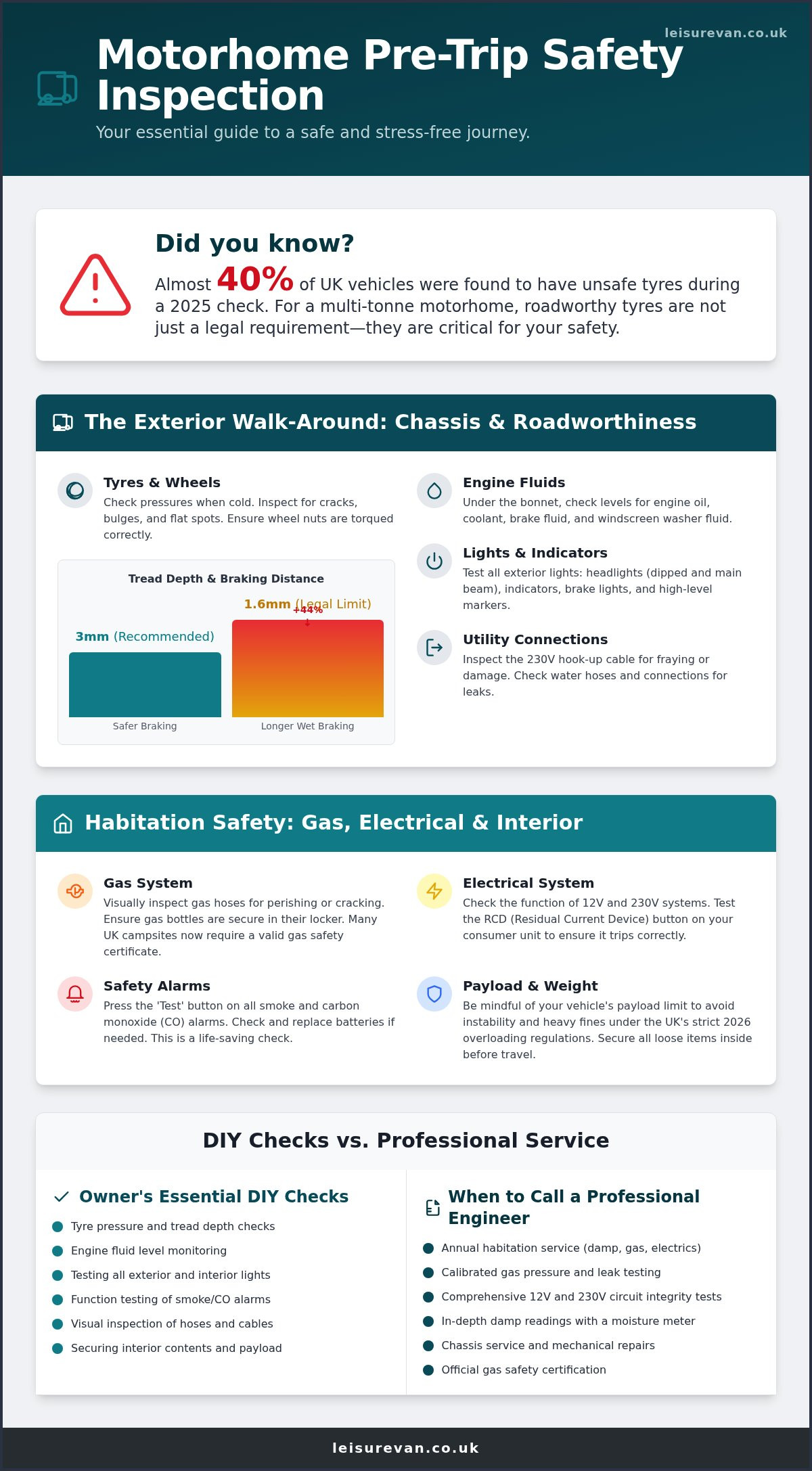
Knowing what you can handle yourself and where you need expert help is the key to a stress-free trip. As an owner, you can safely monitor tyre pressures, check engine oil and coolant levels, and test all exterior bulbs. These tasks form the foundation of any motorhome pre-trip safety inspection. However, certain systems require specialised tools to assess correctly.
Professional engineers use calibrated equipment to perform gas pressure tests, take deep damp readings, and verify the integrity of 230v and 12v electrical circuits. A comprehensive habitation check is the gold standard for pre-season preparation. It uncovers hidden risks like carbon monoxide leaks or early-stage water ingress that a visual DIY check will miss. Mobile services make this even easier by bringing this technical authority directly to your driveway. It ensures your vehicle is a safe environment for your family without the hassle of visiting a workshop.
The Exterior Walk-Around: Chassis and Roadworthiness
A motorhome pre-trip safety inspection begins with a methodical walk-around of the vehicle’s exterior. This isn’t just about aesthetics; it’s about ensuring the chassis is capable of handling the demands of the road. Start by checking all fluid levels under the bonnet. Low engine oil or coolant can lead to catastrophic failure, while old brake fluid compromises your stopping power. Referencing the official MOT inspection manual provides a clear benchmark for what the DVSA considers roadworthy, but your pre-trip checks should go further to ensure total reliability.
Tyres are your only contact with the tarmac. With almost 40% of UK vehicles found to be on unsafe tyres in a 2025 check, this is a critical safety point. The legal minimum tread depth is 1.6mm, but for a heavy motorhome, 3mm is widely recommended. Tests show that braking distance in the wet can be 44% longer on tyres worn to the legal limit compared to those with 3mm of tread. Check for sidewall cracking, which often occurs on vehicles that spend long periods stationary in the sun. Don’t forget the high-level marker lights. These are essential for helping other drivers judge your vehicle’s size at night, particularly on narrow, unlit rural roads.
Tyres and Wheel Security
If your motorhome has been parked up for several months, check for “flat spots” on the tyres. These are temporary deformations that can cause significant vibration once you hit the road. It’s also vital to torque your wheel nuts to the manufacturer’s specification. Vibration over time can cause them to loosen, and a winter lay-up is the perfect time for corrosion to settle in. Ensure your spare tyre is inflated or that your puncture repair kit hasn’t expired. If you’re unsure about the mechanical state of your vehicle, booking a professional chassis only service provides an extra layer of expert reassurance.
External Utility Connections
Utility points are often overlooked during a motorhome pre-trip safety inspection. Inspect your 230V hook-up cable for any signs of fraying or exposed wires. A damaged cable is a severe fire and shock hazard, especially in damp UK weather. Clean out water inlet points to prevent debris from entering your internal tanks and check that all waste valves operate smoothly. Finally, physically pull on awnings and bike racks to ensure they are locked down. A loose fixture can become a dangerous projectile if it catches the wind at 60mph on the motorway.
Gas and Electrical Safety: The Invisible Risks
Whilst the exterior walk-around ensures you can reach your destination, the interior systems keep you safe once you arrive. Gas and electrical faults are often invisible until they become dangerous. This makes them a critical focus for your motorhome pre-trip safety inspection. Modern systems are highly reliable; however, constant vibration from road travel can loosen connections or cause wear that isn’t immediately obvious. Taking twenty minutes to verify these systems doesn’t just protect your vehicle; it protects your family.
Start with your electrical system. If you’re plugged into a 230V mains supply, find your consumer unit and press the ‘Test’ button on the Residual Current Device (RCD). It should trip immediately, cutting the power. This simple action confirms the safety switch is functional and ready to protect you from electric shocks. Next, check your leisure battery. Ensure the terminals are clean and tight; any white, powdery build-up can be gently cleaned away to maintain a solid connection. A battery that isn’t holding a charge might leave you without lights or water pumps when you’re off-grid.
LPG and Gas System Integrity
Gas safety is paramount. Check the date stamp on your high-pressure gas hoses; they typically need replacing every five years as the rubber can perish and crack. You can perform a simple ‘bubble’ check by applying a solution of water and washing-up liquid to the joints. If bubbles grow, you have a leak. If this happens, turn off the gas at the bottle immediately and do not use the system. Ensure your gas bottles are securely strapped in their locker to prevent them from shifting during transit. For peace of mind, a professional gas safety check in South Yorkshire uses calibrated manometers to detect even the smallest pressure drops that a visual check will miss.
Testing Safety Alarms and Monitors
It’s a common mistake to assume that pressing the ‘Test’ button on a Carbon Monoxide (CO) or smoke alarm confirms the unit is fully functional. This button only tests the battery and the buzzer, not the actual sensor. Check the ‘replace by’ date on the back of the unit. Sensors degrade over time and usually last between five and seven years. Position your CO alarm at head height near sleeping areas, as this gas is slightly lighter than air and incredibly toxic. Finally, check your fire extinguisher. The needle should be firmly in the green zone, and the unit must be within its expiry date. If it’s over five years old, it’s often safer and more cost-effective to replace it entirely.
Interior Habitation Essentials and Payload Management
Moving inside the vehicle, the focus of your motorhome pre-trip safety inspection shifts to stability and internal integrity. A major part of this is managing your payload. It’s easy to forget that every bottle of water, full gas cylinder, and even the solar panels you had installed adds to your Maximum Authorised Mass (MAM). In 2026, the DVSA has adopted a “Zero Tolerance” policy regarding overloading. Even being 1% over your weight limit can result in an on-the-spot fine. To maintain safety and legal compliance, always store heavy items low down and as close to the axles as possible to keep the centre of gravity stable.
Beyond weight, your appliances need a quick trial run before you leave. Check that your fridge, cooker, and heating system function correctly on all power sources, whether that is gas, 12V, or 230V mains. If your vehicle uses an Alde heating system, ensure the fluid levels are correct to avoid a cold night in the Highlands. Finally, physically check every cupboard latch and the fridge door lock. A single unsecured door can swing open during a sharp turn, causing damage to the interior or distracting the driver.
Understanding Your Motorhome’s Payload
Overloading isn’t just a legal risk; it’s a significant safety hazard. An overweight vehicle has longer braking distances and less predictable handling, which can even invalidate your insurance in the event of an accident. If you’ve recently added heavy accessories, visit a local weighbridge to get an accurate reading of your “ready-to-go” weight. For many drivers, the 3.5-tonne limit remains a critical threshold that requires careful management to avoid fines that typically range from £100 to £300 for fixed notices, or significantly more for severe offences.
Water Systems and Heating
Hygiene is just as important as mechanical safety. If your motorhome has been stationary, sterilise the fresh water tank to remove any bacterial build-up before your first fill. Whilst you’re at it, check for any signs of water leaks under the sinks and around the shower tray. Early detection is vital because preventing damp in a motorhome starts with a simple check of your window and roof seals. If you notice soft spots on the wallboards or a musty odour, it’s often a sign that water ingress has already begun. To catch these issues before they become a costly repair, you can book a professional damp inspection to ensure your living space remains dry and healthy.
Professional Support: Why a Mobile Habitation Service is Key
Whilst a DIY motorhome pre-trip safety inspection is an essential habit for every owner, it eventually reaches a technical limit. Identifying a potential issue is the first step, but verifying the safe operation of complex gas, water, and electrical systems requires professional tools and training. A comprehensive habitation service acts as a deep-dive into your vehicle’s health. It uncovers hidden risks that a visual walk-around simply cannot detect, such as microscopic leaks in gas manifolds or early-stage water ingress behind furniture. By bridging the gap between basic roadworthiness and total habitation safety, you ensure your vehicle is a truly safe environment for your family.
Modern motorhomes are increasingly sophisticated. Systems like Alde heating require specialist care, including specific fluid changes to prevent internal corrosion and maintain efficiency. Similarly, solar installations and advanced electrical circuits need periodic testing to ensure they aren’t just working, but working safely. Beyond the immediate safety benefits, professional documentation is a vital asset. Building a consistent service history protects your motorhome’s resale value and provides the “peace of mind” that insurers and future buyers look for. It proves that you’ve prioritised maintenance and safety throughout your ownership.
LeisureVan Service Solutions: Your Local South Yorkshire Specialist
Convenience shouldn’t be a barrier to safety. LeisureVan Service Solutions brings expert care directly to your driveway, serving Sheffield, Rotherham, Doncaster, and Barnsley. Our mobile service saves you the hassle of towing or driving to a distant workshop, allowing you to prepare for your trip whilst we handle the technical checks. We provide detailed reports that identify issues like damp or gas pressure drops before they have the chance to ruin your holiday. You can easily book your professional motorhome pre-trip safety inspection via our service booking request page to ensure your vehicle is ready for the road.
Peace of Mind for Your Next Adventure
The true value of a professional inspection is the emotional security it provides. There is a unique sense of comfort in knowing your family is safe whilst sleeping in the motorhome, protected by verified gas seals and functional safety alarms. Professional servicing significantly reduces the risk of expensive “emergency” repairs whilst you’re away, which are often twice as stressful and costly in a foreign location or a remote part of the UK. Don’t leave your safety to chance this season. A small investment in professional oversight today ensures that your next adventure is defined by the memories you make, not the technical failures you encounter.
Ready for the Road: Securing Your Next Adventure
A thorough motorhome pre-trip safety inspection is the final step in turning a simple vehicle into a reliable home for the road. By following the systematic checks we have outlined, you transition from uncertainty to total control. You now understand how to balance your payload, verify your invisible safety systems, and ensure your chassis is road-ready. These small investments in time protect the significant investment you have made in your leisure vehicle, allowing you to focus on the journey ahead rather than worrying about what might go wrong.
If you prefer the reassurance of an expert eye, LeisureVan Service Solutions is here to help. We provide a qualified mobile service across South Yorkshire, including Sheffield, Rotherham, and Doncaster. Our team handles everything from specialist Alde heating fluid changes to comprehensive damp inspections right at your doorstep. We take pride in being a “safe pair of hands” for owners who value thoroughness, transparency, and the convenience of a specialist coming to them.
Book Your Professional Mobile Habitation Check Today and prepare for a season of stress-free travel. Your next great adventure is just around the corner.
Frequently Asked Questions
How often should I perform a motorhome pre-trip safety inspection?
You should conduct a basic motorhome pre-trip safety inspection before every significant journey. If your vehicle has been stationary for more than a month, a more thorough review is necessary to check for perishing seals or battery drain. Whilst a professional habitation service is recommended annually, these personal walk-arounds act as a vital first line of defence. They ensure that small issues don’t escalate into failures whilst you are far from home.
Is a habitation check the same as a mechanical service?
No, they focus on entirely different areas of the vehicle. A mechanical service maintains the engine, gearbox, and brakes to ensure the chassis is roadworthy. In contrast, a habitation check focuses on the living quarters. It verifies the safety of gas, electrical, and water systems. Both are essential for a safe trip; an MOT alone will not identify a carbon monoxide leak or a failing water heater in the cabin.
What are the most common things people forget during a motorhome check?
Owners often overlook high-level marker lights and the expiry dates on safety equipment like smoke alarms and fire extinguishers. Internal security is another frequent omission. Forgetting to lock the fridge door or cupboard latches can lead to significant damage during transit. Physical checks of external fixtures, such as bike racks and awnings, are also vital. Ensuring these are tightly secured prevents them from becoming a hazard on the motorway.
Can I check for damp in my motorhome myself?
You can perform a basic visual inspection by looking for wallboard discolouration or smelling for musty odours. However, DIY checks are limited because damp often starts deep within the structure. Professional engineers use calibrated moisture meters to take readings in hidden areas. This identifies water ingress long before it is visible to the naked eye. Early detection through a professional report can save you thousands in major structural repair costs.
How do I know if my motorhome is overloaded?
The only way to be certain of your vehicle’s weight is to visit a local public weighbridge. You must ensure your total weight, including passengers, water, and fuel, does not exceed the Maximum Authorised Mass (MAM) found on your chassis plate. Overloading significantly affects braking distances and handling. Staying within legal limits is essential to avoid on-the-spot fines and to ensure your insurance remains valid in the event of an accident.
What should I do if I find a gas leak during my inspection?
If you suspect a gas leak, turn off the supply at the cylinder valve immediately and open all windows and doors for ventilation. Don’t operate any electrical switches or create any sparks. Once the area is safe, you must contact a qualified engineer to perform a professional pressure test. Do not attempt to use the gas system again until it has been formally inspected and repaired by a specialist.
Do I need a professional gas safety certificate for UK campsites?
Whilst there is no universal law requiring a certificate for all campsites, many private site owners now insist on seeing a valid habitation or gas safety report before allowing entry. This is especially common on sites with strict health and safety policies. Having a professional motorhome pre-trip safety inspection documented in your service history makes these check-ins much smoother. It also provides reassurance that your appliances are safe for overnight use.
What are the legal tyre requirements for motorhomes in the UK?
Legally, your tyres must have a minimum tread depth of 1.6mm across the central three-quarters of the tread. However, industry experts recommend a minimum of 3mm for heavier vehicles to maintain safe wet-weather performance. You must also check for any visible bulges, cuts, or sidewall cracking. Tyres that are over five years old should be inspected regularly for signs of perishing, even if they still have plenty of tread remaining.