
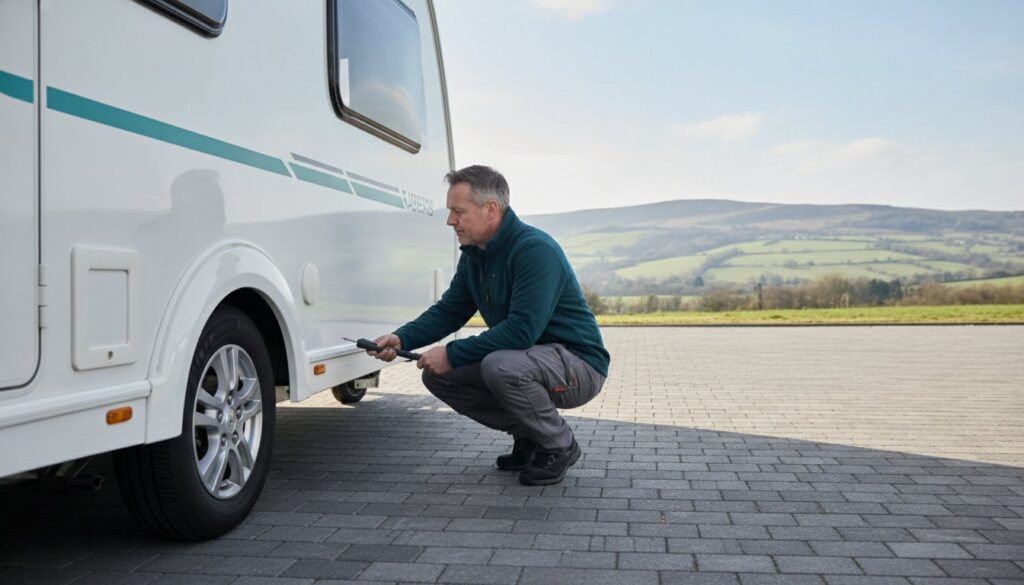
Could a single winter of storage be more damaging to your caravan than a thousand miles on the road? While your tourer has been tucked away, the cold and damp have likely been at work on the seals, tyres, and gas hoses. Most owners feel a sense of excitement when spring arrives, but that joy can quickly turn to anxiety if you’re worried about hidden damp or seized brakes. Successfully preparing a caravan for its first trip of the season is about more than just a quick wash; it is a vital technical audit to reverse months of winter deterioration.
We understand that the safety of your family is your top priority, and you want the peace of mind that comes from knowing your vehicle is roadworthy. This expert guide provides a clear, step-by-step plan for de-wintering your caravan for 2026. You’ll learn how to properly sterilise your water system, check for perished tyres, and identify when a professional habitation check or gas safety test is essential. By following this safety checklist, you can head off on your first adventure with total confidence that your caravan is in peak condition.
Key Takeaways
- Understand why winter inactivity often causes more mechanical deterioration than regular road use, requiring a thorough technical audit before your first outing.
- Master the step-by-step process for preparing a caravan for its first trip of the season, from sterilising fresh water tanks to performing a “Z-pattern” gas appliance check.
- Learn how to distinguish between a simple musty smell and serious hidden damp to protect your caravan’s structural integrity and resale value.
- Ensure roadworthiness by applying the “rule of five” for tyre replacement and inspecting critical hitch components for contamination or wear.
- Discover how a professional mobile habitation check in South Yorkshire provides the technical expertise and peace of mind needed for a safe 2026 touring season.
Why a Season Opening Inspection is Non-Negotiable
A season opening inspection is far more than a superficial spring clean. It is a comprehensive safety and functional audit designed to ensure every mechanical and habitational system is fit for purpose. Whilst many owners assume their tourer is safe because it hasn’t moved, inactivity is often more damaging than regular road use. Rubber seals can dry and crack without movement, whilst leisure batteries often suffer from deep discharge if left unmaintained for months on end. Transitioning from storage mode to touring mode for 2026 requires a methodical approach to catch forgotten issues before they ruin your first family holiday. Understanding Caravan history and terminology helps owners appreciate how these complex vehicles have evolved. However, their core vulnerabilities to the British winter remain a constant challenge.
Preparing a caravan for its first trip of the season is your opportunity to reset the clock on maintenance. It’s about moving beyond the “it worked last year” mindset and verifying that every safety-critical component is still operational. A seized brake or a leaking gas pigtail isn’t just an inconvenience; it’s a significant safety risk. By treating this inspection as a non-negotiable part of your touring calendar, you protect your investment and ensure your first journey of the year is memorable for the right reasons.
The Hidden Risks of Winter Storage
Winter storage presents several silent threats that can compromise your safety. Condensation is the primary culprit. It is the catalyst for early-stage damp that often goes unnoticed until it becomes an expensive structural repair. Even if your caravan is kept under a high-quality cover, temperature fluctuations can trap moisture against the internal wall boards. Tyres are another major concern. Even without road wear, they suffer from flat-spots and UV degradation whilst stationary. Additionally, small insects often find sanctuary in gas flues or water inlets during the quiet months. These tiny nests create blockages that can lead to appliance failure or, in worse cases, dangerous carbon monoxide risks when you first ignite the heater.
Setting Your 2026 Preparation Timeline
You should ideally start your checks at least two weeks before your first planned departure. This timeframe allows you to identify faults and source replacement parts without the stress of a looming deadline. If you discover issues beyond your technical comfort zone, booking professional caravan servicing in South Yorkshire early is essential to beat the inevitable spring rush. Our mobile engineers in Sheffield and Doncaster often see a surge in demand as the weather warms up. Use this preparation period to organise your paperwork too. Ensure your insurance is active, your service history is updated, and any necessary MOT for your tow vehicle is booked. Preparing a caravan for its first trip of the season is a methodical process. A little foresight ensures your family trip starts with the peace of mind you deserve.
Sterilising and Testing Internal Systems
Once you have assessed the exterior, your focus must shift to the life-support systems inside. Preparing a caravan for its first trip of the season involves a rigorous check of the water and gas networks to ensure they haven’t degraded during the colder months. Stagnant water and dormant gas seals are the primary concerns for any owner. A methodical approach ensures you don’t overlook a small leak or a bacterial build-up that could lead to a significant problem once you reach your destination. By testing these systems now, you avoid the frustration of arriving at a campsite only to find you have no hot water or a faulty fridge.
Fresh Water System Start-Up
Restoring your water supply is a three-stage process that requires patience. First, close all drain-down valves, including the yellow flipper valve usually located near the boiler. Inspect these plastic fittings carefully; they are prone to hairline cracks if any residual water froze during winter. Second, use a food-grade sterilising fluid to clean the entire system. This step is vital to eliminate biofilm and bacteria that thrive in damp, dark pipework. Finally, flush the system thoroughly with at least two full tanks of fresh water to remove all chemical traces. This ensures your water is safe for both washing and cooking throughout your 2026 tours.
Alde Heating and Gas Appliances
Specialist systems like Alde central heating require specific technical attention that often goes overlooked. Check the expansion tank to ensure the glycol fluid is at the correct level and remains a clear, vibrant colour, typically magenta, blue, or green. If the fluid appears muddy or brown, it has lost its anti-corrosive properties and requires a professional change to protect your boiler. For your gas appliances, we recommend a “Z-pattern” check: start at the hob, move to the fridge, and finish with the space heater. Perform a visual inspection of all gas hoses for cracking or “out of date” stamps. Most high-pressure hoses have a five-year lifespan and should be replaced if they exceed this. When testing the spark ignition, look for a crisp blue flame; an orange or flickering flame indicates a potential blockage in the burner or flue.
Safety isn’t just about the appliances themselves; it’s about the sensors that protect your family. Replace the batteries in your smoke and carbon monoxide alarms as a matter of course, even if they appear to be functioning. For complete security, a professional gas safety check is the only way to verify that the internal pipework remains airtight. This technical audit provides the ultimate peace of mind before your first night away. If you notice any irregularities during your testing, you can book a specialist inspection to ensure every system is operating at peak efficiency.
Detecting Winter Damage: Damp and Electrical Health
Damp is the single greatest threat to your caravan’s lifespan and its future resale value. Whilst a musty smell is a clear warning sign, water ingress often begins as a silent, invisible process. By the time you notice soft wall boards or black mould, the damage is likely extensive and expensive to rectify. This makes moisture detection a critical part of preparing a caravan for its first trip of the season. Understanding the principles of preventing damp in a motorhome or caravan can help you maintain a dry, healthy environment for your family. A proactive approach now ensures that a small seal failure doesn’t escalate into a structural crisis later in the year.
Electrical health is equally vital after months of storage. Your caravan relies on a complex 12V and 230V network to power everything from the water pump to the safety sensors. Inactivity is particularly hard on leisure batteries, which can suffer permanent capacity loss if their voltage drops too low during the winter. Verifying your power supply now prevents the frustration of a dead battery when you’re miles from the nearest hook-up point.
Spotting the Early Signs of Water Ingress
Water ingress typically starts at the joints and apertures of the vehicle. Begin your inspection by examining the seals around window frames, roof lights, and the four corners of the floor where the steady legs are attached. Look for any discolouration or “pumping” of the sealant. Whilst some owners rely on the “finger test” to feel for soft spots, this is notoriously unreliable. A wall board can feel dry to the touch whilst the wooden frame behind it is saturated. Only a professional damp meter can provide an accurate percentage reading of the moisture levels within the structure. Investing in damp testing in South Yorkshire provides you with a formal report, offering the technical evidence needed to maintain your warranty and preserve your caravan’s value.
Battery and Electrical System Recovery
Start by testing your leisure battery with a multimeter. A healthy, fully charged battery should show a reading of at least 12.6V. If the reading is below 12V, the battery is significantly discharged and may require a slow, deep charge to recover. Take a moment to clean the battery terminals with a wire brush; removing oxidation ensures a solid connection for the 2026 season. Once you have confirmed the 12V supply, plug the caravan into a mains hook-up. Test the operation of the Residual Current Device (RCD) and Miniature Circuit Breakers (MCBs) in the consumer unit. Pressing the “test” button on the RCD should immediately trip the power, confirming that the safety cut-out is functional. This simple check ensures your electrical system is safe for use throughout your upcoming travels.

Road Safety: Tyres, Chassis, and Running Gear
Ensuring your vehicle is roadworthy is the most critical stage of preparing a caravan for its first trip of the season. Whilst internal comfort is important, the mechanical integrity of the chassis and running gear is what keeps your family safe on the motorway. Months of sitting stationary can lead to seized components and degraded rubber that might not be immediately obvious. A methodical physical inspection of the towing interface and wheels is the only way to guarantee a trouble-free journey to your first campsite of 2026.
The “rule of five” is a vital industry benchmark for caravan tyres. Even if your tread depth is well above the legal 1.6mm minimum, the British Tyre Manufacturers’ Association recommends replacing tyres once they reach five years of age. Rubber naturally loses its elasticity and develops internal structural weaknesses over time, regardless of mileage. Beyond the tyres, you must inspect the hitch head and internal friction pads. These pads are designed to grip the towball to prevent snaking, but they can easily become contaminated with grease, rust, or grit during storage. Cleaning them with brake cleaner or replacing worn pads ensures your stabiliser functions correctly.
Your last line of defence is the breakaway cable. This thin steel wire is designed to apply the caravan brakes if the hitch fails. Perform a close visual check for any fraying, rusted strands, or damage to the plastic coating. If the cable shows any sign of wear, it must be replaced immediately. Whilst basic visual checks are helpful, they cannot replace the technical depth of full caravan servicing. Professional engineers perform a complete brake strip-down, cleaning and adjusting the shoes to ensure even braking force, which is something most owners don’t have the tools to manage safely.
Tyre Condition and Pressure
Examine the sidewalls of your tyres for “crazing” or hairline cracks. This is often caused by UV exposure and the weight of the caravan pressing on one spot for months. If you see deep cracks, the tyre’s structural integrity is compromised. Before your first tow, use a calibrated gauge to set the pressures to the manufacturer’s specification. Always use a torque wrench to check the wheel bolts; refer to your manual for the exact setting to prevent over-tightening or wheel loss. Finally, lower the spare tyre from its carrier. It is often the most neglected part of the outfit and is useless in an emergency if it’s flat or perished.
The Chassis and Towing Interface
Start by greasing the corner steadies. A small amount of lithium grease on the threaded bar ensures they operate smoothly and don’t seize when you arrive on-site. Test your 13-pin or 7-pin road lights whilst hitched to your car. Look for green corrosion on the socket pins, which can cause intermittent light failure or “flickering” indicators. Finally, test the handbrake. It should move through its full arc with a smooth, firm resistance. If it feels “notchy” or pulls up too high without resistance, the linkage likely needs professional attention. To ensure your running gear is in peak condition, you can book a mobile chassis inspection to have a specialist verify every safety-critical component.
The Convenience of Mobile Servicing in South Yorkshire
The traditional method of towing your caravan to a distant dealership for maintenance is becoming a thing of the past. For many owners in Sheffield, Rotherham, and Doncaster, the logistical challenge of moving a vehicle that has been stationary for months is a major hurdle. This is where the value of a specialist mobile engineer becomes clear. By bringing the workshop to your driveway or storage site, we remove the stress of navigating city traffic with a potentially unverified chassis. Preparing a caravan for its first trip of the season shouldn’t feel like a chore; it’s the final, professional step that guarantees your 2026 holiday starts without a hitch.
LeisureVan Service Solutions acts as a safe pair of hands for owners across the region. Our mobile service is designed around your convenience, allowing you to carry on with your day whilst we conduct a thorough technical audit of your vehicle. A professional habitation check goes significantly deeper than a standard DIY inspection. It involves a methodical 66-point assessment covering gas safety, electrical integrity, and water systems. This professional oversight ensures that every component is not just functional, but safe for your family to use.
Expert Care at Your Doorstep
We provide comprehensive coverage across South Yorkshire, extending our specialist services to Barnsley and Worksop. A qualified engineer possesses the diagnostic tools and experience to spot subtle warning signs that a DIYer might easily miss. Whether it’s a slight irregularity in a gas flame or the early stages of floor delamination, early detection is the key to preventing expensive future repairs. Upon completion of the service, you receive full documentation. This paperwork is vital for maintaining your service history and ensuring your manufacturer’s warranty remains valid for the 2026 season.
Booking Your 2026 Season Service
Timing is critical when you are preparing a caravan for its first trip of the season. We recommend checking your previous service date against your insurance and warranty requirements well in advance. Beyond our standard safety inspections, we offer specialised technical support, including Alde heating fluid changes and solar panel installations. These upgrades can significantly enhance your touring experience, providing greater comfort and independence on the road. Don’t leave your safety to chance this spring. Book your mobile caravan service today to ensure your vehicle is fully prepared for the adventures ahead.
Ready for Your First 2026 Adventure
Successfully preparing a caravan for its first trip of the season requires a shift in focus from basic cleaning to technical safety. You’ve learned how to flush your water system, verify your gas appliances, and inspect your tyres for age-related wear. These steps are essential for protecting your family and your investment. However, some technical audits are best left to the experts to ensure no hidden faults remain after a long winter in storage.
LeisureVan provides the professional oversight you need without the hassle of towing to a workshop. Our qualified mobile engineers cover all of South Yorkshire, providing specialist Alde heating fluid changes and expert damp inspections right at your doorstep. By choosing a professional service, you receive a comprehensive habitation report. This documentation is vital for your peace of mind and maintains your caravan’s resale value for years to come.
Book your 2026 Caravan Habitation Check with LeisureVan today. We’ll handle the technical details so you can focus on the road ahead. We look forward to helping you start your touring season safely and with total confidence.
Frequently Asked Questions
How often should I sterilise my caravan water system?
You should sterilise your fresh water system at the start of every season and after any period of inactivity lasting more than a month. Using a food-grade sterilising fluid prevents the build-up of biofilm and harmful bacteria in the pipework. If you tour frequently throughout the year, a quarterly flush is a good benchmark to maintain water quality and system hygiene.
Can I perform a habitation check myself?
While you can certainly perform basic visual inspections, a professional habitation check requires specialist calibrated equipment. DIYers often lack the gas pressure gauges and professional damp meters needed to identify hidden faults. A certified engineer provides a formal report that is usually required to maintain your manufacturer’s warranty and satisfy insurance stipulations regarding maintenance.
What is the most common issue found after winter storage?
Battery discharge and early-stage water ingress are the most frequent problems identified during spring inspections. Leisure batteries can suffer permanent capacity loss if they aren’t kept on a trickle charge during the colder months. Moisture often finds its way through seals that have contracted in the cold, making damp detection a vital part of preparing a caravan for its first trip of the season.
Do caravan tyres really need replacing every five years?
Yes, industry bodies like the British Tyre Manufacturers’ Association recommend replacing caravan tyres every five years regardless of how much tread is remaining. Unlike car tyres, caravan rubber often fails due to UV degradation and internal structural weakening caused by sitting stationary. Tyres older than seven years should never be used, as the risk of a high-speed blowout increases significantly with age.
What should I do if I find damp during my spring checks?
You should book a professional damp inspection and report immediately to identify the entry point of the water. Damp spreads quickly through the timber framework of a caravan and can cause extensive structural damage if left untreated. Early intervention often allows for a simple reseal of a window or rail, which is far less expensive than a full wall-board replacement.
How long does a professional mobile caravan service take?
A full single-axle service typically takes between three and four hours to complete thoroughly. This allows the engineer enough time to strip down the brakes, test the gas system for leaks, and conduct a full damp survey. Twin-axle caravans generally take slightly longer due to the additional wheels, bearings, and braking components that require individual adjustment and inspection.
Is an Alde heating fluid change necessary every year?
An annual change isn’t usually required, but an annual inspection of the fluid’s health is essential. Blue glycol fluid typically has a two-year lifespan, whilst the magenta G13 fluid used in newer systems can last up to five years. You must check the level and colour annually; if the fluid looks muddy or faded, it has lost its anti-corrosive properties and needs replacing.
Where can I find a mobile caravan engineer in Sheffield or Rotherham?
LeisureVan Service Solutions provides expert mobile servicing across Sheffield, Rotherham, and the surrounding South Yorkshire areas. Our qualified engineers bring the workshop to your home or storage site, providing a convenient solution for preparing a caravan for its first trip of the season. This mobile service removes the need for stressful towing before your vehicle has been professionally verified as roadworthy.