

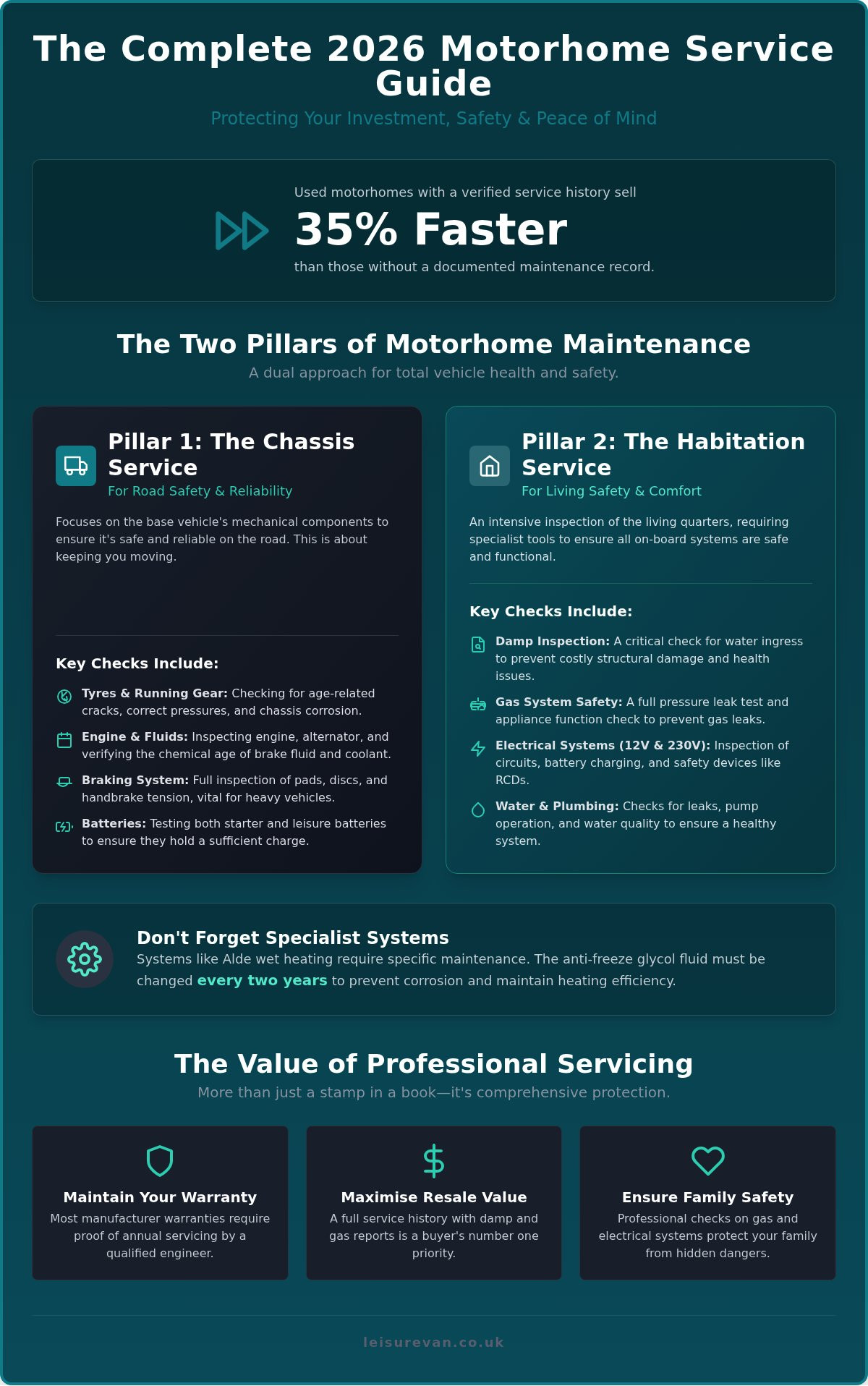
Did you know that used motorhomes with a verified habitation history sell 35% faster than those without? It’s a striking figure that highlights how much buyers value a well-documented maintenance record. Most owners agree that the freedom of the open road is priceless, yet the fear of hidden damp or a faulty gas regulator can often cast a shadow over your travel plans. Using a professional annual motorhome service checklist is the most effective way to protect your investment and ensure your vehicle remains a safe haven for your family.
We’ve designed this guide to provide a clear roadmap for your 2026 maintenance schedule. You’ll learn how to manage everything from mechanical safety and habitation health to specialist systems like solar panels and Alde heating. By the end of this article, you’ll have the expert knowledge required to validate your vehicle’s safety, maintain its resale value, and enjoy your holidays with total peace of mind. It’s about more than just a stamp in a book; it’s about the security of knowing your home on wheels is truly ready for the journey ahead.
Key Takeaways
- Understand the vital distinction between a chassis service for road safety and a habitation check for your living environment.
- Use our comprehensive annual motorhome service checklist to spot early signs of damp and maintain a pristine service history for future buyers.
- Gain confidence in your gas and electrical systems through professional pressure tests and circuit inspections that protect your family.
- Identify why specialist systems like Alde heating require specific glycol fluid changes every two years to maintain heating efficiency.
- Learn how mobile servicing provides expert maintenance at your doorstep or storage centre, saving you time and logistical hassle.
Understanding the Two Pillars of Motorhome Maintenance
Maintaining a motorhome requires a dual-track approach. It’s easy to focus on the engine and forget about the living quarters, or vice versa. To keep your travels trouble-free, your annual motorhome service checklist must address both the chassis and the habitation area. These two pillars serve different purposes but are equally vital for your safety and the longevity of your investment. A recreational vehicle (RV) is a complex machine that functions as both a high-performance vehicle and a comfortable home, meaning maintenance isn’t a one-size-fits-all task.
Mechanical vs Habitation: What’s the Difference?
The chassis service focuses on the “base vehicle” components. This includes the engine, braking system, suspension, and road lights. It’s essentially what keeps you moving safely on the motorway. Whilst a standard garage can often handle these mechanical aspects, the living area requires a specialist habitation engineer with specific diagnostic tools.
A habitation service is an intensive inspection of the living quarters. It covers gas safety, electrical systems, water plumbing, and damp testing. A mechanical technician might check your brake pads, but they won’t necessarily have the equipment to perform a gas pressure leak test or a 230V RCD trip-time analysis. Both services work together to protect your 2026 travel plans. They ensure your vehicle is roadworthy whilst guaranteeing your home environment is safe and functional.
Legal Requirements and Warranty Compliance
Many owners mistakenly believe that a valid MOT certificate means their vehicle is fully serviced. This is a risky assumption. An MOT is a legal minimum for road safety, required once a vehicle is three years old. It’s a snapshot of roadworthiness at a specific moment. It doesn’t check the health of your leisure battery, the efficiency of your fridge, or the presence of life-threatening carbon monoxide.
Professional documentation is also a practical necessity for financial reasons. Most manufacturer warranties are only valid if you can prove you’ve followed a comprehensive annual motorhome service checklist performed by a qualified engineer. Beyond the warranty period, a full service history is your best tool for maintaining resale value. Buyers in 2026 are highly discerning. They prioritise vehicles with “holiday-ready” status, often avoiding vans that lack a recent damp report or gas safety record. By keeping these two pillars in balance, you protect both your family and your wallet.
The Essential Mechanical and Chassis Checklist
Motorhomes face unique mechanical challenges because they often spend long periods in storage. Unlike a daily car, a motorhome’s components can suffer from lack of use. Seized brake callipers, flat-spotted tyres, and perished rubber hoses are common issues that a standard MOT might miss. Following a rigorous annual motorhome service checklist ensures that these hidden problems don’t turn into a breakdown during your summer tour. It’s about moving beyond basic roadworthiness to ensure complete reliability under the heavy loads these vehicles carry.
Tyres and Running Gear Safety
Tyre health is the most critical safety factor for any heavy vehicle. Even if the tread looks deep, motorhome tyres often need replacing every five years due to sidewall cracking and UV degradation. You must check pressures against your specific fully-laden touring weight, as under-inflation leads to overheating and blowouts. We also inspect the chassis for corrosion caused by UK road salt, which can compromise structural integrity if left untreated. Ensuring your running gear is in peak condition provides the stability you need on narrow country lanes.
Engine and Battery Health
A reliable start depends on more than just the engine. We test the performance of both the starter battery and the leisure battery to ensure they hold a charge effectively. The alternator must be checked to confirm it’s correctly charging the habitation system whilst you drive. Under the bonnet, we look for signs of pest damage; mice often find engine bays an attractive nesting spot during winter storage. In 2026, it’s critical to verify the chemical age of fluids such as brake fluid and coolant, as their protective properties degrade over time regardless of the mileage covered.
Whilst these mechanical checks go beyond the official MOT requirements, they’re essential for a vehicle that may weigh over 3.5 tonnes. A thorough inspection of the braking system, including pads, discs, and handbrake tension, is vital for your peace of mind when navigating steep descents. If you haven’t had your running gear checked recently, you can request a professional chassis assessment to ensure your vehicle is ready for the road. By addressing these mechanical basics, you create a solid foundation for a safe and successful holiday season. Using a structured annual motorhome service checklist keeps your maintenance organised and your vehicle’s resale value high.
The Habitation Service Deep-Dive: Safety and Comfort
Whilst the chassis keeps you moving, the habitation area is where your family eats, sleeps, and relaxes. This makes safety here a non-negotiable priority. A thorough annual motorhome service checklist goes deep into the technical health of your living space. It’s about ensuring every system, from the gas hob to the shower pump, operates exactly as it should. We look for the subtle signs of wear that could lead to a failure in the middle of a remote campsite.
Gas and Fire Safety Protocols
Gas safety is perhaps the most critical element of the habitation check. We don’t just check if the burners light; we perform a formal gas tightness test. This involves pressurising the system to identify even the smallest microscopic leaks that could lead to a dangerous build-up of gas. We also use specialist flue gas analysers to monitor carbon monoxide levels. It’s a simple step that saves lives. You should also check the expiry dates on your smoke and carbon monoxide alarms, as these sensors degrade over time. If you have any concerns about your system, it’s best to book a professional gas safety check before your next trip.
Electrical Inspection Condition Reports (EICR)
Many owners assume their electrics are fine because the lights turn on. However, a visual check of your sockets isn’t enough for 2026 safety standards. Constant vibration from road travel can loosen connections over time. We test the integrity of the earth bonding and ensure your circuit breakers (RCDs) trip within the required milliseconds. This prevents electric shocks and fire risks. For a deeper understanding of these technical requirements, read our guide to motorhome electrical installation condition reports. We also inspect the 12V charging circuits to ensure your leisure battery is being maintained correctly whilst off-grid.
Water systems also require annual attention to prevent health risks and plumbing damage. We sanitise fresh water tanks to remove biofilm and check the pump for any signs of weeping or pressure loss. Finally, we inspect internal fittings. Window seals, skylights, and door locks are all checked for smooth operation and watertightness. A perished seal on a skylight can lead to the very damp issues mentioned earlier in this annual motorhome service checklist. By being meticulous with these internal checks, you ensure your motorhome remains a comfortable, safe, and dry environment for years to come. It provides the peace of mind that every component in your living space is ready for the season.
Specialist Systems and Seasonal Maintenance
Whilst standard habitation checks cover the basics, modern motorhomes often feature complex specialist equipment that requires a dedicated approach. Your annual motorhome service checklist should always account for these advanced systems to avoid expensive repair bills later. From hydronic heating to off-grid power solutions, these components are the heart of your vehicle’s luxury and functionality. Ensuring they are maintained by a technician who understands their specific requirements is vital for long-term reliability.
The Critical Damp Inspection
Damp is often described as the silent enemy of the motorhome owner. It can take hold in hidden corners, behind wall tape, or inside lockers long before it becomes visible to the naked eye. We perform a 360-degree inspection using professional moisture meters to identify ‘soft spots’ and hidden water ingress. Catching a leak early is the difference between a simple resealing job and a major structural rebuild. For complete peace of mind, you can access our professional damp testing services to get a detailed report on your vehicle’s health. You may also find our guide on preventing damp in a motorhome useful for year-round protection.
Alde Heating and Solar Power Optimisation
If your vehicle uses an Alde system, maintenance goes beyond checking the thermostat. Alde glycol fluid must be replaced every two years to maintain the correct pH levels and prevent internal boiler corrosion. Neglecting this leads to the degradation of the aluminium components within the heating circuit. Similarly, your solar setup requires more than just a clean surface. We inspect the solar panel seals to prevent roof leaks and electrical shorts, whilst also verifying that the charge controller is delivering maximum efficiency to your battery bank. If you’re considering an upgrade, our motorhome solar panel installation guide provides a deep dive into off-grid capabilities.
Finally, don’t overlook your climate control systems. Before the summer touring season begins, we inspect air conditioning filters and refrigerant levels. A blocked filter reduces airflow and puts unnecessary strain on the compressor, whilst low refrigerant can leave you sweltering in the European sun. Including these specialist checks in your annual motorhome service checklist ensures that your vehicle is truly ‘holiday-ready’ for any weather. If your specialist systems are due for an inspection, you can book your specialist system service today to ensure everything is operating at peak performance. Taking these proactive steps protects your comfort and the future resale value of your vehicle.
Choosing the Right Service Partner in South Yorkshire
Selecting the correct professional to handle your annual motorhome service checklist is a decision that impacts your safety and the vehicle’s long-term value. Whilst general garages handle standard mechanical work, a specialist habitation engineer brings the diagnostic tools required for complex internal systems. Finding a local expert ensures you receive a service tailored to the specific needs of UK tourers, providing the technical depth that a general MOT simply cannot match.
Why Mobile Servicing Wins for Busy Owners
Traditional workshops often require you to drop off your vehicle and arrange a second car for the journey home. Mobile servicing eliminates this logistical headache by bringing the expertise directly to your driveway or storage centre. You can learn more about our habitation checks and how they provide a convenient alternative to fixed-site workshops. This approach allows you to observe the process and ask the engineer questions directly, ensuring total transparency regarding your vehicle’s health.
Booking Your 2026 Service with LeisureVan
As a dedicated specialist, LeisureVan Service Solutions provides deep local expertise across Sheffield, Doncaster, and Barnsley. Our mobile coverage area is extensive, reaching owners in Rotherham and Chesterfield through to Wakefield, Huddersfield, and Leeds. We pride ourselves on being a dependable partner for motorhome owners who value honest advice and meticulous technical work. Whether you need a specialist Alde fluid change or a comprehensive damp report, we focus on delivering peace of mind through technical excellence.
To prepare for your visit, ensure the vehicle is parked on level ground with sufficient water and gas available. Clearing out lockers that provide access to water pumps or electrical units allows the technician to work efficiently. Every inspection concludes with a clear breakdown of findings and honest advice on any necessary repairs, prioritising safety-critical items first. If you want to ensure your motorhome is holiday-ready, you can request a service booking today to protect your investment and your family’s safety. Using a professional annual motorhome service checklist is the most reliable way to guarantee your vehicle is prepared for the road ahead.
Prepare Your Motorhome for the Road Ahead
Protecting your motorhome involves more than just passing an MOT; it requires a proactive approach to both roadworthiness and habitation health. By following a structured annual motorhome service checklist, you address the hidden risks of damp, gas leaks, and electrical wear before they disrupt your travels. We’ve detailed how specialist attention to systems like Alde heating and solar power ensures your vehicle remains efficient and comfortable, regardless of the destination. These steps don’t just secure your safety; they provide the documented history that savvy buyers look for when you eventually decide to upgrade.
LeisureVan Service Solutions provides the expertise you need directly at your home or storage site. Our qualified mobile engineer offers comprehensive damp and gas safety reports, alongside specialist support for Alde heating and solar installations across South Yorkshire. This service-oriented approach gives you the clarity to travel with confidence, knowing every component has been meticulously inspected. It’s about ensuring your vehicle is truly ready for the miles to come.
Book your 2026 Motorhome Habitation Service with LeisureVan Today and secure your peace of mind for the season. We look forward to helping you keep your motorhome safe and holiday-ready for years to come.
Frequently Asked Questions
How often should I have a habitation check on my motorhome?
You should have a habitation check on your motorhome every 12 months. This annual interval ensures your vehicle remains safe for your family and is often a mandatory requirement to maintain your manufacturer’s warranty. Regular inspections help identify minor issues, such as early water ingress or a faulty regulator, before they develop into expensive structural repairs or safety hazards.
What is the difference between a habitation check and a mechanical service?
A habitation check focuses on the living quarters, whilst a mechanical service covers the chassis and engine components. The habitation service ensures systems like gas, water, and internal electrics are safe and functional. In contrast, the mechanical service deals with roadworthiness items such as oil changes, brake pads, and suspension. Both are essential parts of a complete maintenance routine for any motorhome owner.
Can I do my own annual motorhome service to save money?
You shouldn’t attempt to complete your own annual motorhome service checklist if you want to maintain your warranty or ensure gas safety. Professional engineers use specialist equipment, such as calibrated moisture meters and gas pressure gauges, that most owners don’t possess. DIY work on gas or electrical systems can be dangerous and will lack the official documentation required to protect your vehicle’s resale value.
How long does a full motorhome habitation service typically take?
Following a professional annual motorhome service checklist usually takes between three and four hours to complete thoroughly. This duration allows the engineer to perform a meticulous damp inspection, test all gas appliances, and verify the safety of both 12V and 230V electrical systems. The exact time may vary slightly depending on the size of your vehicle and the complexity of its onboard equipment, such as solar panels or air conditioning.
Do I need a gas safety certificate for my motorhome in the UK?
You don’t legally require a gas safety certificate for private motorhome use in the UK, but it’s highly recommended for your family’s protection. Most insurance providers and campsites expect your gas systems to be professionally maintained. A formal gas tightness test provides documented proof that your appliances are functioning correctly and aren’t leaking dangerous carbon monoxide, providing essential peace of mind whilst you tour.
Why is my motorhome damp check so important for resale value?
A damp check is vital for resale value because it provides evidence that the vehicle’s structure is sound and free from water ingress. Used motorhomes with a verified service history sell 35% faster than those without. A clean damp report reassures potential buyers that they aren’t inheriting a costly structural repair, making your vehicle a much more attractive and secure investment in the used market.
Does a habitation service include the engine and brakes?
No, a habitation service doesn’t include the engine, brakes, or tyres. These items are covered under a separate chassis or mechanical service that focuses on roadworthiness. The habitation check is strictly limited to the “home” part of the vehicle. It ensures the safety and functionality of your living environment, including appliances, internal plumbing systems, and the structural integrity of the bodywork.
What happens if my motorhome fails its habitation check?
If your vehicle fails its habitation check, the engineer will provide a detailed report outlining the specific faults found. Safety-critical issues, such as a gas leak or a faulty electrical circuit, should be repaired immediately before you use the vehicle again. For non-critical items, you’ll receive professional advice on the best course of action to rectify the problem and protect your vehicle’s long-term health.