
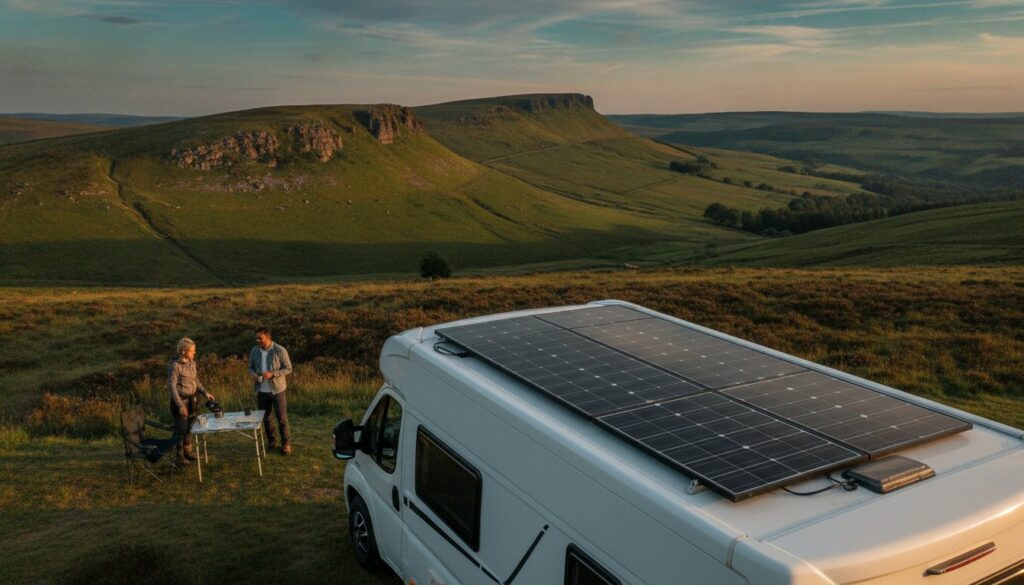
Why spend thousands on a premium vehicle only to remain tethered to an expensive campsite hookup every single night? For many, the dream of the open road is often dampened by the reality of battery drain during winter storage or the constant search for a mains connection. You likely bought your motorhome for freedom, not to be restricted by the length of an electrical cable. We understand that the idea of drilling into your roof is daunting, especially with the very real risk of leaks or electrical faults from a DIY attempt.
This guide demonstrates how a professional motorhome solar panel installation can transform your vehicle into a self-sufficient, off-grid sanctuary whilst protecting its structural integrity. You will discover how to maintain your battery health year-round and gain the confidence to camp wherever the road takes you. We will cover the essential 2026 technical standards, including the latest grounding requirements, and explain why a warrantied installation is the smartest way to add long-term value to your motorhome.
Key Takeaways
- Learn why monocrystalline rigid panels are the gold standard for UK weather conditions, offering the best balance of efficiency and durability for your roof.
- Discover the benefits of a professional motorhome solar panel installation carried out at your home, ensuring your vehicle remains watertight and warrantied.
- Follow our straightforward method for listing appliances and calculating your total daily power needs to ensure you never run out of energy whilst camping off-grid.
- Identify the critical annual cleaning and inspection routines needed to protect your system from efficiency-sapping debris and potential structural wear.
The Benefits of Motorhome Solar Panel Installation: Why Go Off-Grid?
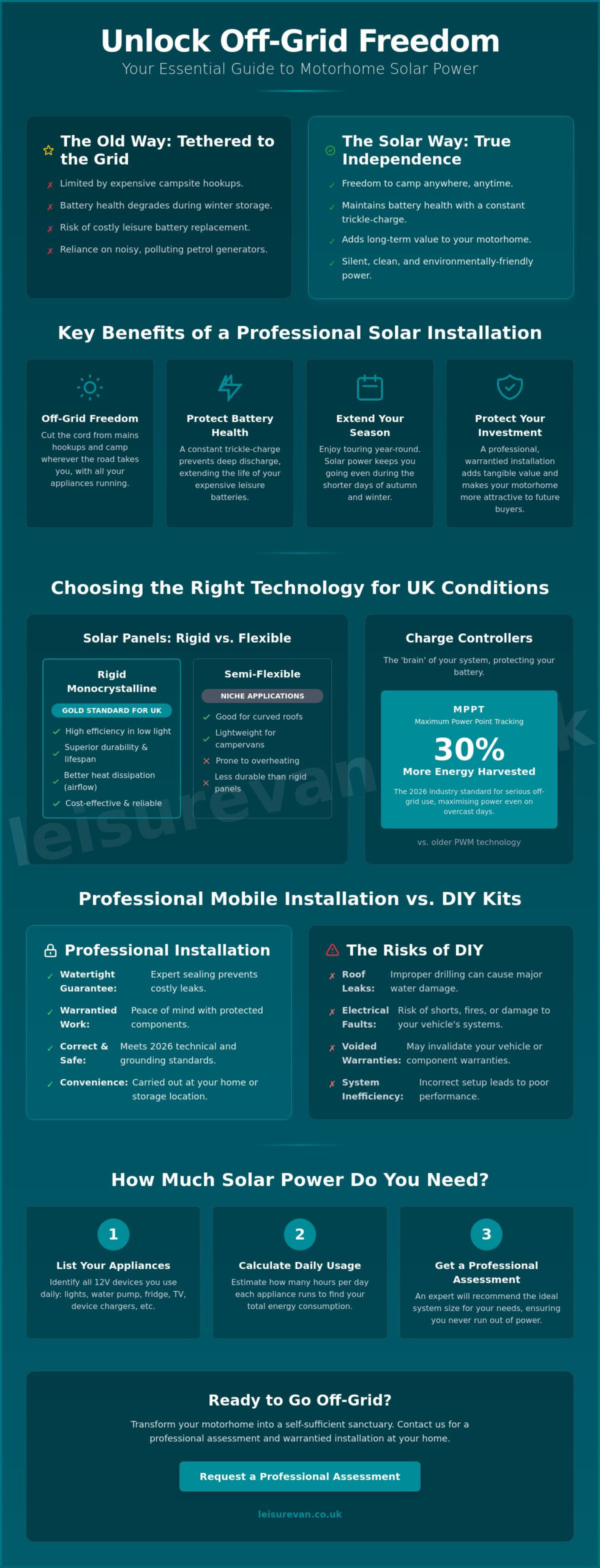
A motorhome solar panel installation is more than just a luxury accessory. It’s a fundamental shift in how you experience the road. At its core, this system involves mounting high-efficiency panels that capture energy from the sun. This energy is then converted into 12V power to charge your leisure batteries. Understanding how photovoltaic systems work helps you appreciate the reliability of this technology. It’s a silent, constant process that works even on overcast British days. You aren’t just buying hardware; you’re buying a self-sustaining power station for your vehicle.
The primary draw for most owners is cutting the “umbilical cord” of the campsite mains hookup. Relying on 240V hookups limits where you can stay and adds a significant premium to your nightly site fees. Solar gives you the power to choose. Whether you’re parked in a remote field or a basic site without facilities, your lights, water pump, and appliances remain fully operational. It replaces the noise and fumes of a petrol generator with a green, silent alternative that respects both your neighbours and the local environment.
Battery health is another critical factor. Batteries suffer when they’re left in a state of discharge, particularly during winter storage. Small parasitic draws from alarms or trackers can flatten a leisure battery in weeks. Once the voltage drops too low, internal damage occurs. A solar setup provides a constant trickle-charge. This keeps the battery at an optimum voltage, preventing the need for expensive replacements and ensuring your motorhome is ready for a spontaneous getaway.
Extending Your Touring Season
With a reliable power source, the UK’s most beautiful spots become accessible year-round. You aren’t restricted to crowded commercial parks with electric points. You can find a quiet corner of the Peak District and stay for days whilst your system replenishes itself. It turns your vehicle into a true sanctuary. You can run essential systems like water pumps and lighting without the anxiety of a failing battery, even in the shorter days of autumn.
Protecting Your Investment
Leisure battery failure is one of the most common and frustrating motorhome issues. By maintaining a healthy charge cycle, you avoid these costly breakdowns. A professionally fitted, warrantied system also makes your vehicle far more attractive on the second-hand market. If you’re looking at motorhome solar panel installation, it’s a precision upgrade that adds tangible value to your asset. Your return on investment is realised through significantly lower site fees and the extended lifespan of your expensive leisure battery bank.
Choosing the Right Tech: Rigid vs Flexible Panels and Controllers
Selecting the right components for your motorhome solar panel installation determines whether your system thrives or merely survives in the UK climate. Monocrystalline panels are the gold standard for British touring. Unlike older polycrystalline versions, monocrystalline cells are more efficient in low-light and overcast conditions. This ensures you’re still harvesting energy even when the sun isn’t blazing. When Choosing the Right Solar Setup, the physical format of the panel is just as important as the cell technology.
Rigid framed panels are the most durable and cost-effective choice for traditional flat roofs. They’re built to withstand decades of exposure. Semi-flexible panels have their place, particularly on curved roofs or weight-sensitive campervans. However, they’re often mounted flush to the roof, which can lead to heat dissipation issues. Solar panels actually lose efficiency as they get hotter. Rigid panels avoid this by being mounted on brackets, allowing air to circulate underneath. If you’re unsure which configuration fits your vehicle, you can enquire about a professional assessment to find the best match.
MPPT vs PWM Charge Controllers
The solar regulator acts as the “brain” of your system, protecting your battery from overcharging. In 2026, MPPT (Maximum Power Point Tracking) controllers have become the industry standard for serious off-grid use. They’re far superior to older PWM (Pulse Width Modulation) technology. An MPPT controller can harvest up to 30% more energy by constantly adjusting the voltage to match the battery’s needs. This is vital in the variable UK climate where light levels change by the minute. Crucially, modern MPPT units are fully compatible with Lithium (LiFePO4) batteries. They provide the precise charging profiles required to protect these high-value power banks.
Mounting and Aerodynamics
The physical installation process requires precision to ensure longevity. We use aerodynamic spoilers on rigid panels. These don’t just look sleek; they reduce wind noise and drag whilst you’re driving at motorway speeds. The air gap created by these mounts is essential for keeping the panels cool and efficient. Equally important is the cable entry gland. This component must provide a 100% waterproof seal. We use high-grade marine sealants to ensure that no water can ever reach your habitation area, even in the heaviest downpours. This meticulous approach protects both your electrical system and the structural integrity of your motorhome.
Why Professional Mobile Installation Trumps DIY Kits
Choosing a professional mobile service over a DIY kit isn’t just about convenience; it’s about protecting a significant asset. A motorhome solar panel installation involves more than just sticking a panel to a roof. It requires a deep understanding of structural integrity and complex electrical systems. Many owners find that the initial savings of a DIY kit are quickly wiped out by the cost of repairing a poorly sealed roof or replacing a fried battery bank. We provide a “safe pair of hands” that ensures your system is both efficient and safe from day one.
We bring our specialist tools and knowledge directly to your doorstep in Sheffield, Barnsley, or Doncaster. This eliminates the need for you to navigate a large vehicle through tight workshop entrances or lose your motorhome for several days. We work on your driveway, allowing you to see exactly how the work is being carried out. This transparency is a core part of our service. It gives you the peace of mind that every seal is perfect and every connection is secure.
Water ingress is the silent killer of motorhomes. A single improperly sealed hole can lead to rot that remains hidden for years. We use industrial-grade sealants and precision techniques to ensure your vehicle remains 100% watertight. Professional fitting also protects your insurance status. Many providers now insist on professional installation for major electrical upgrades to maintain your policy’s validity. Without a certificate of professional installation, you might find a future claim for electrical or water damage is rejected.
A solar system must work in tandem with your on-board charger and the vehicle’s alternator. Without professional balancing, these systems can “fight” each other, leading to inefficient charging or even damage to your leisure batteries. When Calculating Your RV’s Power Needs, it’s vital to consider how these various power inputs interact under different conditions. We ensure your solar output harmonises with your existing electronics, preventing conflicts that could leave you without power when you need it most.
The LeisureVan Mobile Service
We organise every installation around your schedule at your preferred location. Our team has deep expertise in South Yorkshire, possessing local knowledge of the specific roof layouts and structural quirks of popular UK motorhome brands. This means we know exactly where to route cables and place panels for maximum efficiency. You can learn more about LeisureVan Service Solutions and our commitment to meticulous, dependable work that keeps your vehicle in peak condition.
Safety and Compliance
Safety is our absolute priority. We use correct fuse sizing and heavy-duty cable thickness to prevent overheating and potential electrical fires. Your solar setup should be considered a core part of your vehicle’s power infrastructure. We recommend integrating this upgrade with your caravan electrical system test for total confidence. We provide professional documentation for your vehicle’s service history, which is a significant advantage when the time comes to sell or upgrade your motorhome.
Calculating Your Power Needs: How Much Solar Do You Need?
Determining the correct scale for your motorhome solar panel installation starts with a simple power audit. You can’t guess your requirements if you want reliable off-grid freedom. The first step is to list every 12V appliance you intend to use. This includes your LED lighting, water pump, television, and the ignition for your gas fridge. Every device has a wattage rating, usually found on a sticker or in the manual. If you only see Amps listed, multiply that number by 12 to find the Watts.
Once your list is complete, estimate how many hours each item will run per day. Multiplying the wattage by the hours gives you the total Watt-hours (Wh). For example, a 20W television used for three hours consumes 60Wh. To find your Amp-hour (Ah) requirement, divide the total Watt-hours by 12. If your total daily consumption is 480Wh, you’ll need 40Ah from your battery bank every day. A solid rule of thumb for UK summer touring is to match your panel wattage to your battery capacity. A 100W panel is usually sufficient to replenish a 100Ah leisure battery during the sunnier months.
The seasonal multiplier is the most overlooked part of this calculation. In the height of a British summer, you might get five or six hours of peak sun. In the winter, this can drop to less than one hour of equivalent full-strength light. This means your 100W panel might generate 50Ah in July but struggle to provide 5Ah in December. You must decide whether you’re a “fair weather” tourer or an all-season adventurer. This decision will dictate whether you need a single panel or a much larger array to bridge the gap during the darker months.
The Winter Reality Check
Manage your expectations for year-round use. A 100W panel that performs perfectly in July will only produce a fraction of its rated output in December. The sun sits lower in the sky and days are significantly shorter. If you plan on winter touring, consider oversized arrays or tilting mounts to capture every available photon. For many, solar acts as a vital “top-up” and battery maintainer during colder months. It’s often a supplement rather than a total replacement for a mains hookup in the depths of January.
Future-Proofing Your System
Don’t just build for today’s needs. We always recommend leaving physical space on your roof for future panel expansion. Choosing a charge controller that can handle more wattage than your current setup is a smart move. It allows you to add another panel later without replacing the entire “brain” of the system. You can find more detail on component selection in our guide to supply and fit motorhome solar panels. If you’re ready to discuss a tailored setup for your vehicle, you can book a professional consultation with our mobile team.
Maintaining Your Solar System and Habitation Health
Whilst a motorhome solar panel installation is exceptionally robust, it shouldn’t be treated as a “fit and forget” system. Maintaining the hardware ensures that your energy harvest remains at its peak for years to come. Debris is the most common enemy of efficiency. Bird lime is particularly damaging. It contains acidic compounds that can etch the surface of the glass, creating permanent “hot spots” that reduce the panel’s overall efficiency. Regular cleaning with plenty of water and a non-abrasive cloth is usually all that’s required to keep the cells performing as they should.
Annual inspections are the best way to catch minor issues before they become expensive repairs. We check the mounting brackets for any signs of movement caused by road vibrations. It’s also vital to inspect the cable entry glands and the integrity of the sealants. Over time, exposure to UV rays and extreme temperature changes can cause some sealants to degrade. Integrating these checks into your full motorhome habitation service provides a comprehensive overview of your vehicle’s health and safety.
Modern technology has made monitoring easier than ever. Most 2026 systems use Bluetooth-enabled controllers that sync directly to your smartphone. This allows you to track your daily energy harvest and battery voltage in real-time. If you notice a sudden drop in performance, it’s often a sign that the panels need a clean or that a component requires attention. This proactive approach to maintenance keeps your off-grid sanctuary running smoothly without any nasty surprises during your holiday.
Solar and Damp Prevention
Any modification to your vehicle’s roof requires meticulous attention to water ingress. A solar installation should always be a key focus during a motorhome damp inspection. We use specialist moisture meters to check the area around cable entry points from inside the habitation area. This ensures that the structural integrity of your roof remains sound. Catching a tiny leak early prevents the devastating rot that can otherwise write off a vehicle’s value.
Long-Term Battery Care
Solar power is a natural partner for battery longevity. It prevents “sulphation,” a process where lead sulphate crystals build up on battery plates when they are left in a discharged state. By providing a constant trickle-charge, solar keeps these plates clean and active. This synergy is a core part of our mobile caravan servicing in South Yorkshire. A well-maintained solar system can double a leisure battery’s lifespan, saving you hundreds of pounds in replacement costs over the life of your vehicle.
Unlock Your Off-Grid Freedom with Confidence
Investing in a motorhome solar panel installation is the most effective way to gain true independence on the road. By choosing high-efficiency monocrystalline panels and modern MPPT controllers, you ensure your system remains productive even in the unpredictable British weather. Professional fitting doesn’t just secure your vehicle against damp; it also significantly extends the life of your leisure batteries. This upgrade is a long-term investment in the reliability of your touring experience.
As a specialist in South Yorkshire habitation care, we provide an expert solar supply and fit service that brings technical authority directly to your door. Our qualified mobile service engineer handles every aspect of the process, from precision roof mounting to seamless electrical integration. You can enjoy total peace of mind knowing your vehicle is in a safe pair of hands.
Book your mobile solar panel installation in South Yorkshire today to start planning your next remote getaway with a self-replenishing power source. Your journey toward self-sufficiency starts with a reliable, professionally installed system. We look forward to helping you explore further.
Frequently Asked Questions
Do I need a solar panel if I always stay on campsites with hookups?
Yes, solar power remains highly beneficial even if you rarely camp off-grid. Its primary value for hookup users is maintaining battery health during storage periods when the vehicle is away from a mains connection. A solar setup prevents your leisure battery from being drained by alarms or trackers, which avoids the cost of premature battery failure and ensures your motorhome is always ready for your next trip.
Can a solar panel charge my motorhome engine battery as well as the leisure battery?
Yes, this is possible by using a dual-output solar regulator or a battery-to-battery charging system. These devices are designed to prioritise the leisure battery first. Once that is full, they divert the remaining solar energy to the engine starter battery. This is an excellent feature for preventing “flat battery” syndrome after your vehicle has been parked up for several weeks.
Will a solar panel work through a motorhome cover during winter storage?
No, a solar panel will not generate power if it is covered by a standard motorhome cover. Photovoltaic cells require direct exposure to light to function, and most protective covers are opaque. If you intend to cover your vehicle for the winter, you’ll need to rely on a mains hookup to maintain your batteries or choose a specialist cover with a clear “window” for the solar array.
How much does it cost to have a solar panel professionally fitted in the UK?
The total investment for a professional motorhome solar panel installation varies based on the panel wattage and the specific requirements of your vehicle’s electrical system. Whilst we don’t quote specific fees here, a professional fitting provides a warrantied, watertight system that adds tangible value to your vehicle. It is a precision upgrade that pays for itself through reduced site fees and extended battery life.
Do solar panels work on cloudy days in South Yorkshire?
Yes, modern monocrystalline panels are specifically designed to harvest energy from diffuse light on overcast days. Whilst the power output is lower than in direct summer sunlight, the system will still provide a vital trickle-charge to your batteries. This ensures a constant replenishment of energy even during the typical grey skies often found across South Yorkshire during the touring season.
Can I use a solar panel to run my motorhome air conditioning unit?
It is generally not practical to run air conditioning units solely from solar power. These appliances have an exceptionally high power draw that would quickly exhaust even the largest leisure battery banks. Solar is ideally suited for supporting lighting, water pumps, and entertainment systems, whereas air conditioning usually requires a 240V mains hookup or a high-capacity lithium system for sustained operation.
Does a solar panel installation affect my motorhome’s habitation warranty?
A professional installation carried out by a specialist should not negatively impact your habitation warranty. Manufacturers and insurance providers generally accept upgrades that are fitted to industry standards with proper documentation. However, a DIY installation that causes roof leaks or electrical faults will likely void your warranty, which is why a professional “safe pair of hands” is essential.
How do I clean my solar panels without damaging the roof or the cells?
You should use a soft microfibre cloth or a non-abrasive brush with plenty of clean, lukewarm water. Avoid using a pressure washer, as the intense force can damage the panel seals or the waterproof cable entry glands on your roof. Regular cleaning is vital to remove bird lime and salt spray, which can otherwise create “hot spots” that permanently reduce the efficiency of your system.