

Your caravan’s electrical network is a hidden labyrinth that most owners ignore until a fuse blows or a socket stops working. It is a bold statement, but your safety depends on a complex system that faces constant vibration, dampness, and temperature swings every time you hit the road. It is perfectly normal to feel some anxiety about electrical fires whilst your family is asleep, or to feel confused by the technical differences between your 12V battery circuits and the 230V mains connection.
We understand that you want total peace of mind and valid insurance, not a technical headache. By booking a professional caravan electrical system test, you ensure your leisure vehicle meets the latest BS 7671:2018+A4:2026 standards. This article explains exactly what happens during a professional audit and how to identify potential hazards before they ruin your holiday. We will preview the essential safety checklist that keeps you compliant with site regulations and helps you avoid costly roadside breakdowns throughout the 2026 season.
Key Takeaways
- Understand how road vibrations impact internal wiring and why a formal audit is essential to prevent electrical fires.
- Learn the critical role of the Residual Current Device (RCD) in protecting your family from electric shocks when using mains hook-ups.
- Discover how to assess your 12V leisure battery health to ensure your water pumps and lighting remain reliable whilst off-grid.
- Identify what a professional caravan electrical system test covers to help you maintain insurance validity and meet site safety regulations.
- Spot early warning signs of hazards, such as rodent damage or unusual smells, with our straightforward DIY visual inspection checklist.
Why a Caravan Electrical System Test is Non-Negotiable in 2026
Owning a caravan (trailer) offers unparalleled freedom, but that freedom relies on a complex network of wires and components hidden behind your furniture. A caravan electrical system test is a comprehensive safety audit that goes far beyond a simple function check. It’s a deep-dive into the health of your 12V and 230V systems to ensure they are safe for continued use. While many owners assume a standard habitation service covers everything, that isn’t the case. A habitation check is a general health scan; a dedicated electrical test is a specialist diagnostic.
Safety remains the primary driver for these inspections. Faulty wiring and loose connections are leading causes of fires in leisure vehicles. Because caravans are built with lightweight, often flammable materials, an electrical spark can escalate into a life-threatening situation in minutes. Beyond physical safety, there is the matter of financial protection. Insurance providers are increasingly diligent. If you make a claim for fire damage or a serious accident, they may request a valid electrical report. Without proof that your system was professionally tested and maintained, your policy validity could be at risk.
Understanding BS7671 and UK Wiring Regulations
The gold standard for electrical safety in the UK is BS 7671, also known as the IET Wiring Regulations. As of 2026, the industry follows the BS 7671:2018+A4:2026 amendment. This regulation ensures that mobile habitations meet the same rigorous safety standards as bricks-and-mortar homes. A qualified engineer will issue an Electrical Installation Condition Report (EICR) after your caravan electrical system test. This document acts as a “clean bill of health,” proving that your circuits, RCDs, and earthing arrangements are fit for purpose. It’s your evidence of compliance for both insurance companies and site operators.
The Touring Factor: Movement vs. Electrics
Touring caravans face physical stresses that static homes never encounter. Every pothole, speed bump, and motorway mile sends vibrations through the chassis. These constant movements can cause screw terminals in your consumer unit to loosen over time. A loose wire creates resistance, which leads to heat, melting insulation, and eventually, fire. Cable chafing is another hidden danger. As cables rub against sharp wooden or metal edges in hidden cavities during transit, the protective outer layer wears thin. This is why touring vehicles require more frequent, meticulous inspections than static units to ensure road-induced wear doesn’t turn into a roadside disaster. Working with a qualified mobile caravan electrician who understands the unique stresses of touring vehicles is the most effective way to catch these issues before they escalate.
The 230V Mains System: Protecting You from Electric Shocks
The 230V system is the powerhouse of your caravan. It handles the heavy lifting for your microwave, fridge, and internal sockets. However, high voltage requires high levels of safety. A professional caravan electrical system test focuses heavily on the integrity of this mains circuit to prevent electric shocks. One of the most critical elements is the earth bonding to the chassis. This ensures that if a fault occurs, the metal body of your vehicle doesn’t become live. Without this vital connection, touching the exterior of your caravan during a fault could result in a serious injury.
Engineers also scrutinise the consumer unit. They check that the Miniature Circuit Breakers (MCBs) are correctly rated for the loads they carry. Overloaded circuits are a fire risk; under-rated ones are a nuisance. We also look for physical signs of wear, such as scorching around 13-amp sockets or loose wiring behind the faceplates. These small issues often go unnoticed behind furniture but can quickly escalate under the load of a high-wattage kettle or heater.
RCD and MCB: Your First Line of Defence
Your consumer unit contains two vital components: RCDs and MCBs. While an MCB protects the wiring from drawing too much current, the Residual Current Device (RCD) is there to save your life. It detects tiny leaks of electricity and cuts the power instantly. During a test, we use specialist equipment to simulate a fault. We measure how many milliseconds it takes for the RCD to trip. If it’s too slow, it won’t protect you. This level of precision is why following UK government electrical safety standards remains the benchmark for professional inspections.
Appliance Testing and Hook-up Integrity
Safety starts outside the vehicle. Your orange hook-up cable is exposed to the elements, making it prone to UV damage, nicks, and internal wire fatigue. We inspect the entire length and the inlet socket for signs of heat damage. Inside, we test fixed appliances like water heaters and built-in chargers. For smaller items like kettles, a basic check ensures the cables haven’t frayed or pulled loose from the plug. If you haven’t had your mains system checked recently, booking a dedicated caravan electrical system test is the best way to ensure your next trip is shock-free.
The 12V Leisure System: Ensuring Off-Grid Reliability
While the 230V system handles your heavy appliances, the 12V leisure system is the true heart of your caravan whilst off-grid. It powers your water pump, interior lighting, and essential heating control panels. Without a functioning 12V circuit, your holiday effectively stops. A professional caravan electrical system test treats this low-voltage network with the same rigour as the mains supply. We focus on reliability. Our goal is to ensure that when you are miles from the nearest hook-up point, your essential services remain fully operational.
The inspection starts at the leisure battery itself. We don’t just check if it’s “on”; we test its actual capacity and monitor for significant voltage drops under load. This reveals whether your battery is genuinely healthy or just holding a surface charge. We also examine the 12V fuse board. Over time, fuses can loosen due to road vibration, or previous owners may have installed incorrect ratings. Verifying these ratings is vital. It ensures your sensitive electronics, like your PCB control boards, are protected from unexpected surges or shorts.
Reliability also depends on how effectively your system replenishes power. We evaluate the charging circuits from both the internal mains transformer and the vehicle engine. If you have solar panels installed, we assess the performance of the solar charge controller. We verify that it is delivering the correct voltage to the battery bank without overcharging. This dual-system audit ensures you have the power you need and the means to recover it efficiently during a caravan electrical system test. If you are considering upgrading your off-grid power setup, our guide to the best solar panels for motorhomes UK explains how to build a reliable system that complies with BS 7671 safety standards.
Leisure Battery Health and Maintenance
Batteries don’t last forever. We look for physical warning signs such as terminal corrosion, swelling, or leaks. A failing battery can release dangerous gases, so we check that the battery box is correctly vented to the exterior. We clean and lubricate all terminals with specialist grease. This simple step prevents high-resistance joints that drain your power and cause unnecessary heat build-up in the battery compartment.
Road Lights and Towing Electrics
Safety extends to the motorway. We test your 13-pin or twin 7-pin towing plugs for internal corrosion and secure wiring. It is essential that your road lights, indicators, and brake lights are perfectly synchronised with your car. We also verify that the dedicated pins for fridge-power and battery-charging are functioning correctly. This ensures your food stays cold and your leisure battery continues to charge whilst you are in transit to your next destination.
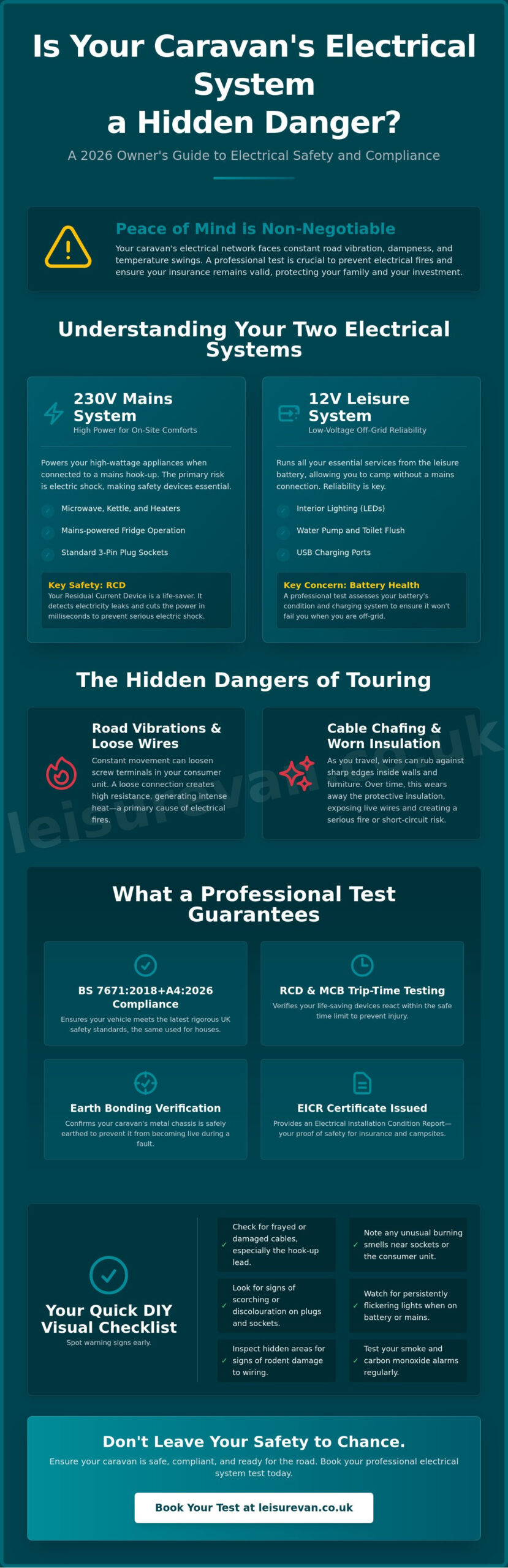
Your DIY Pre-Test Checklist: What to Check Today
Performing your own visual checks can help you prepare for a professional caravan electrical system test and identify urgent issues before they become dangerous. Whilst you should never attempt to dismantle electrical components yourself, your eyes, ears, and nose are excellent diagnostic tools. Rodents often seek shelter in leisure vehicles during storage and find wire insulation particularly appealing. Open your bed boxes and lockers to check for any signs of chewed cables or nesting materials. If you spot exposed copper, don’t plug the vehicle into the mains.
Pay close attention to the area around your sockets and consumer unit. Discolouration or brown scorch marks are clear indicators of overheating. Similarly, a distinct “fishy” smell is a common warning sign of arcing or melting plastic components. You should also walk through the vehicle and test every light switch and 12V outlet. Identifying dead spots now helps you provide a clear list of faults for your engineer. Finally, check the manufacture date on your smoke and carbon monoxide detectors. Most units require replacement every five to seven years to remain reliable.
These simple DIY steps ensure you get the most value from your formal caravan electrical system test by allowing the engineer to focus on technical diagnostics rather than basic maintenance issues. If you spot any of these red flags during your walk-through, you can book a professional electrical system test today to have a qualified engineer verify your vehicle’s safety.
Spotting the Warning Signs of Electrical Failure
Flickering lights are rarely just a loose bulb. They often signal a dying leisure battery or a loose connection in the 12V circuit. You can also perform a “hot plug” test. After running a high-draw appliance like a heater for ten minutes, carefully feel the plug. It should be cool. A hot plug indicates a high-resistance joint that needs immediate attention. Also, listen for unusual buzzing or humming sounds coming from your transformer or fuse box, as this often precedes a component failure. If these symptoms persist, an experienced mobile caravan electrician can diagnose the root cause on-site without the need for a workshop visit.
Organising Your Documentation for the Engineer
Help your engineer work more efficiently by gathering your paperwork in advance. Locate any previous habitation reports or electrical certificates to provide a history of the vehicle’s maintenance. It is also helpful to note down any intermittent faults, such as a fridge that only works occasionally on 12V. Ensure the engineer has clear, unobstructed access to the battery compartment and the consumer unit. Clearing out lockers beforehand saves time and allows for a more thorough physical inspection of the wiring.
Professional Mobile Electrical Testing in South Yorkshire
Finding a reliable specialist for your caravan electrical system test shouldn’t involve the stress of navigating tight workshop entrances or losing your vehicle for days at a time. We bring the expertise directly to you. Whether your caravan is parked on your driveway in Sheffield, at a secure storage plot in Rotherham, or already pitched up for a break in Doncaster, our mobile service ensures minimal disruption to your schedule. This on-site approach allows you to see the testing process firsthand and ask questions about your specific setup whilst we work.
Local knowledge is vital for efficient service. By focusing on the South Yorkshire region, we maintain responsive arrival times and understand the specific needs of owners in Barnsley and the Dearne Valley. When LeisureVan arrives, you can expect a methodical and professional approach. We arrive with calibrated diagnostic equipment designed specifically for leisure vehicle circuits. Many of our clients choose to combine their electrical inspection with a Full Caravan Service or a Caravan Habitation Service. This integrated approach provides better value and ensures every safety-critical system, from gas to damp protection, is checked in a single visit.
Preparation is the key to a stress-free holiday. By booking your 2026 inspection now, you can beat the traditional spring rush and ensure your vehicle is road-ready before the first bank holiday. Our goal is to provide a “safe pair of hands” for your technical needs, allowing you to focus on the journey ahead with total confidence in your equipment.
Serving Sheffield, Barnsley, and Beyond
Our service area extends across the heart of South Yorkshire and into the surrounding districts. We regularly visit clients in Chesterfield and Worksop, providing a professional alternative to fixed-base dealerships. The primary advantage of a mobile service is the elimination of the “towing day.” You don’t have to worry about hitching up and driving through city traffic just for a safety check. We work around your pre-holiday preparations, offering flexible scheduling that respects your time and convenience.
The LeisureVan Guarantee: Peace of Mind on the Move
Transparency is at the core of everything we do. Following your caravan electrical system test, you will receive a detailed digital report. This document is essential for maintaining your service history and can be vital for insurance compliance or future resale value. Beyond the technical data, we provide practical, expert advice. If the test reveals that your battery is nearing the end of its life, or if you are considering Solar Panel Installation to improve your off-grid capacity with the best solar panels for motorhomes UK, we can guide you through the best options for your touring style. You can Book your mobile electrical system test in South Yorkshire today to secure your preferred date and ensure a safe season of touring.
Prepare for a Season of Safe Touring
Your holiday shouldn’t be defined by electrical anxiety or the risk of a roadside breakdown. By understanding the dual-system nature of your vehicle and performing regular visual checks, you’ve already taken the first step toward a safer season. A professional caravan electrical system test is the final piece of the puzzle. It provides the technical validation that DIY inspections cannot, ensuring your RCDs trip correctly and your leisure battery remains a reliable heart for your off-grid adventures.
As a qualified mobile service engineer specialising in the Sheffield, Rotherham, and Doncaster area, I bring technical expertise directly to your driveway or storage plot. You will receive comprehensive digital safety reports that protect your insurance validity and provide complete peace of mind for your family. Don’t leave your safety to chance whilst the 2026 season approaches. Secure your 2026 caravan electrical test with LeisureVan today. We look forward to helping you stay safe on the open road.
Frequently Asked Questions
How often should I have a caravan electrical system test?
You should arrange a formal inspection at least every three years for a touring caravan. Whilst an annual habitation check is recommended for general maintenance, a more rigorous caravan electrical system test provides a deeper audit of the fixed wiring. If you tour frequently on uneven roads or store your vehicle in damp conditions, you might consider more frequent checks to ensure connections remain secure and corrosion-free.
Does a standard habitation check include a full electrical system test?
A standard habitation check is a general health scan and does not include a full electrical audit. Whilst a habitation service checks that your lights and sockets work, it does not involve the technical “dead testing” or RCD timing required for a formal safety certificate. To ensure your wiring is truly safe, you must book a dedicated electrical inspection. This provides a much higher level of scrutiny for your mains and leisure circuits.
Can I perform a caravan electrical test myself if I am good at DIY?
Professional electrical testing is not a DIY task because it requires specialist calibrated equipment and deep technical knowledge. Attempting to test circuits yourself can be dangerous and may lead to electric shocks or accidental fires. Using an unqualified person can also void your insurance policy. A professional engineer ensures your vehicle complies with the latest regulations, providing a level of safety that standard household tools cannot achieve.
What is an EICR and do I need one for my touring caravan?
An EICR stands for Electrical Installation Condition Report and it is the formal document issued after a caravan electrical system test. You need this report to prove your vehicle meets current UK safety standards, specifically BS 7671. Many insurance providers and some premium caravan sites now require a valid EICR to ensure that your 230V and 12V systems are safe for both your family and the site’s infrastructure.
Why does my caravan RCD keep tripping when I plug in at a site?
A tripping RCD is a safety response to a “leak” of electricity to earth, signalling a fault in an appliance or cable. It is often caused by a damp heating element in a kettle or a nick in your hook-up lead. The RCD cuts the power to prevent a fatal shock. If it trips repeatedly, stop using the system until a professional can safely diagnose the underlying fault.
How long does a professional caravan electrical inspection take?
A thorough professional inspection typically takes between two and three hours to complete. This timeframe allows the engineer to test every individual circuit, check the RCD trip times, and inspect all physical connections for wear. If your caravan has complex systems like solar arrays or advanced control panels, it may take slightly longer. We work efficiently to ensure your vehicle is returned to you as quickly as possible without compromising on safety.
Will an electrical test help me identify why my leisure battery keeps dying?
Yes, a professional test is the best way to diagnose chronic battery issues. We examine the charging output from your transformer and the vehicle engine to ensure the battery receives the correct voltage. We also check for parasitic drains, which are hidden electrical loads that pull power whilst the caravan is not in use. This thorough approach identifies whether you simply need a new battery or if a fault is causing the drain.
What happens if my caravan fails its electrical safety test?
If your caravan fails, the engineer will provide a report categorising the issues from C1 (danger present) to C3 (improvement recommended). You must address any C1 or C2 faults immediately to make the vehicle safe for use. Once the remedial work is finished, you will receive a passing certificate. This process ensures that minor issues are rectified before they lead to dangerous fires or expensive component failures.