

A pristine exterior often hides the one thing that can quietly devalue your motorhome by thousands of pounds: undetected damp. Whilst your vehicle might look perfect on the driveway, following a thorough annual motorhome service checklist is the only way to catch hidden issues before they become costly nightmares. We know how frustrating it is to juggle mechanical MOTs with habitation requirements, especially when you’re worried about preserving your warranty or the safety of your gas and electrical systems.
This guide promises to clear up that confusion by outlining exactly what a professional service must include to keep your vehicle legal and safe for 2026. You will discover how to future-proof your motorhome against common failures and ensure your service history remains impeccable for future resale. We will preview the essential safety steps, from damp reports to gas pressure tests, so you can enjoy your travels with complete confidence in your home on wheels.
Key Takeaways
- Protect your manufacturer warranty and vehicle resale value by maintaining a documented, professional service history.
- Use our detailed annual motorhome service checklist to ensure your gas and electrical systems meet the latest safety standards for 2026.
- Identify the warning signs of hidden damp early with professional moisture metering before they cause permanent structural damage.
- Learn why specialist maintenance, such as Alde heating fluid changes, is vital for the longevity of your vehicle’s internal systems.
- Save time and stress by choosing mobile servicing that brings expert technical inspections directly to your home or storage site.
Why an Annual Motorhome Service is Non-Negotiable in 2026
Many owners mistakenly believe that a valid MOT certificate means their motorhome is fully maintained. This is a risky assumption. An MOT only confirms the base vehicle meets minimum road safety standards at the time of testing. It does not inspect the habitation area where you eat, sleep, and live. Following a professional annual motorhome service checklist bridges this gap. It ensures the complex systems that make your vehicle a home are operating safely and efficiently.
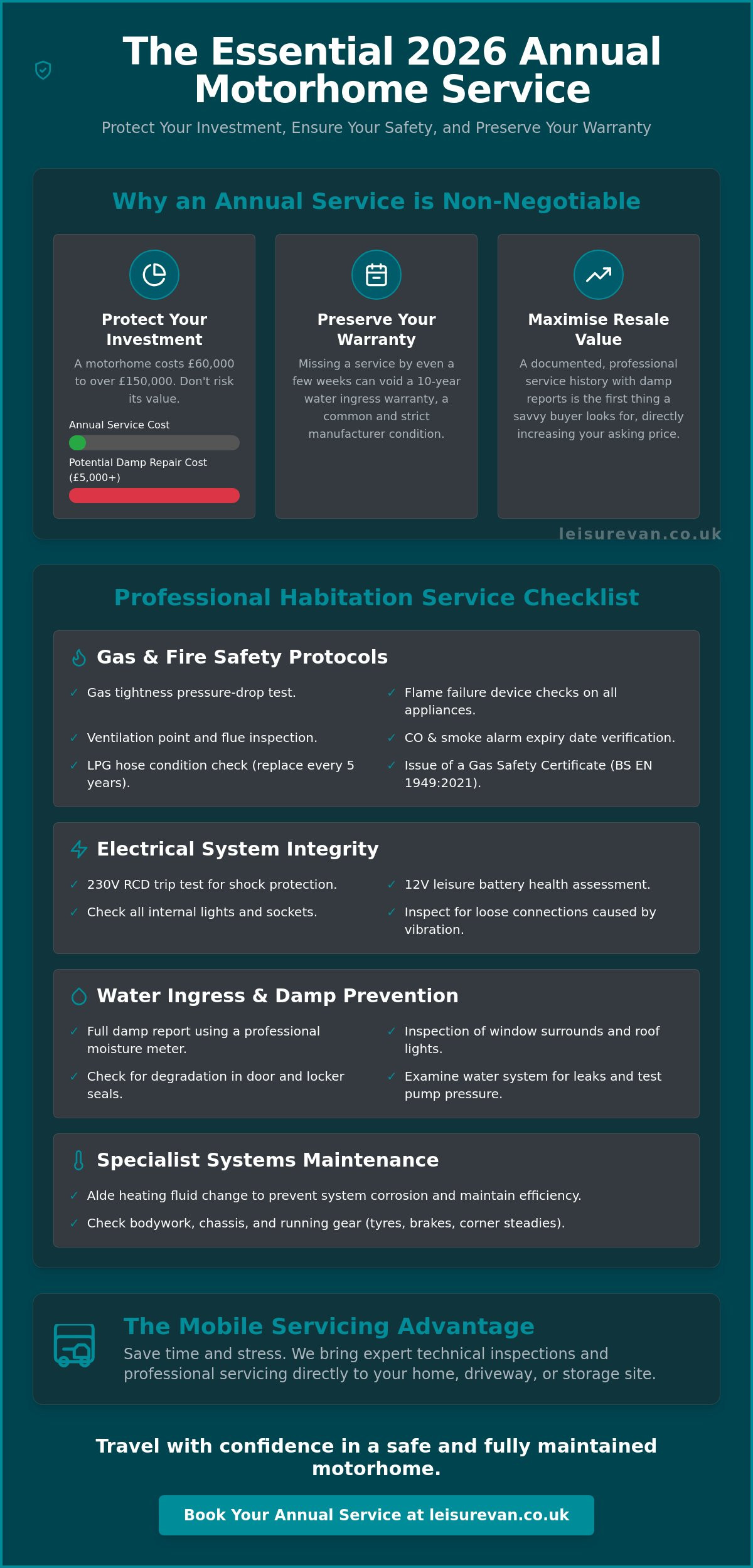
Skipping your annual check is a significant financial risk. Modern motorhomes are substantial investments, often costing between £60,000 and over £150,000. Whilst a habitation service is a modest annual expense, ignoring it can lead to damp issues that require repairs exceeding £5,000. Most manufacturers are incredibly strict about warranty conditions. If you miss a scheduled service by even a few weeks, you may find your 10-year water ingress warranty is voided instantly. A proactive approach saves your bank balance and protects the structural integrity of your vehicle for years to come.
Protecting Resale Value in the UK Market
A full service history is the first thing a savvy buyer looks for. In the UK’s competitive second-hand market, a documented record of care is essential for a quick sale. Buyers specifically want to see a recent motorhome damp check before buying to ensure they aren’t inheriting a vehicle with hidden structural rot. Your service book acts as a historical record of your diligence. It proves you have prioritised maintenance, which directly translates into a higher asking price when you decide to upgrade your model.
Insurance and Legal Compliance
Most insurance policies include “roadworthy” clauses that require you to maintain your vehicle to a high standard. Failing to do so could complicate a claim if a fire or gas-related accident occurs. Beyond insurance requirements, there is the matter of family safety. A professional service includes a Gas Safety Certificate, verifying that your LPG systems meet recognised standards such as BS EN 1949:2021. Adhering to a comprehensive vehicle service schedule and your annual motorhome service checklist ensures your vehicle meets 2026 UK road safety standards. This methodical approach gives you the peace of mind to enjoy your travels without worrying about system failures.
The Professional Habitation Service Checklist: Your Living Space
The habitation area is the heart of your touring experience, but it is also the most complex part of your vehicle to maintain. Whilst your vehicle’s roadworthiness is governed by official MOT inspection standards, those rules don’t cover the safety of your internal living systems. A comprehensive annual motorhome service checklist focuses on the technical integrity of your gas, water, and electrical circuits to ensure your family remains safe whilst off-grid or on-site.
Gas safety is the most critical element of any inspection. Engineers perform a detailed audit of the LPG system, checking that flame failure devices on your hob, oven, and fridge trigger correctly to prevent gas build-up. We also examine ventilation points to ensure they aren’t obstructed, as adequate airflow is vital for preventing carbon monoxide poisoning. Beyond the appliances, the physical structure of your motorhome requires attention. We inspect window surrounds, roof lights, and door apertures for signs of seal degradation. Catching a perished seal early prevents water from reaching the internal wall board, saving you from the structural rot discussed in the previous section.
Gas and Fire Safety Protocols
A gas tightness test is a professional pressure-drop assessment designed to verify that the entire LPG circuit, from the regulator to the appliance nozzles, is free from leaks. We also verify the expiry dates on your carbon monoxide and smoke alarms; these sensors have a finite lifespan and must be replaced to remain effective. Gas hoses are checked for signs of cracking or “alligatoring,” as these rubber components typically require replacement every five years to meet safety standards.
Electrical System Integrity
Road vibrations can easily loosen electrical connections over time, leading to intermittent faults or even fire risks. We test the 230V RCD (Residual Current Device) to ensure it trips within the required milliseconds, protecting you from electric shocks. On the 12V side, we assess your leisure battery health and the output of your charging circuits. With modern solar panels now reaching efficiencies of up to 25%, verifying that your solar regulator is delivering the correct voltage is essential for battery longevity. For a more technical breakdown of these safety tests, you can refer to our guide on the motorhome electrical installation condition report.
Water systems also undergo a rigorous check during the service. We test the water pump’s performance and inspect tap seals for leaks that could cause dampness under cupboards. Finally, we recommend waste tank sanitisation to remove biofilm and odours that accumulate during the touring season. If you haven’t had these systems checked recently, it’s easy to request a professional habitation assessment to ensure your next trip is trouble-free.
Chassis and Mechanical Maintenance: Ensuring Roadworthiness
Whilst the habitation check ensures your living space is safe, the mechanical components of your vehicle require equal attention. A thorough annual motorhome service checklist must include a comprehensive chassis inspection to maintain roadworthiness and prevent mechanical failure. Unlike a typical family car, a motorhome carries its maximum authorised mass almost constantly. This weight places significant stress on the braking system, suspension, and tyres, making regular professional oversight essential for safe touring. Our motorhome servicing prioritises these high-stress areas to keep you moving without interruption.
Braking systems are especially prone to issues if the vehicle isn’t used frequently. We check for seized calipers and uneven pad wear, ensuring your stopping power is consistent and reliable. Tyre health is another area where motorhomes differ from standard vehicles. Tyres often “age out” before they “wear out” due to UV degradation and sidewall cracking. We check the DOT codes to verify age and inspect for bulges that could lead to a dangerous high-speed blowout. Lubricating moving parts, such as corner steadies and chassis grease points, prevents them from becoming stiff or inoperable; this simple step ensures your setup on-site is always effortless.
The “Idle Vehicle” Syndrome
Low mileage doesn’t guarantee a healthy motorhome. In fact, vehicles that sit for months often develop more issues than those in regular use. Condensation can build up in the engine oil, whilst coolant can lose its anti-corrosive properties over time. We check all fluid levels and quality to ensure your engine remains protected during long periods of inactivity. To prevent tyre flat-spots, it’s helpful to move the vehicle periodically or adjust tyre pressures for winter storage. We also ensure the handbrake mechanism remains free and functional, as these can easily bind when left engaged for months at a time.
Under-Vehicle Inspection
The underside of your motorhome is constantly exposed to road salt and moisture, which can lead to rapid corrosion. We inspect the chassis and exhaust system for structural integrity and early signs of rust. Road springs and shock absorbers are checked for leaks or fractures, which are common given the constant load these vehicles carry. Finally, we verify the condition of the spare wheel carrier and the spare tyre itself. There is nothing more frustrating than needing your spare only to find the carrier mechanism is rusted solid or the tyre is flat.
Specialist Systems: Alde Heating, Solar, and Damp Detection
Modern motorhomes are increasingly reliant on sophisticated technology to provide off-grid comfort. Whilst basic checks cover the essentials, a truly comprehensive annual motorhome service checklist must include specialist systems like hydronic heating and solar arrays. These components require specific technical knowledge and tools that go beyond a standard visual inspection. For instance, solar panel efficiency can drop significantly if the mounting brackets are loose or the charge controller isn’t calibrated correctly. We also check air conditioning units, ensuring filters are clean and refrigerant levels are sufficient to keep you cool during summer tours. Neglecting these high-end features can turn a luxury getaway into a frustrating experience.
The Importance of Alde Glycol Changes
The Alde hydronic system relies on a mixture of water and glycol to heat your vehicle. Over time, this fluid loses its anti-corrosive properties and becomes acidic. If left unchanged, it can corrode your boiler and aluminium pipework from the inside out, leading to catastrophic system failure. Most systems use either blue glycol, which requires a change every two years, or magenta (long-life) glycol, which lasts for five. Performing this task isn’t as simple as a drain and fill; it requires specialist pumping equipment to ensure no airlocks remain in the complex network of radiators. If you’re unsure which fluid your system currently uses, you can book an Alde system health check to protect your heating circuit.
Professional Damp Inspections
Damp is the single biggest threat to a coachbuilt motorhome’s longevity in the UK climate. Our engineers use professional moisture meters to identify water ingress before it becomes visible to the naked eye or develops a musty smell. We pay particular attention to “danger zones,” such as the junctions where the roof meets the side walls and the areas around the wheel arches. When you receive your report, the percentages indicate the moisture content within the wall board. Anything under 15% is considered dry, whilst readings over 20% require immediate investigation to prevent structural rot. For more advice on keeping your vehicle dry between services, read our guide on preventing damp in a motorhome. Catching these issues early as part of your annual motorhome service checklist is the only way to avoid the five-figure repair bills mentioned earlier in this guide.
The Mobile Advantage: Professional Servicing at Your Doorstep
Driving a seven-metre motorhome through the congested streets of Sheffield or Leeds is a task most owners dread. Navigating tight corners and busy industrial estates just to reach a fixed workshop adds unnecessary stress to your maintenance routine. Mobile servicing eliminates this logistical headache by bringing the workshop to you. Whether your vehicle is parked on your driveway or at a secure storage facility, a mobile engineer provides a level of convenience that fixed centres simply cannot match. You stay in control of your day whilst we ensure your vehicle remains in peak condition.
Transparency is a core benefit of the mobile approach. When an engineer follows an annual motorhome service checklist on your property, you have the unique opportunity to see exactly what is being tested. You can ask questions about your solar panel efficiency or observe the damp testing process in real-time. This direct interaction builds a level of trust that’s often missing in large dealerships. A mobile specialist acts as a dependable guide, offering personalised advice based on how you specifically use and store your vehicle throughout the year.
Mobile Service vs. Workshop: A Comparison
Fixed workshops often juggle multiple vehicles across several bays, which can lead to a rushed environment. Mobile engineers typically have lower overheads and focus on one vehicle at a time, meaning more thorough attention is paid to every detail of your service. You also avoid the “follow car” routine. Normally, dropping off a motorhome requires a second driver to collect you or a long wait for public transport. Mobile servicing removes these extra steps, allowing you to carry on with your day at home whilst the work is completed to the highest standards.
Booking Your 2026 Service in South Yorkshire
Preparing for a mobile visit is straightforward and ensures the engineer can work efficiently. We recommend leaving at least one metre of clear space around the entire vehicle so all external lockers and seals can be inspected easily. It’s also vital to ensure your leisure battery has sufficient charge for electrical testing and that there’s enough gas in your bottles to test appliance functionality. If your motorhome is in a South Yorkshire storage site, please verify that they allow on-site servicing; most professional facilities are happy to accommodate mobile specialists during the quieter off-season months.
Securing your vehicle’s safety and warranty doesn’t have to be a chore. You can book your mobile motorhome habitation service today and enjoy the peace of mind that comes with a professional, at-home inspection. By completing your annual motorhome service checklist now, you’ll be ready to hit the road the moment the 2026 touring season begins.
Ready Your Motorhome for the 2026 Touring Season
Maintaining your vehicle is about more than just ticking boxes; it’s about ensuring every trip is safe and every pound invested is protected. By following a professional annual motorhome service checklist, you’ve taken the most important step in preventing hidden damp and mechanical failures. We’ve explored how habitation checks, chassis maintenance, and specialist care for solar or Alde systems work together to keep your home on wheels in peak condition for years to come.
As a qualified mobile service engineer, I bring technical expertise directly to your driveway in Sheffield, Rotherham, and throughout South Yorkshire. We use specialist Alde heating fluid change equipment to ensure your hydronic system remains efficient and free from internal corrosion. Don’t wait for a small issue to become a major repair bill during your summer holiday. You can Book Your 2026 Professional Mobile Service Now to secure your preferred date and maintain your warranty. We look forward to helping you enjoy another year of trouble-free adventures on the open road.
Frequently Asked Questions
How long does a full motorhome habitation service take?
A comprehensive motorhome habitation service typically takes between three and four hours to complete. This timeframe allows the engineer to meticulously work through the annual motorhome service checklist, ensuring every gas connection, electrical circuit, and water seal is thoroughly inspected. We prioritise accuracy over speed to ensure no hidden faults are overlooked during the assessment.
Can I stay in my motorhome whilst it is being serviced?
You cannot stay inside the vehicle whilst the service is being performed. The engineer requires unrestricted access to all internal lockers, floor hatches, and under-seat storage areas to conduct safety tests and damp inspections. For your own safety, it’s also necessary to remain outside whilst gas pressure and electrical RCD tests are being conducted.
Does a habitation check include an engine service?
A habitation check does not include a mechanical engine service as standard. These are two distinct types of maintenance. The habitation service focuses on the living area’s safety and functionality, whilst an engine service addresses the vehicle’s mechanical reliability. We recommend booking both annually to ensure your vehicle is fully maintained from bumper to bumper.
What happens if damp is found during the inspection?
If damp is detected, we will provide you with a comprehensive report highlighting the specific moisture percentages and the affected areas. Early detection usually means the issue can be resolved with simple resealing before structural damage occurs. We will discuss the results with you immediately to help you decide on the best course of action for repairs.
Do I need a separate gas safety certificate for my motorhome?
A professional habitation service includes a gas tightness test and appliance check, which results in a documented safety report. Whilst not a legal requirement for private use in the same way as a landlord’s certificate, it is essential for insurance compliance and your family’s safety. This report confirms your LPG system is leak-free and your appliances are functioning correctly.
Is a mobile motorhome service as thorough as a workshop service?
A mobile service is every bit as thorough as one conducted in a fixed workshop. We follow the same annual motorhome service checklist and use the same calibrated moisture meters, gas leak detectors, and technical protocols. The primary difference is the convenience of having the work completed at your home or storage site without the stress of driving to a service centre.
How often should I have my Alde heating fluid changed?
You should change your Alde heating fluid every two years if it contains blue glycol, or every five years for magenta long-life fluid. This prevents the mixture from becoming acidic and corroding the internal components of your heating system. Regular changes are vital for maintaining the manufacturer’s warranty and ensuring the longevity of your boiler.
Will a professional service help with my motorhome insurance premium?
Maintaining a valid service history can help ensure your insurance remains valid. Most insurers require the vehicle to be kept in a “roadworthy” condition. Having a documented service history proves you have been proactive with maintenance, which is often vital if you ever need to make a claim for fire, gas, or water damage.