
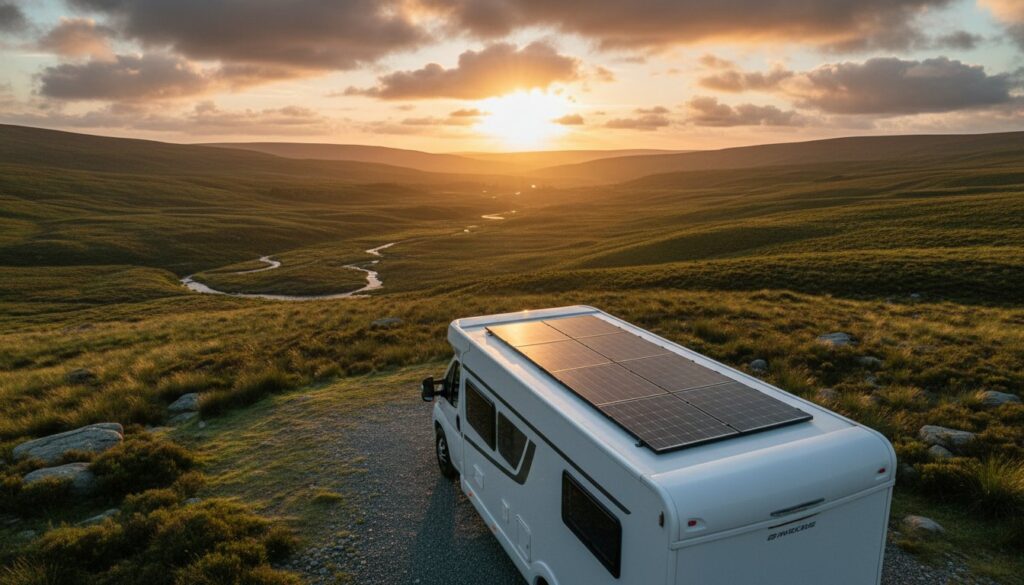
What if you could stop paying rising campsite electric hook-up fees and finally achieve total off-grid freedom? We know that the constant anxiety of battery depletion can ruin a trip, especially when you’re relying on your fridge and tech whilst parked up in the unpredictable British weather. Finding the best solar panels for motorhomes uk is no longer just about picking the highest wattage; it’s about building a dependable system that works even when the sun stays behind the clouds.
This 2026 guide will show you how to build a reliable power setup that provides genuine peace of mind for every journey. You’ll discover why high-efficiency monocrystalline panels and MPPT controllers are the gold standard for modern adventurers. We also preview the latest trends in lithium (LiFePO4) batteries and explain how professional installation ensures your system complies with BS 7671 safety standards. With the current 0% VAT rate on energy-saving installations available until March 2027, there’s never been a more logical time to secure your energy independence and enjoy the quiet of the wild without compromise.
Key Takeaways
- Learn how to design a self-sustaining power loop that maintains your leisure battery health even during overcast British winters.
- Compare the latest monocrystalline and flexible technologies to select the best solar panels for motorhomes uk for your specific roof layout.
- Master the step-by-step ‘Power Audit’ to accurately calculate your daily wattage requirements and avoid unexpected battery depletion.
- Understand why an MPPT charge controller is a vital component for maximising energy harvest in the variable UK climate.
- Discover the safety benefits of professional installation for protecting your vehicle’s habitation warranty and ensuring long-term system reliability.
Understanding Motorhome Solar Power in the UK
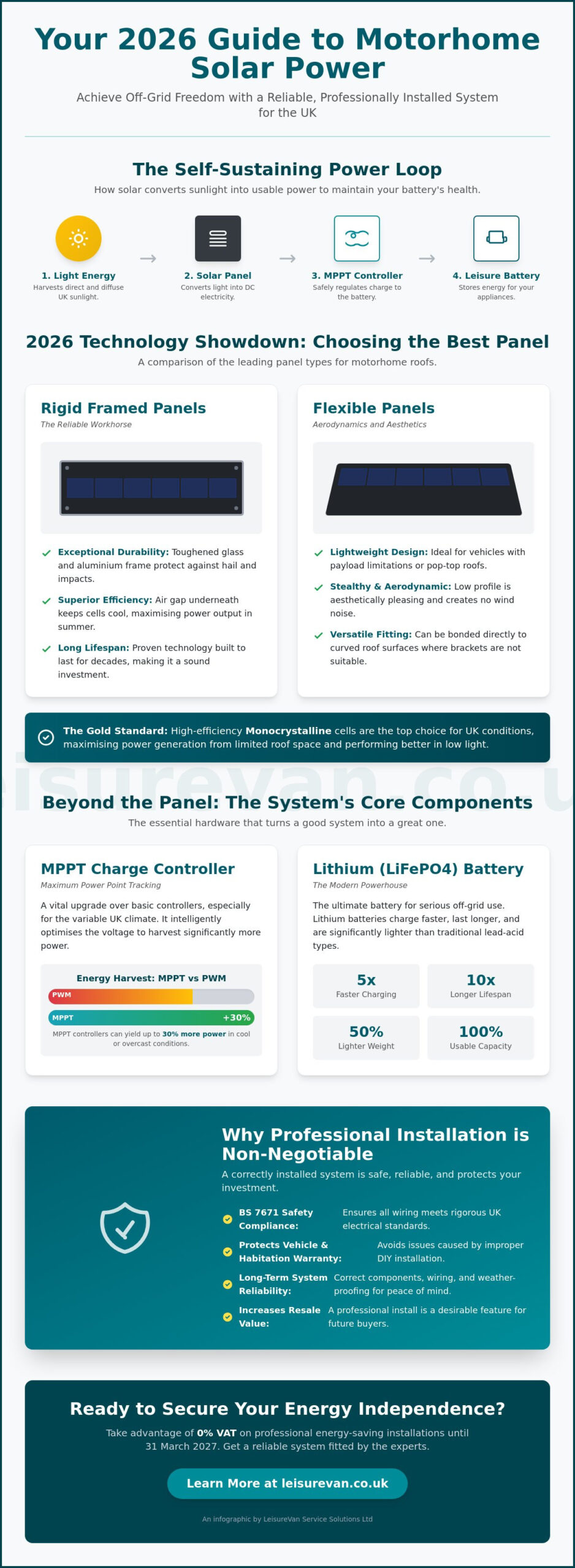
Solar power for your motorhome is more than just a luxury accessory; it’s a self-sustaining loop designed to preserve the life of your leisure battery. By constantly trickling charge into your system, solar prevents the deep discharge cycles that often lead to premature battery failure. In 2026, finding the best solar panels for motorhomes uk means looking for setups that can handle our specific light conditions. Modern high-efficiency cells ensure that even when you aren’t parked on a sunny beach, your appliances remain powered and your batteries stay healthy.
The financial case for independence is stronger than ever. With the 0% VAT rate on the installation of energy-saving materials remaining in place until 31 March 2027, professional solar fitting is a cost-effective upgrade for those who use their vehicles frequently. This incentive, combined with the avoidance of rising daily electric hook-up (EHU) fees, allows the system to eventually pay for itself through saved touring costs. It’s a move that reduces your environmental footprint whilst granting you the freedom to explore the quietest corners of the British countryside.
A reliable off-grid setup functions as a complete ecosystem. It begins with the photovoltaic system on your roof, which converts light into DC electricity. This energy flows through a charge controller to ensure the battery is charged safely without the risk of overcharging. Finally, the energy is stored in your leisure battery, with a monitoring system providing real-time data on your power reserves. Every component must work in harmony to provide a safe, dependable power source.
How UK Weather Affects Solar Performance
British weather is famously unpredictable, but you don’t need a cloudless sky to generate power. Modern panels are designed to harvest “diffuse” light, which is the light that filters through cloud cover. While your output will naturally be lower during the winter months, a well-sized system remains essential for battery maintenance. It prevents self-discharge during storage. This ensures your vehicle is ready to go the moment you are, without the frustration of a flat battery after a few weeks of inactivity.
The Rise of Off-Grid Independence in 2026
The trend towards independent touring has accelerated. Owners now demand reliable power for fridges, laptops, and tech without the tether of a cable. Integrating solar with modern lithium (LiFePO4) batteries has changed the game; these batteries can accept charge much faster and more efficiently than traditional lead-acid versions. Beyond the personal freedom, a professionally fitted solar system increases the resale value of your motorhome. It signals to future buyers that the vehicle is a “safe pair of hands” and is fully equipped for modern off-grid adventures.
Comparing the Best Solar Panel Types for 2026
Choosing the right technology is the foundation of a successful off-grid system. In 2026, monocrystalline panels have firmly established themselves as the industry standard for those seeking the best solar panels for motorhomes uk. They offer significantly higher efficiency rates compared to older polycrystalline versions. This is critical for motorhomes; roof space is a finite resource and you need to maximise every square centimetre. To get the most out of your setup, modern systems often utilise shingled cell technology. This breakthrough allows the panel to continue producing power even when partially shaded by a TV aerial or a nearby tree. It’s a significant leap forward for touring in the UK, where perfect, unobstructed sun is rarely guaranteed.
While roof-mounted systems provide constant charging, some owners also carry portable “suitcase” panels. These are ideal if you prefer to park your vehicle in the shade to keep the cabin cool whilst placing the portable panel in a sunny spot nearby. For a deeper look at how solar technology has evolved to meet modern energy demands, this Energy Saving Trust guide to solar panels provides excellent context on efficiency and long-term value for British users.
Rigid Framed Panels: The Reliable Workhorse
These panels are the traditional choice for a reason. They feature toughened glass and a sturdy aluminium frame, making them incredibly durable against UK hailstorms or low-hanging branches. One major advantage is the air gap created by mounting brackets. This allows air to flow beneath the panel, which keeps the cells cool and maintains high efficiency during the summer. You can choose between standard Z-brackets for maximum airflow or aerodynamic spoilers that reduce wind noise whilst driving. They are a “safe pair of hands” for any long-term installation.
Flexible Panels: Aerodynamics and Aesthetics
If you’re conscious of your vehicle’s 3,500kg weight limit, flexible panels are an attractive alternative. They’re significantly lighter and can be bonded directly to the roof, maintaining a sleek, aerodynamic profile. This makes them a popular choice for curved campervan roofs where a rigid frame simply won’t fit. However, they require careful installation. Because they lack an air gap, they can suffer from heat build-up. This can reduce their lifespan if high-quality adhesives and proper thermal management aren’t used during the fitting process.
Selecting the best solar panels for motorhomes uk depends on your specific vehicle and how you plan to travel. If you’re unsure which setup fits your needs, a professional solar panel installation can ensure your system is safe, efficient, and tailored to your touring style.
Sizing Your System: Calculating Your Daily Wattage
Sizing a solar system is a methodical process. It requires an honest look at your daily energy habits. To find the best solar panels for motorhomes uk for your specific needs, you must first conduct a comprehensive power audit. This involves listing every appliance you use and estimating how many hours they run each day. It’s a vital step for achieving true off-grid independence. For those new to the concept, this beginners guide to motorhome solar panels offers a helpful starting point for understanding how these components interact to keep your vehicle powered.
The “Summer vs Winter” gap in the UK is significant and must be accounted for in your strategy. During a bright July day, a solar array might produce its full rated output for several hours. In the depths of December, that same system might only see an hour of weak, usable light. This is why we recommend a minimum of 150W to 200W for modern motorhomes in 2026. This higher baseline provides a necessary buffer during overcast days. It ensures your leisure battery stays topped up even when the weather isn’t cooperating. Your battery capacity, measured in Amp-hours (Ah), acts as your reservoir. A larger battery allows you to store excess energy on sunny days to use when the clouds roll in, providing true peace of mind.
Common Appliance Power Draws
Understanding your draws helps you size your array correctly. Modern LED lighting and water pumps are relatively efficient, but other systems require more support. A 12V compressor fridge is often the largest constant draw, frequently consuming 30Ah to 40Ah per day. If you tour in winter, your Alde heating system’s circulation pump will also pull power from the battery. A well-planned solar setup ensures these essential systems don’t leave you in the dark or without heat. By matching the best solar panels for motorhomes uk to these specific draws, you protect the longevity of your equipment.
- LED Lighting: 0.5 – 1.0 Amps per hour
- Water Pump: 3.0 – 5.0 Amps (used in short bursts)
- 12V Compressor Fridge: 1.5 – 3.0 Amps (cycling on and off)
- TV and Satellite systems: 2.0 – 4.0 Amps
The ‘Rule of Three’ for UK Sizing
A simple way to estimate production is the ‘Rule of Three’. On average, a panel in the UK will produce roughly three times its rated wattage in Amp-hours during a typical summer day. For example, a 150W panel might yield 45Ah. However, you must account for system losses in cabling and controllers, which can reduce efficiency by 10% to 20%. In 2026, the smart move is to over-size your solar array. If your roof space allows, fitting more wattage than you strictly need provides a safety net for those weeks when the British sun is nowhere to be seen.
Essential Components: More Than Just the Panels
The best solar panels for motorhomes uk are only as effective as the components supporting them. While the panels capture the energy, the rest of the system ensures that power is delivered safely and efficiently to your battery. High-quality cabling is a priority often overlooked. Using undersized wires causes “voltage drop,” which means the energy harvested on your roof never actually reaches your leisure battery. To prevent this, professional installations use thick, UV-stable cables that minimise resistance and maximise harvest. Safety is equally paramount. Every reliable system requires a properly rated fuse between the panel and the controller, and another between the controller and the battery. An isolation switch is also a sensible addition, allowing you to safely disconnect the array during maintenance or storage.
For those running complex systems, such as an Alde heating system, solar is vital for maintaining the circulation pump whilst off-grid. A well-designed system ensures your heating remains operational without draining your reserves, even in the colder months. If you are concerned about your current power levels or the health of your wiring, a professional caravan electrical system test can identify any weaknesses in your setup before you head off on your next trip. Modern monitoring has also moved to the palm of your hand. Smart shunts and Bluetooth-enabled components now allow you to track your exact state of charge, solar input, and power consumption via your smartphone, removing the guesswork from off-grid touring.
Smart Charging Controllers
In the variable British climate, a Maximum Power Point Tracking (MPPT) controller is non-negotiable. Unlike older Pulse Width Modulation (PWM) technology, MPPT controllers can harvest up to 30% more energy by constantly adjusting to the panel’s optimal voltage. This is especially beneficial on overcast days when every watt counts. Modern controllers from brands like Victron Energy now offer 2026 smart-app integration. This provides real-time data and historical logs of your system’s performance. These devices also provide multi-stage charging, which tailors the flow of electricity to the specific needs of your battery, significantly prolonging its overall lifespan.
Battery Compatibility: Lead Acid vs AGM vs Lithium
Your choice of storage dictates how your solar controller should be configured. Traditional lead-acid and AGM batteries have specific charging profiles that must be matched to the controller settings to avoid internal damage. Solar is particularly useful for AGM batteries during long periods of storage, as it provides a constant trickle charge that prevents the battery from falling into a deep discharge state. However, Lithium (LiFePO4) batteries are the ideal partner for high-output solar. They can accept a much higher rate of charge and offer a deeper depth of discharge. This synergy allows you to run high-draw appliances with confidence, knowing your solar array will replenish the battery efficiently.
Professional Installation: Protecting Your Vehicle and Warranty
Choosing the best solar panels for motorhomes uk is only the first step towards energy independence. The way those panels are attached to your roof and integrated into your electrical system determines the long-term safety and value of your vehicle. A DIY approach might seem cost-effective initially, but it often leads to complications that far outweigh the savings. Improperly sealed cable entries are a primary cause of water ingress, which can lead to expensive structural damage and damp issues. Many insurance providers now require proof of professional installation to maintain your coverage. By choosing an expert fitting, you protect your habitation warranty and ensure that every connection meets the BS 7671 electrical safety standards. Before any solar work begins, it is worth arranging a thorough caravan electrical system test to confirm your existing 12V and 230V circuits are in good health and fully compliant with current standards.
Professional fitting also ensures that your system is balanced. If your solar array isn’t correctly fused or if the wire gauges are insufficient, you risk electrical fires or system failure. When a specialist handles the work, they use industry-standard components that are designed to withstand the vibrations and temperature fluctuations of life on the road. This technical precision provides a level of security that a home-build simply cannot match. It gives you the peace of mind that your “safe pair of hands” has handled the complex wiring and roof bonding correctly.
The LeisureVan Mobile Advantage
We understand that taking your vehicle to a workshop can be a logistical headache. We solve this by providing a fully mobile service across Sheffield, Rotherham, Doncaster, Barnsley, and throughout South Yorkshire. We come directly to your home or storage centre to carry out the work at your convenience. Our meticulous approach includes the use of high-quality waterproof glands and strategic cable routing to ensure a neat, leak-proof finish. Because we also specialise in electrical system testing, we verify that your solar array interacts perfectly with your existing onboard electronics and charging circuits.
Ensuring Long-Term Reliability
Reliability comes from thoroughness, not just the quality of the panels. Every installation we perform concludes with a full system test and a comprehensive handover. We explain exactly how your new setup works and how to monitor your power levels via your smartphone or display panel. We also recommend a post-installation damp inspection and report to confirm that the roof integrity remains uncompromised. This proactive care is what makes us a trusted partner for motorhome owners. A professional solar fitting also integrates seamlessly with your annual motorhome habitation service, keeping your vehicle in peak condition for years of off-grid touring.
Book your professional solar installation with LeisureVan today and start your journey towards true off-grid independence with complete confidence.
Secure Your Off-Grid Independence
Achieving true freedom on the road requires more than just high-wattage hardware. It demands a system where high-efficiency monocrystalline cells, intelligent MPPT controllers, and robust leisure batteries work in perfect harmony. By selecting the best solar panels for motorhomes uk and pairing them with professional installation, you eliminate the risks of water ingress or electrical faults. This methodical approach protects your habitation warranty whilst ensuring your appliances stay powered throughout the British seasons.
Our qualified mobile service engineers are specialists in complex electrical systems and Alde heating integration. We bring this technical expertise directly to your home or storage centre in Sheffield, Doncaster, and across South Yorkshire. This professional service provides the “safe pair of hands” your vehicle deserves. With the 0% VAT rate on installations available until 31 March 2027, it’s a logical time to invest in your vehicle’s future value and your own touring comfort.
Get a Quote for Professional Solar Installation
Take the first step towards silent, reliable power today. We look forward to helping you reach your off-grid goals with confidence and ease.
Frequently Asked Questions
Do solar panels work on cloudy days in the UK?
Yes, solar panels generate electricity on cloudy days by capturing diffuse light. While the output is lower than in direct sunlight, the best solar panels for motorhomes uk are designed with high-efficiency monocrystalline cells to maximise energy harvest in overcast conditions. This ensures a steady trickle charge to your leisure battery even when the British weather is less than ideal.
Can I run my motorhome air conditioning from solar panels?
Running air conditioning purely from solar is technically possible but practically challenging due to the high power draw. Most air con units require a significant amount of energy that often exceeds what standard roof-mounted panels can provide in real-time. You would typically need an extensive solar array and a substantial lithium battery bank with a powerful inverter to make this viable for short periods.
Will installing solar panels void my motorhome’s warranty?
Professional installation generally ensures your motorhome’s warranty remains intact. Manufacturers and insurance companies often require that electrical work and roof modifications are performed by qualified engineers. This prevents issues like water ingress or electrical faults that could void your habitation warranty if attempted as a DIY project. A professional fitting provides a safe pair of hands for your vehicle.
What is the difference between a solar regulator and a charge controller?
There is no difference between a solar regulator and a charge controller; these terms are used interchangeably within the industry. Both devices perform the essential task of managing the flow of electricity from the panels to the battery. They prevent overcharging and ensure the voltage is at the correct level for your specific battery type, whether you use lead-acid, AGM, or Lithium technology.
How do I clean and maintain my motorhome solar panels?
Maintenance is straightforward and involves keeping the panels free from dust, bird droppings, and green algae. You should clean them using plenty of water and a soft brush or cloth to avoid scratching the glass surface. It’s also sensible to check the mounting brackets and waterproof glands during your annual habitation service to ensure everything remains secure and leak-free for the long term.
Do I need to change my leisure battery when I install solar?
You don’t always need to change your battery, but upgrading can often improve your system’s overall efficiency. If your current lead-acid battery is old, it may not hold the charge provided by your new panels effectively. Moving to a Lithium (LiFePO4) battery allows you to store more energy and use it more deeply, making the most of the best solar panels for motorhomes uk.
How much does it cost to have solar panels professionally fitted in the UK?
The cost of professional solar fitting varies depending on the complexity of the system and the specific panels chosen. Factors such as the number of panels, the type of charge controller, and the routing of cables all influence the final requirement. We recommend contacting a specialist for a tailored quote that reflects your specific vehicle needs and touring style to ensure you get a reliable, safe installation.
Can solar panels charge my engine battery as well as the leisure battery?
Yes, solar panels can charge your engine battery if you install a dual-output charge controller or a specialised split-charge system. This is a popular setup for motorhome owners because it ensures the vehicle’s starter battery remains topped up during long periods of storage. It provides peace of mind that your engine will start reliably after a long stay at an off-grid location.