
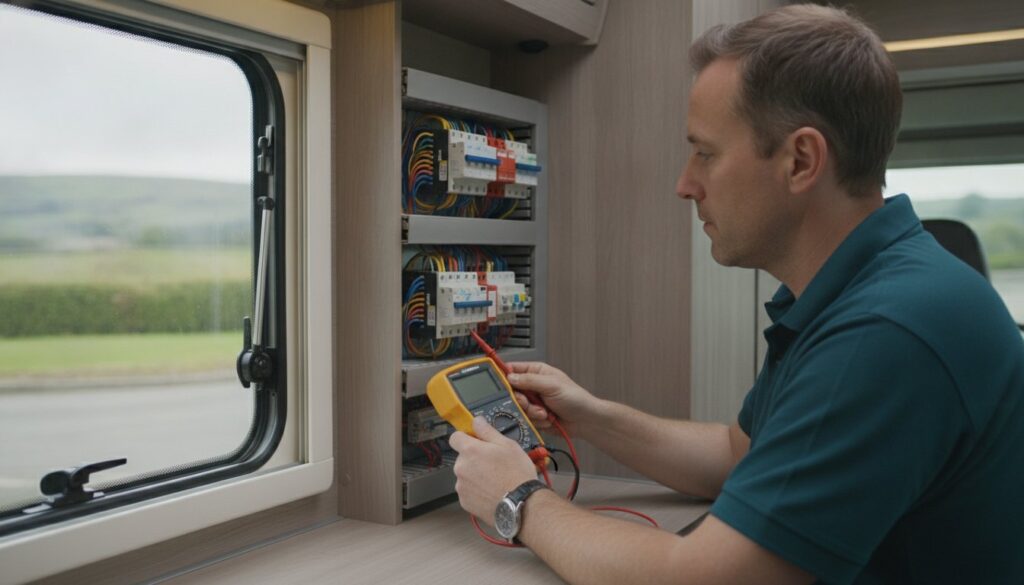
A motorhome is not just a leisure vehicle; it’s a complex electrical environment subjected to constant mechanical stress and vibration every time you drive. While most owners diligently book an annual habitation service, many are surprised to learn that these checks often overlook the deeper health of the 230v mains system. It’s understandable to feel a sense of unease regarding hidden electrical fire risks or the validity of your insurance policy if a fault occurs. You want to know that your family is safe and your investment is protected whilst you’re enjoying the open road.
This guide explains why a professional motorhome electrical installation condition report is a vital safeguard for your vehicle. We’ll clarify the confusion between different testing types and show you how a specialised inspection provides the peace of mind that a standard check cannot. You’ll discover the latest requirements under the BS 7671:2018+A4:2026 standards, the specific risks caused by vehicle movement, and exactly what happens when an expert technician evaluates your system’s integrity.
Key Takeaways
- Understand why a standard habitation service is often insufficient for detecting hidden wiring faults caused by constant road vibrations and mechanical stress.
- Learn how a motorhome electrical installation condition report provides a rigorous technical evaluation of your 230v mains system that basic visual checks cannot match.
- Identify the hidden fire risks that can develop whilst your vehicle is in transit and how professional testing helps maintain your insurance validity.
- Prepare for a professional inspection by understanding the typical 2 to 4-hour timeframe and the specific internal access your engineer will require.
- Discover the benefits of a mobile service that brings technical expertise directly to your driveway, saving you the time and fuel of visiting a service centre.
Understanding the Motorhome Electrical Installation Condition Report (EICR)
A motorhome electrical installation condition report is a comprehensive technical assessment of your vehicle’s 230v mains system. Whilst many owners are familiar with the term EICR, industry professionals often refer to it as a Periodic Inspection Report, or PIR. This isn’t a simple visual check. It’s a rigorous audit designed to identify damage, deterioration, and potential defects that could lead to electrical fires or shocks. By evaluating the system against the latest safety standards, it provides a clear picture of whether your installation is safe for continued use.
Unlike a basic habitation check, an EICR involves the use of specialised testing equipment to verify circuit integrity. The inspection covers several critical areas:
- Verifying that protective bonding and earthing are adequate.
- Checking for any wear and tear that could cause a short circuit.
- Testing the effectiveness of Residual Current Devices (RCDs) to ensure they trip during a fault.
- Identifying any overloaded circuits that might pose a fire risk.
What is a Motorhome EICR?
This report is a formal document issued after a qualified engineer has performed a deep-dive assessment of your vehicle’s electrical infrastructure. It focuses specifically on the ‘habitation’ side of the motorhome, ensuring the consumer unit, sockets, and hidden wiring are fit for purpose. The engineer uses high-voltage testing tools to see “inside” the cables, spotting issues that are invisible to the naked eye. In 2026, the motorhome EICR stands as the gold standard for verifying electrical safety and protecting your leisure investment.
Is it a Legal Requirement for UK Owners?
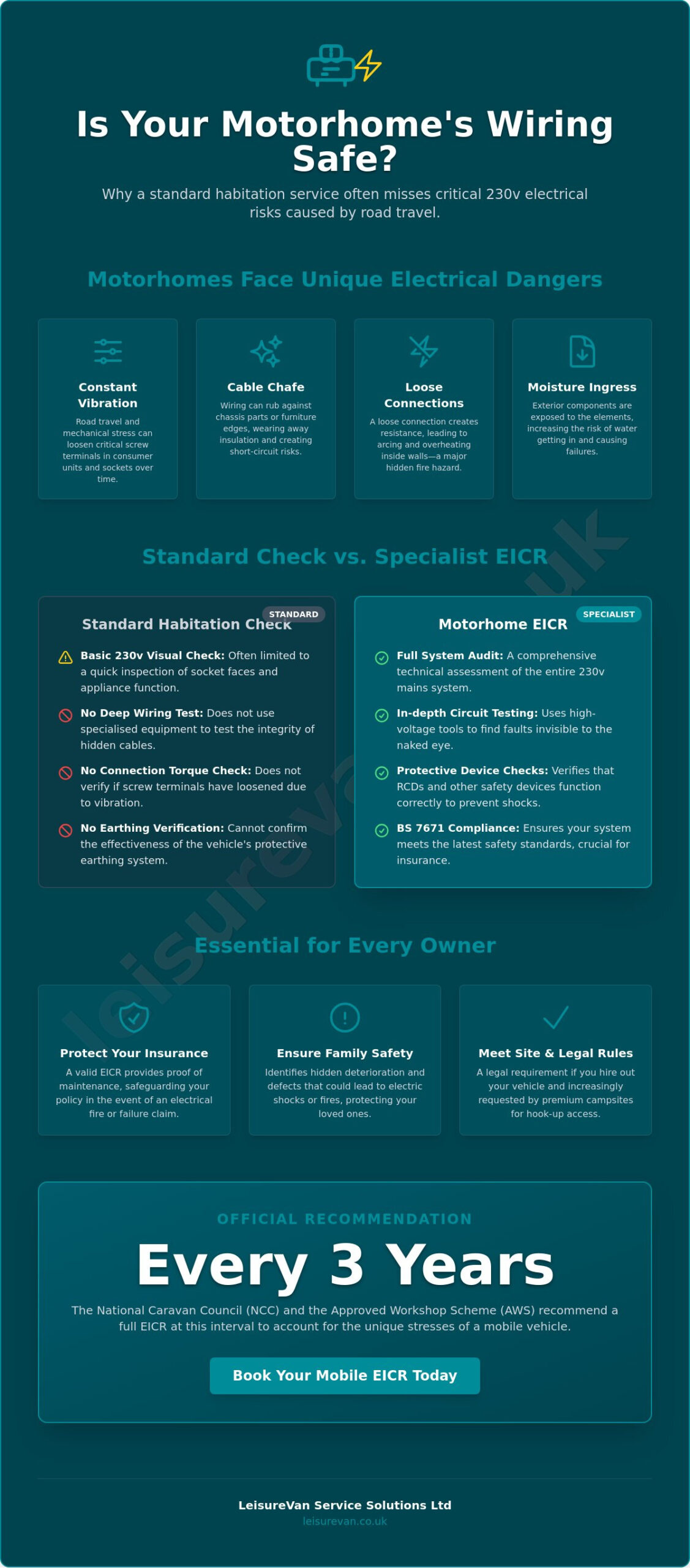
For private owners in the UK, an EICR isn’t a legal mandate in the same way an MOT is. However, if you hire out your vehicle, it becomes a strict legal requirement to ensure tenant safety. Even for personal use, the National Caravan Council (NCC) and the Approved Workshop Scheme (AWS) recommend a full inspection every three years. This 3-year interval accounts for the unique stresses that a moving vehicle places on its electrical connections.
Beyond safety, there’s a practical side to compliance. Many insurance providers now look for a valid certificate when processing claims related to fire or electrical failure. If you can’t prove the system was maintained to BS 7671:2018+A4:2026 standards, your policy could be at risk. Additionally, a growing number of premium campsites may request proof of a recent inspection before allowing you to hook up to their power supply. Maintaining this documentation ensures you aren’t turned away at the gates and that your cover remains robust.
Why Your Motorhome Electrics Face Unique Risks
Unlike a domestic property, a motorhome is a dynamic environment. It’s built to move, but that very movement creates a unique set of challenges for its electrical infrastructure. Every mile on the road subjects the wiring to thousands of micro-vibrations and occasional heavy shocks. Over time, these forces can compromise the safety of the installation in ways that are rarely seen in a traditional house. This is why a regular motorhome electrical installation condition report is so critical; it accounts for the physical toll that travel takes on your van’s internal systems.
The mobile nature of the asset increases the likelihood of several specific failure points:
- Loosened screw terminals in consumer units and socket outlets.
- Mechanical fatigue in copper conductors due to constant flexing.
- Insulation damage where cables pass through furniture or chassis apertures.
- Moisture ingress in exterior-facing components.
The Impact of Vibration and Movement
The most common risk stems from screw-terminal connections. In a stationary building, these stay tight for decades. In a motorhome, the constant rattling can cause these terminals to back out slightly. When a connection becomes loose, it creates electrical resistance. This leads to arcing and localised overheating, often hidden within junction boxes or behind decorative panels. If left unchecked, this heat can eventually melt insulation or ignite nearby combustible materials like timber framing or foam insulation.
Road movement also introduces the risk of cable chafe. As the vehicle twists and turns, wiring looms can rub against sharp furniture edges or metal chassis components. This mechanical wear eventually strips away the protective outer sheath. Professional testing, such as a dedicated Electrical System Test, is the only reliable way to identify these insulation failures before they result in a dangerous short circuit.
Corrosion and Environmental Factors
Motorhomes are also particularly susceptible to the British weather. Rapid temperature fluctuations lead to condensation forming on cold metal surfaces, including electrical contact points. Whilst you’re sleeping comfortably inside, moisture may be accumulating in the consumer unit or battery compartment. This moisture triggers oxidation, often appearing as a distinctive green crust on terminals. This ‘green’ corrosion increases electrical resistance and can lead to system failure or overheating.
Exterior components face even harsher conditions. Your 230v hook-up point is constantly exposed to road spray, salt, and driving rain. These environmental factors can degrade the seals and allow moisture to enter the socket housing. During a motorhome electrical installation condition report, an engineer will pay close attention to these high-risk areas, ensuring that humidity hasn’t compromised the safety of your external power connection. By identifying these issues early, you can avoid the stress of a sudden electrical failure whilst on your holiday. Moisture ingress is also closely linked to wider vehicle deterioration, and understanding the full picture of preventing damp in a motorhome is an essential part of protecting your investment year-round.
EICR vs. Standard Habitation Checks: Knowing the Difference
Many owners assume that their annual habitation service covers every aspect of electrical safety. It’s a common mistake. Whilst a habitation check is essential for general maintenance, it only scratches the surface of the electrical system. A motorhome electrical installation condition report is a separate, more rigorous procedure that looks at the health of the wiring itself rather than just the appliances it powers. One ensures your vehicle is comfortable; the other ensures it’s safe.
The primary difference lies in the depth of the inspection. A habitation service is largely functional and visual. In contrast, an EICR is a technical audit of the hidden infrastructure. Relying solely on a habitation check can leave serious faults undetected, such as degraded cable insulation or a failing earth connection that won’t show up during normal use. Understanding these differences helps you make informed decisions about your vehicle’s maintenance schedule. If you are considering purchasing a used vehicle, carrying out a thorough motorhome damp check before buying is equally essential, as hidden structural moisture damage can be just as costly as an electrical fault.
What a Habitation Service Covers
A standard habitation service ensures your vehicle is liveable and that its systems are operating as intended. The technician performs a visual inspection of visible sockets and switches to check for cracks or signs of burning. They’ll also test the RCD by pressing the “test” button to confirm it trips and check that your fridge, lights, and water heater function correctly on 230v power. It’s a vital “health check” for your comfort and convenience, but it doesn’t verify the integrity of the cables hidden inside the walls or behind the furniture. A habitation service also typically includes a check of your heating system, so if you’ve been experiencing Alde heating system problems such as airlocks or degraded glycol fluid, these are worth flagging to your engineer at the same time.
The Depth of a Periodic Inspection Report (PIR)
An EICR, often called a Periodic Inspection Report amongst engineers, goes much deeper into the technical “bones” of the van. It involves technical testing where the engineer uses calibrated meters to send specific electrical pulses through the circuits. This identifies insulation resistance issues, which essentially checks if electricity is “leaking” out of the wires due to damp or mechanical damage. This is a level of detail that a visual check simply cannot provide.
The engineer also performs continuity testing to ensure the earth path is robust. If a fault occurs, you need to be certain that the earth path is strong enough to trip the circuit breaker instantly. Polarity checks are also a key part of the motorhome electrical installation condition report. These ensure the live and neutral wires haven’t been accidentally swapped, a dangerous condition that can leave appliances “live” even when they’re switched off. By verifying these hidden factors, an EICR provides the technical certainty that your habitation service cannot.
What to Expect During Your Professional EICR Inspection
A professional inspection is a methodical and thorough process. It typically takes between 2 and 4 hours to complete, depending on the size and complexity of your vehicle’s electrical layout. To ensure a comprehensive motorhome electrical installation condition report, the engineer requires full access to several key areas. You’ll need to clear space around the consumer unit, the leisure battery compartment, and every internal and external socket. This allows the technician to work efficiently and ensures no part of the system is left unverified.
Visual Inspection and Tightening Connections
The process begins with a detailed visual audit. The engineer examines the consumer unit to verify that fuse ratings are correct and looks for any tell-tale signs of heat damage or discolouration. Because we’ve already established how road vibrations can loosen components, the technician will manually check the tightness of terminations. This involves removing socket faces to inspect the quality of the wiring behind them. They also ensure the mains hook-up inlet is securely mounted and that the weather-sealing remains intact to prevent moisture ingress.
Dead Testing and Live Testing Protocols
Once the visual checks are complete, the engineer moves on to technical testing. This is divided into two distinct phases. First, “dead testing” is performed whilst the power is safely disconnected. This verifies the integrity of the insulation and ensures there are no hidden short circuits. It’s a critical safety step that prevents damage to the vehicle during the subsequent live tests.
Next, live testing is conducted with the mains power restored. The engineer measures the “loop impedance” to ensure that, in the event of a fault, your circuit breakers will trip fast enough to prevent a fire. They also perform RCD trip-time testing. This confirms that your safety switch reacts within milliseconds to a fault, providing the high level of protection you expect. To ensure your vehicle meets these rigorous safety standards, you can book a professional Electrical System Test to be carried out at your convenience.
Upon completion, you’ll receive a formal report. Findings are categorised using industry-standard codes: C1 indicates immediate danger, C2 signifies an urgent requirement for improvement, and C3 suggests a non-urgent recommendation. If your vehicle passes without any C1 or C2 faults, you’ll be issued a “Satisfactory” result. This provides you with a multi-year certificate for your records, offering the peace of mind that your motorhome is safe for many more miles of adventure.
Securing Your Peace of Mind with a Mobile EICR in South Yorkshire
LeisureVan Service Solutions Ltd brings the rigorous ‘Approved Workshop’ standard directly to your driveway or storage site. This mobile approach eliminates the logistical headache of navigating narrow streets or heavy traffic just to reach a fixed service centre. You save on fuel costs and avoid the stress of moving your vehicle purely for an inspection. Whether your van is parked at home or in a secure facility, we provide a thorough motorhome electrical installation condition report with minimal disruption to your daily routine.
Our expert technicians provide comprehensive coverage across Sheffield, Rotherham, and Doncaster, extending to Barnsley, Worksop, Chesterfield, and Wakefield. We also serve owners in Huddersfield and Leeds, ensuring that professional electrical testing is accessible throughout the region. By choosing a mobile specialist, you receive a dedicated service where the engineer focuses entirely on your vehicle’s safety without the distractions of a busy workshop. For a complete safety overhaul, you can combine your electrical testing with a professional motorhome habitation service, ensuring every system is fit for the road.
The Convenience of On-Site Testing in Sheffield and Beyond
On-site testing is the favourite choice for busy owners across the region. We organise the visit around your schedule, making the process as convenient as possible. A significant advantage of our mobile presence is the ability to address minor faults immediately. If our engineer identifies a loose terminal or a degraded socket face whilst performing the technical checks, LeisureVan Service Solutions Ltd can often fix it there and then. This proactive approach ensures your vehicle is safe and compliant without the need for a second appointment or a return journey to a garage.
Protecting Your Insurance and Resale Value
Protecting your investment is also about proper documentation. A valid motorhome electrical installation condition report acts as powerful social proof when the time comes to sell your vehicle. It demonstrates to potential buyers that you’ve been a meticulous owner who prioritised professional maintenance. This documentation can often justify a higher asking price, as it removes the uncertainty surrounding the vehicle’s hidden electrical health. It shows the installation has been maintained by a “safe pair of hands”.
Having the correct documentation is increasingly important for those planning European travel. Some premium continental campsites and insurance providers now request evidence of professional electrical verification. Maintaining an up-to-date certificate ensures you stay compliant with modern standards whilst protecting your investment. Don’t leave your safety to chance. Book your mobile motorhome EICR with LeisureVan Service Solutions Ltd today and enjoy the reassurance of a professional, local expert.
Ready for a Safer Journey in 2026?
Your motorhome represents freedom, but that freedom relies on a foundation of technical safety. We’ve established why standard habitation checks often miss the hidden fatigue in your 230v system and why movement-related wear is a constant factor for leisure vehicles. Securing a motorhome electrical installation condition report isn’t just about compliance; it’s about the confidence that your next trip won’t be cut short by an avoidable electrical failure. It’s the ultimate safeguard for your family and your investment.
LeisureVan Service Solutions Ltd is here to provide that certainty. As a qualified mobile service engineer working to AWS approved standards, I ensure your vehicle meets the latest regulations without you having to leave your home. You’ll receive a comprehensive digital report detailing every finding, giving you a clear, transparent record of your installation’s health. It’s a professional, dependable service designed for your convenience and total peace of mind.
Book your professional mobile EICR in South Yorkshire today.
Enjoy the road ahead knowing your electrical system is in a safe pair of hands. Safe travels.
Frequently Asked Questions
How often should I get an EICR for my motorhome?
Industry bodies like the NCC and the Approved Workshop Scheme recommend a motorhome electrical installation condition report every three years. This frequency is higher than a domestic home because of the constant vibration and movement experienced on the road. If you use your vehicle as a hire unit, this inspection becomes a mandatory requirement to ensure the safety of your tenants.
Is an EICR the same as a PAT test?
No, these are entirely different safety checks. Portable Appliance Testing (PAT) focuses on individual plug-in items like kettles, toasters, or hair dryers. An EICR is a technical audit of the vehicle’s fixed wiring, consumer unit, and built-in sockets. Both are important, but only an EICR verifies the integrity of the hidden electrical infrastructure within your van.
What happens if my motorhome fails the electrical inspection?
If the engineer identifies faults, they will categorise them in your report using standard industry codes. C1 and C2 codes indicate dangerous or potentially dangerous conditions that must be rectified before a “Satisfactory” certificate is issued. Many specialists can perform minor repairs during the same visit, allowing you to secure your safety certificate without booking a second appointment.
Do I need an EICR if my motorhome is brand new?
New vehicles are typically issued with an initial Electrical Installation Certificate at the point of manufacture. You generally won’t require your first periodic report until three years after that initial date. It’s a good habit to check your vehicle’s documentation pack to confirm exactly when your first professional motorhome electrical installation condition report is due.
Can a standard domestic electrician perform a motorhome EICR?
Whilst a domestic electrician is technically qualified to test 230v systems, they often lack the specialist knowledge required for leisure vehicles. Motorhomes use unique earthing arrangements and components that differ significantly from a traditional house. Using an AWS-approved leisure specialist ensures the engineer understands these specific technical requirements and has the correct adapters for your vehicle’s inlets.
How much does a motorhome EICR typically cost in the UK?
The cost of an inspection varies depending on the complexity of your vehicle and the number of circuits being tested. Larger motorhomes with multiple consumer units or extensive modifications may require more time to audit thoroughly. We recommend requesting a quote specific to your vehicle’s make and model to ensure you receive an accurate price for the work required.
Will the engineer need to dismantle my motorhome’s interior?
No major dismantling of your vehicle’s interior is required during a professional inspection. The engineer will need to remove socket faces and access the consumer unit to perform technical tests on the wiring. Clearing personal items from around your sockets and battery compartment before the technician arrives will help the process move quickly and efficiently.
Does an EICR cover the 12v battery and solar panel system?
A standard EICR focuses specifically on the 230v mains system and its safe interaction with your battery charging equipment. Whilst the engineer will visually check the leisure battery terminals for corrosion, a full technical audit of a solar installation is usually a separate service. You can often combine these tests to ensure your entire power system is operating at peak performance.