Would you trust a standard domestic sparky to navigate the intricate blend of 12V automotive logic and 230V safety standards inside your motorhome? As leisure vehicle technology evolves, the need for a specialist mobile caravan electrician has never been more critical. With the 2026 updates to the BS 7671 wiring regulations, particularly regarding secondary battery storage and solar integration, keeping your electrical system compliant requires a specific set of tools and technical expertise that goes beyond household wiring.
It’s deeply unsettling when flickering lights or a leisure battery that refuses to hold its charge begin to overshadow your holiday plans. You deserve to feel confident that your vehicle is safe whilst you sleep, and you shouldn’t have to lose weeks of your season to a workshop waiting list. This guide explains how professional on-site care keeps your vehicle powered and road-ready without the need for a workshop visit. We will look at modern safety requirements, the complexity of new lithium setups, and how expert maintenance ensures your peace of mind on every journey.
Key Takeaways
- Understand the critical differences between domestic wiring and leisure vehicle systems, specifically how vibration and moisture impact your electrical safety.
- Learn to identify common 12V and 230V faults and discover when to call a professional mobile caravan electrician to prevent minor issues from becoming costly repairs.
- Clarify the legal and safety requirements for an Electrical Installation Condition Report (EICR) and why these specialist inspections are essential every three years.
- Explore the transition to off-grid touring, including how to correctly size a solar panel array to meet your daily power demands in 2026.
- Discover the benefits of on-site habitation services that provide expert maintenance at your home or storage site for maximum convenience.
What is a Mobile Caravan Electrician and Why Do You Need One?
A mobile caravan electrician is a specialised engineer who focuses exclusively on the unique requirements of leisure vehicles. Unlike a traditional domestic electrician, these professionals must master the complexities of recreational vehicle electrical systems, which operate using a delicate balance of 230V AC mains power and 12V DC battery power. This dual-voltage setup requires a deep understanding of how these two systems interact. It’s about more than just wiring; it’s about managing safety components like RCDs and battery chargers in a compact, mobile environment.
Choosing a specialist over a general tradesperson is vital. Houses are stationary; caravans are not. Every mile you tow involves constant vibration that can loosen terminals and chafe wiring insulation. A specialist understands these mechanical stresses and knows exactly where to look for wear. They also account for the specific challenges of moisture and condensation that occur in leisure vehicles. Proper earth bonding is another area where domestic knowledge often falls short, as the safety requirements for a chassis-based vehicle differ significantly from a permanent building. Using an accredited professional also ensures you maintain your manufacturer warranty through documented, high-standard servicing.
The Convenience of On-Site Diagnostics
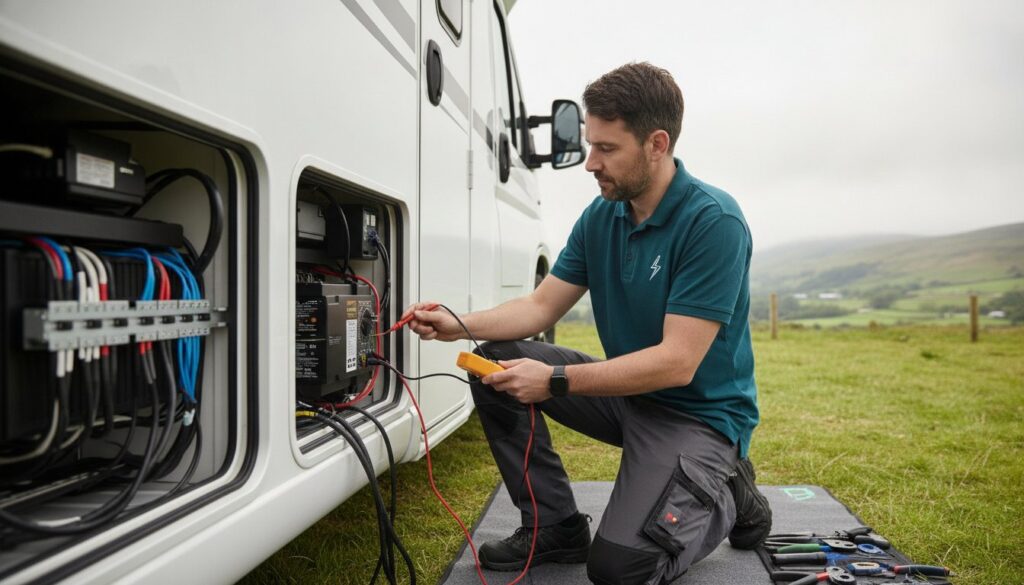
One of the greatest advantages of a mobile service is the ability to diagnose faults in their natural environment. You don’t have the stress of towing a faulty vehicle to a distant workshop. Mobile engineers use portable diagnostic equipment to trace ‘phantom’ battery drains, which are hidden power draws that empty your leisure battery whilst your vehicle is in storage. Whether you are based in Sheffield, Rotherham, or Doncaster, having an expert arrive at your driveway or storage site saves time. It ensures the system is tested exactly as you use it. You can find more advice on maintaining your system on our blog.
Specialist Qualifications to Look For
Safety is paramount. When selecting an engineer, look for those who adhere to the National Caravan Council (NCC) and Approved Workshop Scheme (AWS) standards. These accreditations are the gold standard for leisure vehicle care. It is essential that your mobile caravan electrician holds the latest 18th Edition wiring regulation certificates, specifically the 2026 amendments adapted for mobile units. Because electrical systems often interact with appliances like fridges and heaters, having an engineer who understands both gas and electrical safety provides a comprehensive habitation check. This integrated approach ensures every component is functioning correctly and safely.
Troubleshooting Common 12V and 230V Electrical Faults
Leisure vehicle electrics are a hybrid of two distinct worlds. You have the 12V DC system, which powers your lights, water pump, and master switches, and the 230V AC mains system for sockets and heavy appliances. When things go wrong, it’s often due to the complex interaction between these two. A qualified mobile caravan electrician can quickly determine whether a fault lies within a specific appliance or the core wiring. Identifying the root cause early prevents minor glitches from escalating into dangerous faults or complete system failures.
Common issues often start at the heart of the 12V system. If your water pump is pulsing or your master switch feels unresponsive, the culprit is usually voltage drop or a failing relay. Many owners also struggle with charging problems where the on-board transformer fails to top up the battery whilst on hook-up. Modernising your vehicle with an energy-efficient LED conversion is a practical way to reduce the load on your circuit, but this requires checking for circuit continuity to ensure the older wiring can handle the new components safely.
Identifying 12V Leisure Battery Failure
Batteries don’t last forever. Signs of failure include rapid voltage drops as soon as a load is applied or “sulphation,” where lead sulphate crystals build up on the battery plates. This often happens when batteries are left partially discharged for long periods. Modern smart chargers can sometimes struggle to recover a deeply discharged battery, leading to a cycle of poor performance. A parasitic drain is a continuous, often undetected electrical load that draws power from the leisure battery even when all visible appliances are switched off, eventually leading to deep discharge during periods of inactivity.
To keep your system in peak condition, you should also consider Solar Panels and Off-Grid Power Management. An efficient solar controller acts as a secondary charger, ensuring your battery stays topped up even when you aren’t connected to the mains. If you suspect your charging system is underperforming, a professional Electrical System Test can provide the clarity you need.
Mains Electricity and RCD Tripping
It is frustrating when your caravan trips the site’s power bollard, yet your internal breakers remain on. This usually indicates a “leakage” to earth, often caused by a faulty water heater element or a damp fridge element. External lockers are also common culprits, as moisture can ingress into sockets or light fittings. Investigating these faults requires specialist testing equipment to measure insulation resistance. For a detailed breakdown of what to look for, you can refer to the Caravan Electrical System Test Checklist to help you understand the safety parameters an engineer will check.
When you encounter persistent tripping or socket failures, don’t ignore them. A mobile caravan electrician can perform a full diagnostic at your location, checking the integrity of your EHU cable and internal RCDs. This ensures your mains system is safe for use, protecting both your equipment and your family during your next trip.
Why Annual Electrical Safety Inspections are Non-Negotiable
While many owners prioritise damp reports during their annual maintenance, the electrical integrity of a leisure vehicle is what truly ensures your family’s safety. A comprehensive habitation check isn’t just about ticking boxes; it’s about verifying that the complex wiring systems haven’t degraded over time. In the confined, often timber-framed environment of a caravan, an electrical fault can escalate far more quickly than in a traditional brick-and-mortar home. This makes regular professional oversight a vital part of responsible ownership.
Moisture ingress is a primary enemy of caravan electrics. When damp reaches electrical terminals, it causes rapid corrosion. This leads to increased electrical resistance, which generates heat and creates a significant fire risk. A qualified mobile caravan electrician uses specialised testing equipment to identify these invisible hazards before they become emergencies. We also frequently encounter “DIY” modifications from previous owners. These “quick fixes” often bypass safety fuses or use incorrect cable gauges, which can jeopardise your safety and lead to insurance claims being rejected if a fault occurs.
The EICR: Beyond the Standard Habitation Check
Beyond the annual check, a formal Electrical Installation Condition Report (EICR) is recommended every three years for leisure vehicles. This deep-dive inspection aligns with the same rigorous UK electrical safety standards applied to domestic properties. It involves insulation resistance testing and verifying the continuity of earth bonding to ensure the chassis remains safe. For a more technical breakdown, see our Motorhome EICR Essential Guide. A clean report isn’t just a safety certificate; it’s a vital document that protects your vehicle’s resale value and provides genuine peace of mind.
Gas and Electric: The Interconnected Safety Loop
Safety in a caravan is an interconnected loop where different systems rely on each other to function correctly. Many people don’t realise that gas appliances, such as fridges and boilers, rely on electrical spark ignition systems. A fault in your 12V circuit can lead to gas ignition failures, leaving you without heating or refrigeration whilst on holiday. During an inspection, your mobile caravan electrician will test these ignition systems alongside your carbon monoxide and smoke detectors. Ensuring these life-saving devices are correctly powered and positioned is a fundamental part of maintaining a safe living environment.

Modern Upgrades: Solar Panels and Off-Grid Power Management
Off-grid touring has transitioned from a niche interest to a primary requirement for many UK travellers in 2026. Recent industry data shows a 25% increase in demand for off-grid specifications at the point of sale, reflecting a desire for greater independence. Standard lead-acid leisure batteries often struggle to meet the power demands of modern caravans equipped with 5G Wi-Fi, multiple charging ports, and high-definition entertainment systems. To achieve true freedom, you need a system sized correctly for your specific habits. This involves calculating your daily Watt-hour usage, accounting for everything from LED lighting and water pumps to the power draw of your appliances.
Integrating modern Lithium (LiFePO4) batteries is the most significant upgrade you can make to your power system. These units offer far deeper discharge cycles and faster charging than traditional alternatives. However, they require specific charging profiles to avoid permanent damage. A professional mobile caravan electrician ensures your existing on-board transformer or alternator charging system is compatible, often installing a DC-to-DC charger to manage the power flow safely. This technical oversight prevents the common “burnt-out” terminal issues associated with amateur lithium conversions. For a comprehensive overview of how to plan and execute this transformation, our guide to motorhome solar panel installation covers the essential 2026 technical standards and grounding requirements in full detail.
Solar Panel Installation in South Yorkshire
Choosing between rigid and flexible panels depends largely on your vehicle’s roof profile and weight limits. Rigid panels are often preferred for their longevity and the air gap beneath them, which helps maintain efficiency during the warmer summer months. Flexible panels are ideal for curved roofs or weight-sensitive motorhomes. For a detailed comparison of the latest hardware, read our guide on the Best Solar Panels for Motorhomes UK. Our mobile service ensures that all roof penetrations are sealed with marine-grade adhesives to prevent leaks, whilst the solar controller is programmed precisely for your specific battery chemistry.
Smart Monitoring and Battery Management
Power management is no longer a guessing game. Installing Bluetooth battery monitors allows you to track your state of charge, temperature, and remaining runtime directly via a smartphone app. We also recommend upgrading to ‘Smart’ chargers that include specific storage modes to prolong battery life during the off-season. A professional ‘Supply and Fit’ service avoids the common pitfalls of DIY solar kits, such as undersized cabling that causes significant voltage drop and reduces your charging efficiency. If you’re ready to embrace independent touring, our expert Solar Panel Installation service provides a reliable, high-performance solution tailored to your vehicle.
Choosing a Mobile Caravan Electrician in the Sheffield Area
Selecting a mobile caravan electrician in the Sheffield area involves more than just finding someone who can use a multimeter. It requires an engineer with local expertise regarding the storage facilities and campsites across South Yorkshire and North Derbyshire. This familiarity allows for a quicker response and a better understanding of the environments where your vehicle spends its time. When you hire a specialist with local knowledge, you gain a partner who understands the specific challenges of the region, from the security protocols of local storage hubs to the best practices for maintaining systems in the varied British climate.
Integrity is the foundation of a professional service. When you hire a mobile caravan electrician, you should always verify that they hold the necessary credentials, such as AWS or NCC accreditation. A trustworthy expert will be transparent about their pricing, providing a clear breakdown of parts and labour. There are no hidden extras or surprise fees. At LeisureVan, we pride ourselves on a personalised approach. We treat every vehicle as if it were our own, ensuring we don’t just fix the immediate problem but also look at the long-term health of your entire system.
Areas of Service: From Barnsley to Chesterfield
We provide comprehensive mobile electrical support across a wide geographic area, including Wakefield, Huddersfield, Leeds, and Doncaster. This mobile service is particularly beneficial for owners who keep their vehicles in high-security storage facilities. In these locations, towing a caravan out for a minor electrical fault is often difficult and time-consuming. By bringing the workshop to you, we eliminate that stress. To make the most of your time and budget, consider scheduling your electrical testing alongside your annual habitation service. This integrated approach is the most cost-effective way to ensure your vehicle is ready for the road.
Ready to Secure Your Caravan’s Electrics?
Whether you need a specific repair, a full system test, or a modern solar upgrade, getting a bespoke quote is the first step toward a safer holiday. It is wise to book your inspection early, especially before the peak summer touring season begins. High demand in the spring often leads to longer wait times, so proactive maintenance is always recommended. For expert, friendly advice on any 12V or 230V issue, you can find more information on our blog. Let us help you keep your leisure vehicle safe, powered, and ready for your next adventure.
Ready for the Road: Secure Your Power for 2026
Maintaining your leisure vehicle’s electrical system is about more than just convenience; it is a fundamental pillar of safety and long-term value. Specialist knowledge is essential for managing the unique hybrid of 12V and 230V systems, especially with the 2026 updates to wiring regulations. By prioritising annual inspections and formal EICRs, you protect your investment from the invisible risks of terminal corrosion and previous DIY modifications. Whether you are troubleshooting a persistent fault or investing in a high-performance solar upgrade, the expertise of a mobile caravan electrician ensures your vehicle remains a safe sanctuary.
As a qualified mobile service engineer, I provide expert solar and air con installation directly at your home or storage site. We take pride in delivering meticulous care across South Yorkshire, Derbyshire, and West Yorkshire, providing the peace of mind you deserve before every trip. Don’t let electrical anxiety overshadow your holiday plans.
Book your professional mobile caravan electrical service with LeisureVan today and ensure your vehicle is safe, powered, and ready for your next adventure. Your journey starts with a reliable connection.
Frequently Asked Questions
Can a standard domestic electrician work on my caravan?
Whilst a domestic sparky understands 230V AC circuits, they rarely have the specialist training for 12V DC systems or the specific earth bonding requirements of a mobile chassis. Leisure vehicles face constant vibration and moisture issues that fixed buildings simply do not. Hiring a specialist mobile caravan electrician ensures your vehicle remains compliant with the latest BS 7671:2018+A4:2026 regulations. This technical expertise protects your manufacturer warranty and guarantees the safety of your dual-voltage setup.
What is the difference between a 12V and 230V caravan system?
Your 12V DC system is powered by the leisure battery and runs essential components like water pumps, LED lighting, and control panels. In contrast, the 230V AC system only functions when you are connected to a site’s mains hook-up. This high-voltage circuit powers your internal sockets, microwave, and heavy heating elements. Understanding how these systems interact through the on-board transformer is vital for troubleshooting power failures and managing your energy usage effectively whilst touring.
How often should I have an electrical safety test (EICR) on my motorhome?
Industry standards recommend a formal Electrical Installation Condition Report (EICR) every three years for leisure vehicles. This is a more rigorous assessment than a standard annual habitation check. It involves deep-level testing of insulation resistance and circuit integrity to ensure no degradation has occurred due to road vibration or damp ingress. Keeping these records up to date is essential for maintaining your insurance validity and ensuring the vehicle’s resale value remains high.
Why is my leisure battery not charging when I’m plugged into mains power?
This issue is frequently caused by a blown fuse between the battery and the charger or a failure in the on-board power converter unit. If the mains supply is active but the battery voltage doesn’t rise, the charger itself may have reached the end of its service life. Alternatively, the battery might be “sulphated” and unable to accept a charge. A quick diagnostic check can determine if you need a replacement unit or a simple wiring repair.
Is it worth installing a solar panel on my caravan in the UK?
Installing a solar panel is highly beneficial for maintaining battery health during storage and enabling off-grid touring. Even in the UK’s overcast weather, modern monocrystalline panels generate enough trickle charge to counteract parasitic drains from alarms and trackers. This prevents deep discharge, which is the leading cause of premature battery failure. For those who enjoy independent camping, a correctly sized solar array provides the freedom to power lights and pumps without a mains hook-up. To understand exactly what a professional installation involves and how to size your system correctly, read our complete guide to motorhome solar panel installation for off-grid power in 2026.
What should I do if my caravan’s RCD keeps tripping at the campsite?
Start by unplugging all appliances to see if the RCD still trips; this identifies if the fault is in a specific device or the caravan’s internal wiring. Common culprits include faulty water heater elements or moisture ingress in external sockets. If the trip happens immediately upon connection, your electric hook-up cable might be damaged. Persistent tripping suggests a leakage to earth that requires professional investigation from a mobile caravan electrician to prevent potential shocks.
Can a mobile caravan electrician fix my motorhome’s step or awning motor?
Yes, these motorised components are part of your vehicle’s 12V electrical system. A specialist can diagnose whether the issue is a mechanical seizure, a blown fuse, or a failure in the control relay. Since these systems often involve safety interlocks with the engine ignition, professional repair is essential to ensure the step or awning doesn’t deploy whilst driving. We carry the diagnostic tools needed to trace faults in these specific leisure vehicle circuits quickly and efficiently.
How much does a mobile caravan electrical call-out usually cost?
Call-out fees for a specialist engineer typically vary based on your location and the complexity of the fault. Most professional engineers charge a fixed attendance fee that covers travel and the initial diagnostic time. Whilst general domestic rates might seem lower, a caravan specialist provides the specific tools and knowledge required for leisure vehicle safety. It is always best to request a transparent quote that includes both the visit fee and the anticipated hourly rate before work begins.